

 Português pt
 Español es
 العربية ar
 বাংলা bn
 Deutsch de
 Filipino fil
 Français fr
 हिन्दी hi
 Bahasa Indonesia id
 Italiano it
 Русский ru
 Svenska sv
 ไทย th
 Türkçe tr
 Tiếng Việt vi
 简体中文 zh
Updated:
MarketsSpaceX, OpenAI, and Anthropic's Mega-IPOs: What Changes in the Market
 Rafael AzevedoEditorial character · Markets Desk
Quick answer
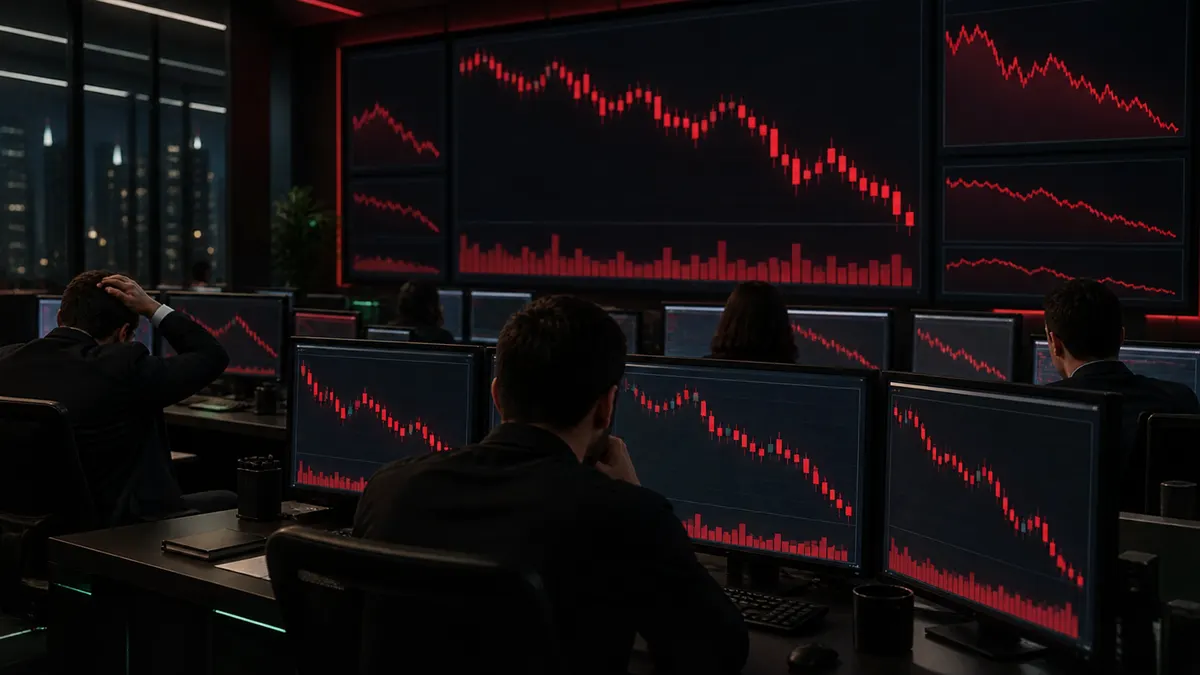
Mega-IPOs like SpaceX's, and the possible ones from OpenAI and Anthropic, pull capital and attention toward an entire sector and can force index funds to buy the new shares, selling off a bit of everything else. They don't change the market's rules, but they tend to increase volume and volatility around the theme. The OpenAI and Anthropic offerings may still never happen the way they've been discussed.
SpaceX's stock market debut wasn't just a large transaction: it was treated as the start of a mega-IPO season capable of shifting how the market prices entire sectors tied to space, artificial intelligence, and computing infrastructure. With OpenAI and Anthropic pointed to as the next candidates, the question is whether listings of this size actually change how the market works, or whether they're just another cycle of euphoria around well-known names.
This piece organizes the points discussed about this movement, based on public information, and uses real 2026 prices (Yahoo Finance) to show how the artificial intelligence theme was already moving the market. Nothing here is investment advice.
What a mega-IPO is
An IPO is an initial public offering, the moment a company sells shares on the exchange for the first time. A mega-IPO is an offering of exceptional size, whether in the amount raised or in the company's valuation. What sets these cases apart is the ripple effect: a listing of this scale pulls money, attention, and institutional capital toward a single stock and, by extension, toward the entire sector.
The pattern SpaceX left behind
SpaceX's offering drew attention for setting aside an unusually large share for retail investors, reportedly up to 30% of the total, a rare level for deals of this size. With a valuation approaching $2 trillion, the company entered the market already among the most valuable in the world, with demand from investors in the United States, Europe, the United Kingdom, and Asia.
Why an OpenAI offering would carry its own weight
An OpenAI listing would be the first chance for ordinary investors to buy into the company most associated with the modern AI boom. A public valuation for it would shape how the market sees the entire ecosystem: chipmakers, cloud, software, and energy. CEO Sam Altman himself summed up the needed caution by saying an IPO is just a financing event: the value would depend on the company's ability to sustain the enormous investment advanced AI requires.
Where Anthropic would fit in
Anthropic, the creator of the Claude assistant, built much of its business around enterprise customers, with a reported valuation in the hundreds of billions of dollars. If both went public, the market would have, for the first time, a direct comparison between two competing approaches in the same sector: one more consumer-facing, the other more enterprise-facing.

How a mega-IPO affects indices and funds
Passive funds track indices. When a new company joins an index, those funds are required to buy the stock in proportion to its weight, and to do that they sell off a bit of everything else. A hypothetical example: a $1 billion fund tracking an index where the new company ends up weighing 2% needs to buy $20 million of it and sell $20 million from the rest of the portfolio. Multiply that across every fund tracking the same index and the flow adds up fast.
In practice, each index's rules (minimum listing time, profitability, free-float shares) delay or limit that entry, and the weight is calculated only on the shares actually trading in the market. Because of that, the effect tends to be spread out over time, rather than concentrated on the debut day.
Real example: the AI theme on the Nasdaq in 2026
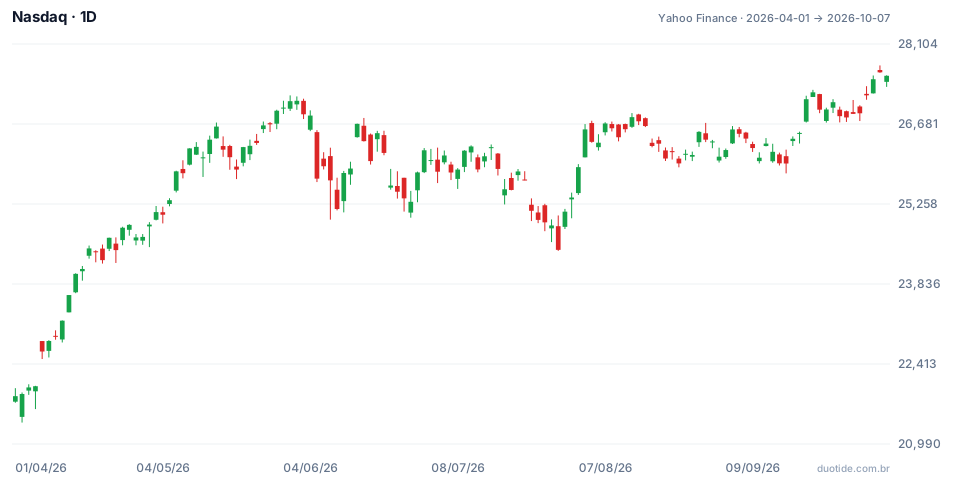
The chart shows the Nasdaq Composite index from April 1, 2026 to October 7, 2026. Over the period, it went from 21,840.95 to 27,538.69 points, up 26.09%, with a low of 21,371.32 on April 2 and a high of 27,722.75 on October 6. The more diversified S&P 500 rose 18.65% over the same stretch.
The theme doesn't rise evenly
Even within the AI-linked universe itself, the results were very different between April 1 and October 7, 2026: AMD rose 207.25% and Micron 195.77%, while Oracle ended down 1.15% and Vertiv down 4.97%. Nvidia rose 35.12%. Betting on the theme isn't the same as picking the right company.
Deep drops along the way
Even with the index up for the period, the Nasdaq got as much as 9.8% below its closing peak on July 29. Some theme stocks suffered far more: Oracle fell as much as 53.7% from its closing peak through July 24, and Micron 39.1% through July 29. A crop of mega-IPOs concentrated around the same theme tends to amplify this kind of swing, because it pours even more capital and expectation into the same place.

How to follow a mega-IPO season
Separate expectation from fact
News about dates, valuations, and retail allocations move the prices of sector companies before any offering actually happens. Follow what has been officially filed, not what's being speculated.
Watch the effect on companies already listed
Competitors and suppliers tend to react to news of a big IPO. Sometimes they rise on the valuation comparison; sometimes they fall because money rotates into the new listing.
Be careful with the first few days
In the first sessions, an IPO's price tends to swing a lot, with little historical data and a lot of pent-up demand. There's no chart to read and no pattern to compare it to.
Limitations
An OpenAI or Anthropic listing may never happen, or may happen under conditions quite different from what's been discussed. The numbers above describe the 2026 market, not the behavior of stocks that don't exist yet.
Common mistakes around mega-IPOs
- Buying on the first day just because of the company's fame, without knowing the valuation and the offering's size.
- Thinking every stock in the theme will rise together, when the dispersion between them was huge in 2026.
- Trading based on rumors about offering dates and prices.
- Concentrating the portfolio in a single theme because of the headlines.
- Reading the numbers in this piece as a forecast: they describe what happened, not what will happen.
If you want to follow this movement, use a demo account: put together a watchlist with the Nasdaq index and a few AI-theme stocks, note how each one reacts to offering-related news, and compare after a few weeks. The log shows the real effect better than any headline.
Practice before you risk. Open your Duotide account and test your ideas on the demo account with US$10,000 in virtual funds.
Create free accountUpdated:
Editorial character of the Duotide newsroom. Articles are written by the team with the help of artificial intelligence; prices and charts come from real market data. Follows the news that moves prices — rates, stock markets, companies and commodities — explained without jargon.
Was this article helpful?
Be the first to rate it.
Comments
- No comments yet. Be the first to comment.
Ready to put it into practice?
Open your account and practice on the demo account with US$10,000 in virtual funds, without risking money.
- Secure platformProtected login and identity verification
- Multilingual supportHelp available every day
- Free demo accountUS$10,000 virtual to practice
Trading involves the risk of losing the capital invested.
