

 Português pt
 Español es
 العربية ar
 বাংলা bn
 Deutsch de
 Filipino fil
 Français fr
 हिन्दी hi
 Bahasa Indonesia id
 Italiano it
 Русский ru
 Svenska sv
 ไทย th
 Türkçe tr
 Tiếng Việt vi
 简体中文 zh
Updated:
MarketsAfter-Hours Trading: How It Works and the Risks
 Rafael AzevedoEditorial character · Markets Desk
Quick answer
After-hours trading is buying and selling that happens before the open (pre-market) or after the close (after-hours). It works with fewer participants, wider spreads, and prices that swing more per order. The move from this period shows up the next day as an opening gap, and it doesn't always hold once the regular session resumes.
Most exchanges have an official trading session, but trading doesn't stop completely when the closing bell rings. In the United States, for example, there's pre-market trading before the open and after-hours (or post-market) trading after the close. In these windows, orders keep getting filled, just with far fewer people on the other side.
To show the effect of this with real numbers, we used Nvidia's actual daily quotes (NVDA, Yahoo Finance data) between April and October 2026. The daily chart doesn't show after-hours trading itself, but it shows its result: the difference between one day's close and the next day's open, known as the gap.
What After-Hours Trading Is
It's any trade made before the open or after the close of the regular session. On the US exchanges, the regular session runs from 9:30 a.m. to 4:00 p.m. New York time; pre-market trading happens before that, and after-hours trading after it, on electronic systems that match orders with far fewer participants. Not every broker offers access, and not every asset has extended-hours trading.
This window exists mainly because of news. Companies usually release quarterly earnings and other material announcements outside regular trading hours, precisely so the market has time to digest the information. Anyone who wants to react before the next day's open uses these windows.
The Practical Differences From the Regular Session
- Fewer participants: much of institutional and retail investors don't trade in this window, and volume drops sharply.
- Wider spread: with fewer orders in the book, the gap between the best bid and ask price widens, and every entry and exit costs more.
- More impact per order: an order of reasonable size can move the price much more than it would during the regular session.
- Prices that don't always hold: an after-hours move can shrink or reverse once normal volume returns.

How to Measure the Effect: the Opening Gap
The gap is the change between one session's close and the next session's open:
- Gap (%) = (open ÷ previous close − 1) × 100
Everything that happened during after-hours, overnight, and in the pre-market shows up concentrated in this number. For Nvidia, on 08/26/2026 the stock closed at $209.66 and, on 08/27, opened at $222.86. The gap was 222.86 ÷ 209.66 − 1 = 6.3%. Anyone who could only trade in the regular session had no way to capture any part of that jump: the price already arrived at the open with it baked in.
Across the 131 sessions between 04/01 and 10/07/2026, Nvidia's average gap, in absolute value, was 1.06%. In 20 of those sessions, the open was more than 2% away from the previous close. In other words, about once every six and a half sessions, a meaningful part of the day's move happened outside regular hours.
Real Example: Nvidia's Gaps in 2026
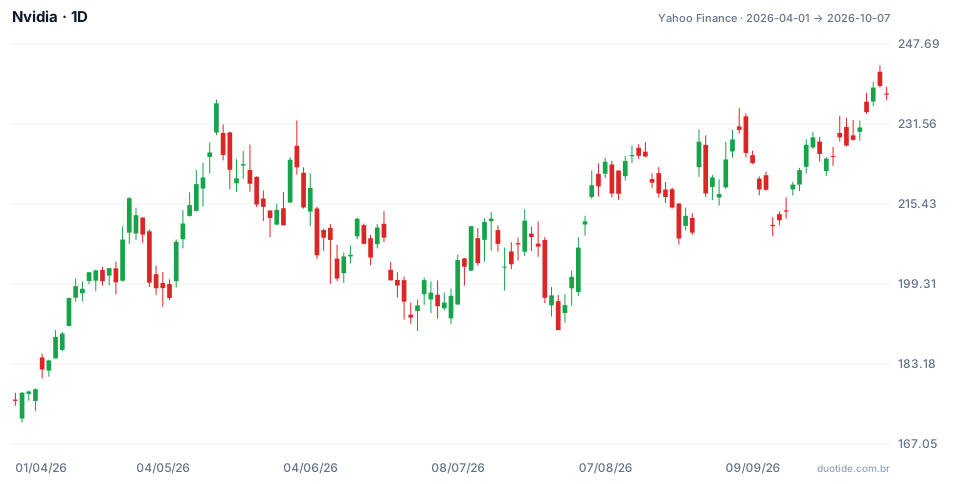
Over the chart's period, the stock went from $175.75 on 04/01 to $237.47 on 10/07. Three moments show what extended hours do to the price:
August 27: a Jump That Didn't Fully Hold
The 08/27 open, at $222.86, was the window's biggest gap (6.3%). That same day the stock climbed further to $230.47 and closed at $227.98, on volume of about 299 million shares, more than double the period's average (about 140 million). The next day, though, it closed at $217.55, a 4.6% drop. Anyone who bought in the after-hours heat, near the highs, watched part of that gain disappear once the full market resumed trading.
April 28: a Downside Gap Partly Recovered
The stock closed 04/27 at $216.61 and opened 04/28 at $209.49, a −3.29% gap. During the session, it recovered to $214.73 and closed at $213.17. Selling in the pre-market, at the worst moment, would have meant exiting near the day's low ($208.20).
September 14: the Weekend Is Also Outside Regular Hours
Between Friday's close on 09/11 ($218.29) and Monday's open on 09/14 ($211.24), the stock lost 3.23% without anyone being able to trade in the regular session. This time the gap held: the day's close was $210.96. There's no rule that says a gap always closes.

How to Handle Extended Hours
Use Limit Orders
With a wide spread and a thin book, a market order can get filled far from the last displayed price. A limit order sets the worst price you're willing to accept. Many platforms only accept limit orders outside regular hours for exactly this reason.
Reduce Position Size
If the cost of entering and exiting is higher and the price moves more per order, it makes sense to trade with a smaller size than usual during this window.
Treat After-Hours as a First Reaction, Not the Final Price
The move outside regular hours is a clue to sentiment about the news. The open, with full volume, tends to be a better test. The August case shows that even a 6% jump can give back a good part of the move in a single day.
Watch Out for Positions That Carry Overnight
Anyone who sleeps on an open position takes on gap risk. A stop left from the previous session doesn't protect against an open well below it: the order gets filled at the first available price, which can be much worse.
Limitations of This Reading
The daily chart doesn't show how many trades happened in after-hours or at what price; it only shows the regular close and the following open. Gaps also blend together the post-close period, overnight, and pre-market. And the numbers above come from a single stock, over a specific period.
Common Mistakes When Trading Outside Regular Hours
- Using a market order with an empty book and getting filled far from the expected price.
- Buying or selling on the news impulse, before seeing how the market reacts with full volume.
- Thinking a stop protects against gaps: execution happens at the first available price.
- Trading with the same position size as the regular session, ignoring the wider spread.
- Assuming every gap closes the same day, as if it were a rule.
- Forgetting that the examples above describe what happened, not what will happen.
To practice without risking money, use a demo account to follow a few stocks during earnings week and note, in each case, the close, the next open, and the day's close. Within a few weeks you'll have your own record of how often gaps hold or fade.
Practice before you risk. Open your Duotide account and test your ideas on the demo account with US$10,000 in virtual funds.
Create free accountUpdated:
Editorial character of the Duotide newsroom. Articles are written by the team with the help of artificial intelligence; prices and charts come from real market data. Follows the news that moves prices — rates, stock markets, companies and commodities — explained without jargon.
Was this article helpful?
Be the first to rate it.
Comments
- No comments yet. Be the first to comment.
Ready to put it into practice?
Open your account and practice on the demo account with US$10,000 in virtual funds, without risking money.
- Secure platformProtected login and identity verification
- Multilingual supportHelp available every day
- Free demo accountUS$10,000 virtual to practice
Trading involves the risk of losing the capital invested.
