

 Português pt
 Español es
 العربية ar
 বাংলা bn
 Deutsch de
 Filipino fil
 Français fr
 हिन्दी hi
 Bahasa Indonesia id
 Italiano it
 Русский ru
 Svenska sv
 ไทย th
 Türkçe tr
 Tiếng Việt vi
 简体中文 zh
Updated:
MarketsWhat Is the OTC Market: a Guide to Weekend Trading
 Rafael AzevedoEditorial character · Markets Desk

Quick answer
The OTC market, short for over-the-counter, is trading done directly between parties, without going through an exchange's order book. On trading platforms, assets marked OTC have a price set by the broker itself and can be traded when the official market is closed, like on weekends. In exchange, liquidity tends to be lower, and the price can drift away from the official market by the time it reopens.
Most beginners quickly discover that markets don't run the same way 24 hours a day. The stock exchange has set trading hours, the currency market pauses on weekends, and even on weekdays there are windows with little trading. Anyone who only has free time on Saturday morning runs right into that limit.
The OTC market fills that gap. In this guide we explain how it works and use real 2026 data to show two things that matter to anyone trading outside regular hours: how much the price can move over a weekend, and what happens when the official market reopens.
What the OTC Market Is
OTC stands for over-the-counter. In the classic sense, it's trading done directly between two parties, without going through an exchange's centralized order book. Many bonds, derivatives, and currencies trade this way worldwide.
On trading platforms, the term has taken on a more specific use. Assets with the OTC tag next to their name are contracts whose price is set by the broker itself, based on formulas and quotes from different sources. This lets versions of stocks, indexes, and currency pairs keep trading when that asset's official market is closed, like on weekends and holidays.
Why It Exists
For anyone who works during the week, OTC extends the hours available to study and trade. That's its main appeal. The cost is that the price doesn't come from a session with thousands of participants, but from a single source.

Differences From the Regular Session
- Liquidity: outside regular hours there are fewer trades, and the price can move more sharply.
- Price formation: the OTC quote comes from the broker's own rules and can differ from the official price when the market reopens.
- Reopening: weekend news all lands at once on Monday, and the official asset can open with a gap from Friday.
Real Example: Weekends in 2026
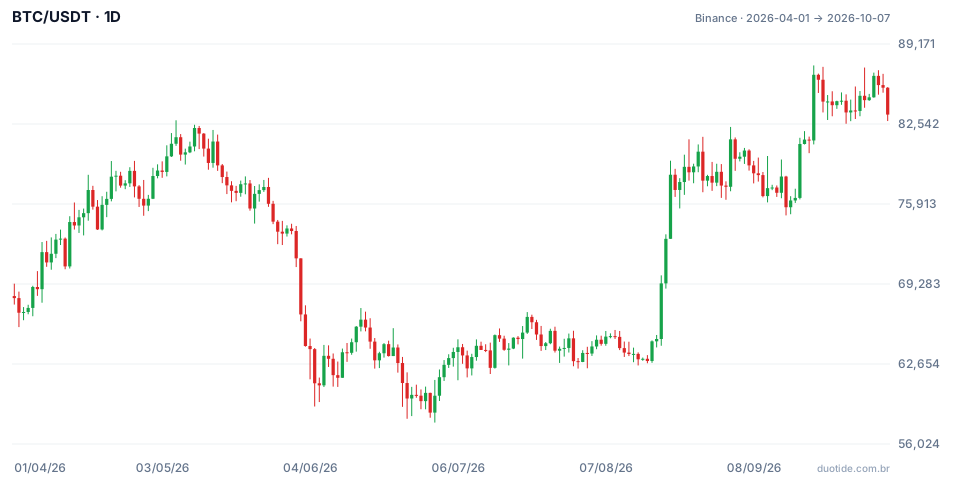
Bitcoin is a good lab for this because it trades nonstop, including Saturday and Sunday. The chart shows BTC/USDT on Binance between 04/01 ($68,113.92) and 10/07/2026 ($83,321.81), with a low of $57,800.19 on 07/01 and a high of $87,395.67 on 09/21.
How Much the Price Moves Over a Weekend
We compared Friday's close with Sunday's close across 27 weekends in the period. The average move, in absolute value, was 1.48%. The extremes were bigger:
- 04/17 to 04/19: from $77,072.00 to $73,801.79, a 4.24% drop.
- 06/05 to 06/07: from $61,056.47 to $63,332.01, a 3.73% gain. Between Saturday's and Sunday's high and low, the gap reached 7.75% of Friday's close.
Less Money Moving
BTC/USDT's average dollar volume on Binance was about $695 million a day on Saturday and Sunday, against $1.35 billion on weekdays: the weekend saw just over half the activity. This is the lower liquidity people talk about, measured on an asset that never closes.
Monday's Gap
On the other hand, the S&P 500 doesn't trade on weekends. Across 25 Mondays in the period, the open sat 0.29% away from Friday's close on average. The biggest gap was on 06/15: from 7,431.46 points on Friday (06/12) to 7,516.75 at the open, up 1.15%. An OTC price formed over the weekend may or may not anticipate that move; there's no guarantee the two will match.
These numbers describe what happened, not what will happen.

How to Trade OTC More Carefully
Adjust Position Size
An example with the numbers above: a R$ 5,000 account and 1% risk per trade, R$ 50. If the stop sits at 4% of the entry price, to cover a move like the one from 04/17 to 04/19, the maximum position is 50 ÷ 0.04 = R$ 1,250. With a 1.5% stop, close to the average move, the position could be R$ 3,333, but a weekend like April's would have blown through that stop.
Follow the News Even With the Market Closed
Elections, decisions from other countries' central banks, and geopolitical events can break on Saturday or Sunday and move the OTC quote before the reopen.
Use Stops With Discipline
With less liquidity, loss limits set before entering keep a move with little volume behind it from knocking you out of the trade in an uncontrolled way.
Limitations
The OTC asset isn't a perfect copy of the official one. Price-formation rules vary from platform to platform, and it's worth reading them before trading. The data in this article comes from public markets, not from any broker's OTC quotes.
Common Mistakes in the OTC Market
- Treating the OTC price as an exact match for the official price.
- Using the same weekday position size on weekends, without accounting for the lower liquidity.
- Ignoring news just because the market is closed.
- Leaving a position open into the reopen without accounting for gap risk.
- Trading on the weekend just because it's the only free time, without a plan.
- Forgetting that the examples above describe what happened, not what will happen.
To practice without risking money, use a demo account over a weekend and log, trade by trade, the position size, the stop, and the result. Then compare it with your weekday trades: the record will show whether OTC suits your style.
Practice before you risk. Open your Duotide account and test your ideas on the demo account with US$10,000 in virtual funds.
Create free accountUpdated:
Editorial character of the Duotide newsroom. Articles are written by the team with the help of artificial intelligence; prices and charts come from real market data. Follows the news that moves prices — rates, stock markets, companies and commodities — explained without jargon.
Was this article helpful?
Be the first to rate it.
Comments
- No comments yet. Be the first to comment.
Ready to put it into practice?
Open your account and practice on the demo account with US$10,000 in virtual funds, without risking money.
- Secure platformProtected login and identity verification
- Multilingual supportHelp available every day
- Free demo accountUS$10,000 virtual to practice
Trading involves the risk of losing the capital invested.
