

 Português pt
 Español es
 العربية ar
 বাংলা bn
 Deutsch de
 Filipino fil
 Français fr
 हिन्दी hi
 Bahasa Indonesia id
 Italiano it
 Русский ru
 Svenska sv
 ไทย th
 Türkçe tr
 Tiếng Việt vi
 简体中文 zh
Updated:
BeginnersTrading for Beginners: The First Steps to Start Trading
 Marina CostaEditorial character · Beginner's Guide

Quick answer
To get started in trading, pick one or two markets, learn the basic vocabulary, write a plan with rules for entry, exit, and stop, and limit each trade's risk to about 1% of capital. Train that process on a demo account and log every trade before using real money.
People starting to trade usually spend almost all their energy looking for the right indicator or the perfect strategy. In practice, what separates those who last in the market from those who quit in the first few months is simpler and less glamorous: knowing what you're trading, deciding in advance how much you're willing to lose, and drilling the process until it becomes routine.
This guide walks through those steps in the order they come up for a beginner. So the numbers aren't made up, the risk-management example uses real daily quotes for Apple (AAPL) between April and October 2026.
What trading is
Trading means buying and selling financial assets aiming to profit from price changes over a relatively short period, from minutes to a few weeks. It's different from long-term investing, where someone buys a company or a fund thinking in years and accepts the swings along the way.
The most common markets for beginners are:
- Stocks: shares of companies listed on an exchange, like Apple in the United States or Ibovespa companies in Brazil.
- Indices: baskets of stocks, like the S&P 500 and the Ibovespa, that show the mood of the market as a whole.
- Forex: currency pairs, like euro against dollar (EUR/USD), traded almost 24 hours a day on business days.
- Commodities: gold, oil, and agricultural products.
- Cryptocurrencies: bitcoin, ethereum, and others, traded even on weekends and, generally, far more volatile.
Each market has its own hours, volatility, and costs. To get started, pick one or two and learn how they behave before spreading your attention across ten different assets.

The first steps to start trading
1. Learn the basic vocabulary
Buying (a long position) means betting on a rise; short selling (a short position) means betting on a drop. A stop loss is the order that closes the trade at a loss defined in advance; a take profit closes it at a gain defined in advance. Leverage means trading with more money than what's deposited, which multiplies both the gain and the loss. Spread and fees are the cost of every trade.
2. Write a plan before clicking
A trading plan answers, in writing, simple questions: which assets will I trade, at what time, what signal makes me enter, where's the stop, where do I take profit, and how much of my capital do I risk per trade. If the answer to any of these is "it depends on the day," the plan isn't ready yet.
3. Define the risk per trade
The rule most beginners use is to risk at most 1% to 2% of capital on each trade. The reason is mathematical: losses weigh more than they seem to. Someone who loses 20% of the account needs to gain 25% just to get back to even; someone who loses 50% needs to double what's left, meaning gain 100%. With 1% per trade, even a streak of ten losses in a row leaves the account with about 90% of its value, and there's still room to keep going.
4. Train on a demo account
A demo account uses fake money with real quotes. It's useful for learning the platform, testing the plan, and catching execution mistakes (an order on the wrong side, a forgotten stop, the wrong lot size) without them costing money.
Real example: position size with Apple's volatility
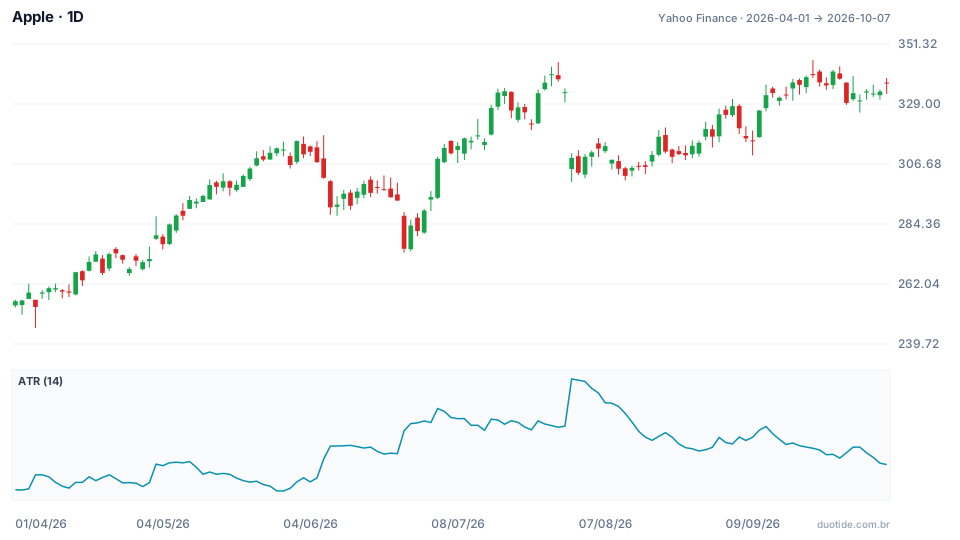
The chart shows Apple's daily candles from April 1, 2026, to October 7, 2026, and, below, the 14-period ATR, which measures how much the stock usually swings per day, in dollars. Over the period, the stock went from $255.63 and closed at $336.67, a 31.7% gain, with a low of $245.70 on April 7 and a high of $345.34 on September 22. The path, though, wasn't a straight line.
Calculating the position on October 7, 2026
Suppose a $10,000 account and the rule of risking 1% per trade, meaning $100. On October 7 the ATR was at $6.58. A common way to place the stop is 2 ATRs from the entry, far enough not to get hit by a normal day's swing:
- Stop distance: 2 × 6.58 = $13.16 per share
- Quantity: 100 ÷ 13.16 = 7.6 → 7 shares (always round down)
- Position value: 7 × 336.67 = $2,356.69
- Loss if the stop is hit: 7 × 13.16 = $92.12, below the $100 limit
The same calculation on a more jittery day
On July 31, 2026, Apple fell 7.4% in a single session and closed at $308.91. That day the ATR reached $9.87, the period's highest value. With the same rule, the stop would sit $19.74 from the entry and the quantity would drop to 100 ÷ 19.74 = 5.07, meaning 5 shares. The dollar risk stays the same; what changes is the position size. That's how risk management adapts to the market without you having to guess anything.
Why this matters for beginners
Between June 2 ($315.20) and June 25 ($275.15), the stock fell 12.7% at the close, the period's biggest drop, even though it ended the half-year higher. Anyone who bought in June with half the account in a single trade and no stop would have seen more than 6% of their capital evaporate in three weeks. Anyone using 1% risk per trade would have walked away with a small loss and capital intact for the next attempt.

How to build your beginner routine
Before the session
Look at the daily chart of the assets you follow, mark support and resistance, and check for scheduled news, like earnings reports or rate decisions. Decide in which situations you'd enter and write it down.
During the session
Only enter if the plan's signal shows up. Place the stop along with the order, not afterward. Calculate the position size beforehand, as in the example above.
After the session
Log every trade in a journal: date, asset, reason for the entry, stop, target, result, and how you felt. After 30 or 40 trades, the journal reveals patterns no book shows, like times of day when you make more mistakes or setups that don't work for you.
Limitations
No risk rule turns a bad strategy into a good one: it only guarantees you survive long enough to find that out. The ATR also measures the past; an unexpected event can move the price well beyond 2 ATRs, and the stop can be filled with slippage, at a worse price than planned.
Common mistakes for beginners
- Trading with no stop because "the price will come back."
- Risking a large chunk of the account in a single trade to recover a previous loss.
- Using high leverage before understanding how it multiplies losses.
- Switching strategies every week, without giving any of them time to be judged.
- Not logging trades and, because of that, repeating the same mistakes.
- Believing past performance guarantees the future: the Apple example describes what happened, not what will happen.
The best first step is to open a demo account, pick an asset, apply the 1% rule with ATR-based position sizing, and log at least 30 trades. Only after calmly reviewing that record does it make sense to think about real money.
Practice before you risk. Open your Duotide account and test your ideas on the demo account with US$10,000 in virtual funds.
Create free accountUpdated:
Editorial character of the Duotide newsroom. Articles are written by the team with the help of artificial intelligence; prices and charts come from real market data. Answers the first questions of those just starting out: account, platform, basic concepts and common mistakes.
Was this article helpful?
Be the first to rate it.
Comments
- No comments yet. Be the first to comment.
Ready to put it into practice?
Open your account and practice on the demo account with US$10,000 in virtual funds, without risking money.
- Secure platformProtected login and identity verification
- Multilingual supportHelp available every day
- Free demo accountUS$10,000 virtual to practice
Trading involves the risk of losing the capital invested.
