

 Português pt
 Español es
 العربية ar
 বাংলা bn
 Deutsch de
 Filipino fil
 Français fr
 हिन्दी hi
 Bahasa Indonesia id
 Italiano it
 Русский ru
 Svenska sv
 ไทย th
 Türkçe tr
 Tiếng Việt vi
 简体中文 zh
Updated:
ForexBest Time to Trade Forex (Brasília Time)
 Naomi TanakaEditorial character · Analysis Desk

Quick answer
For most pairs, the busiest hours are the London and New York session overlap, roughly 9 a.m. to 1 p.m. Brasília time (10 a.m. to 2 p.m. during the northern hemisphere's winter). That's when there's more volume, tighter spreads, and the release of the main American data. More movement also means more risk per trade, so the best time is the one that fits your pair, your strategy, and your routine.
The foreign exchange market runs 24 hours a day, from Sunday night to Friday afternoon Brasília time, but that doesn't mean trading at 4 a.m. gives the same result as trading at 10 a.m. Forex is, in practice, the sum of financial centers that open and close in sequence. Liquidity and the size of the moves change depending on who's awake.
In this guide we show the sessions in Brasília time, what changes in each one, and, with real daily EUR/USD quotes from April to October 2026, why the same stop distance can mean very different risks depending on the time.
The Four Sessions in Brasília Time
Brazil has had no daylight saving time since 2019, but Europe, the United States, and Australia do. That's why the hours below shift by one hour throughout the year:
- Sydney: roughly 6 p.m. to 3 a.m. during the Australian winter (April to October) and 5 p.m. to 2 a.m. during their summer. It opens the week, with lower volume.
- Tokyo: roughly 9 p.m. to 6 a.m. all year round, since Japan doesn't change its clocks. It concentrates the yen and the Asian and Oceanic currencies.
- London: roughly 4 a.m. to 1 p.m. between late March and late October, and 5 a.m. to 2 p.m. the rest of the year. It's the day's highest-volume session.
- New York: roughly 9 a.m. to 6 p.m. between March and early November, and 10 a.m. to 7 p.m. during the American winter. It concentrates the release of US economic data.

The Window Where Everything Meets
The busiest stretch is usually the London and New York overlap: roughly 9 a.m. to 1 p.m. Brasília time for most of the year, and 10 a.m. to 2 p.m. when both countries are on winter time. During these hours, the world's two biggest currency centers operate together, volume grows, and spreads get tighter. EUR/USD and GBP/USD usually cover a good part of the day's range in this window.
This window is also when the main American numbers come out. Employment, inflation, and retail sales data are usually released at 8:30 a.m. New York time, which is 9:30 a.m. Brasília time during American daylight saving and 10:30 a.m. in winter. The Fed's interest rate decisions come out at 2 p.m. New York time, 3 p.m. Brasília time for most of the year.
Real Example: EUR/USD's Volatility in 2026
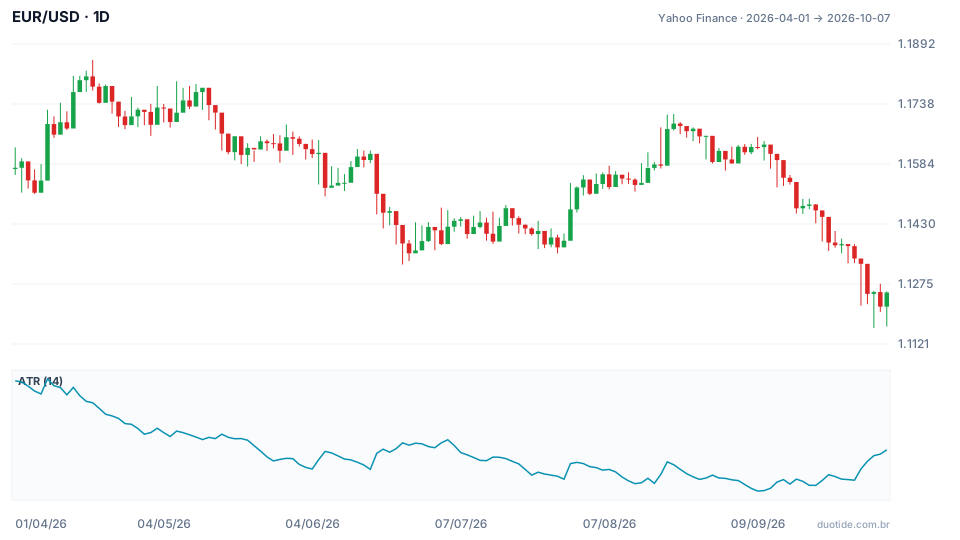
The chart shows EUR/USD between April 1 and October 7, 2026, with the 14-period ATR in the lower panel. The ATR measures the average daily range, already accounting for gaps between a close and the following open. The pair started the window at 1.15742 and ended at 1.12535, a 2.77% drop, with a high of 1.18511 on April 17 and a low of 1.11623 on October 5.
The Range Fell by Half Between April and September
On April 8, the ATR stood at 96.5 pips, the period's highest value. On September 9, it had fallen to 47.3 pips, the lowest. On October 7, after a run of declines in the euro, it climbed back to 65.4 pips. On August 19, a single day's range reached 105.8 pips, more than double the window's daily average, which was 49.1 pips.
What That Does to Position Size
Imagine a $50-per-trade risk rule, with a stop at a distance of 1 ATR, on a pair where each pip of a standard lot is worth $10:
- April (ATR of 96.5 pips): 50 ÷ (96.5 × 10) = 0.052 lots, or about 0.05 lots.
- September (ATR of 47.3 pips): 50 ÷ (47.3 × 10) = 0.106 lots, or about 0.10 lots.
The same reasoning applies within the day. The early hours of the Asian session usually move much less than the London-New York overlap. A 20-pip stop that works at 2 a.m. can get hit by a normal swing at 10 a.m. To keep the same dollar risk, a wider stop calls for a smaller position.
Days of the Week Also Change
Over the same window, EUR/USD's average daily range was 56.5 pips on Thursdays and 53.0 on Fridays, against 42.7 on Tuesdays, based on the date of each daily candle in the source. It's not a fixed rule: it depends on each week's calendar of announcements, such as the European Central Bank's decision and the American jobs report.

How to Choose Your Trading Hours
Start with Your Routine
There's no point choosing the London-New York overlap if you're working during those hours and will trade distractedly on your phone. A time when you can actually pay attention is worth more than the theoretically best hour.
Match the Pair with the Session
Pairs with the yen and the Australian dollar move more during the Asian sessions. Pairs with the euro and the pound pick up strength starting around 4 a.m. or 5 a.m. Brasília time. Trading EUR/GBP in the early Asian hours usually means little movement and a wider spread.
Caution Around Announcement Minutes
In the minutes before and after an important data release, the price can jump dozens of pips in seconds and the spread widens. For beginners, waiting for the first reaction to settle down is usually more prudent than trying to guess the direction.
Limitations
A good time isn't a guarantee of a good trade. The overlap has more opportunity and also more risk per trade. And the windows shift twice a year because of daylight saving time in the northern hemisphere: check each session's clock in March, October, and November.
Common Mistakes When Choosing the Time
- Using the same stop in pips during the early Asian hours and in the middle of the London-New York overlap.
- Forgetting that European and American daylight saving shifts the sessions by one hour in Brasília time.
- Opening a trade seconds before a jobs or interest rate announcement without knowing it was scheduled.
- Trading outside the main sessions without checking the spread, which tends to widen with fewer participants.
- Choosing the time based on what's free in the schedule, rather than the pair and the strategy.
To find your best time, trade in a demo account for a few weeks and note, for each trade, the entry time, the pair, the stop distance, and the result. Split the records by time window: the numbers will show which window your strategy performs best in and which one just generates cost. The 2026 data cited above describes what happened, not what's going to happen.
Practice before you risk. Open your Duotide account and test your ideas on the demo account with US$10,000 in virtual funds.
Create free accountUpdated:
Editorial character of the Duotide newsroom. Articles are written by the team with the help of artificial intelligence; prices and charts come from real market data. Explains charts, indicators and trading strategies: how they work, where they fail and how to test them first.
Was this article helpful?
Be the first to rate it.
Comments
- No comments yet. Be the first to comment.
Ready to put it into practice?
Open your account and practice on the demo account with US$10,000 in virtual funds, without risking money.
- Secure platformProtected login and identity verification
- Multilingual supportHelp available every day
- Free demo accountUS$10,000 virtual to practice
Trading involves the risk of losing the capital invested.
