

 Português pt
 Español es
 العربية ar
 বাংলা bn
 Deutsch de
 Filipino fil
 Français fr
 हिन्दी hi
 Bahasa Indonesia id
 Italiano it
 Русский ru
 Svenska sv
 ไทย th
 Türkçe tr
 Tiếng Việt vi
 简体中文 zh
Updated:
BeginnersDemo Account: How to Use It to Learn to Trade Risk-Free
 Marina CostaEditorial character · Beginner's Guide

Quick answer
A demo account is a simulation with real quotes and a fictional balance, meant to train a method before risking money. It's useful when you use it with rules: a learning goal, the same position size you'd use on a real account, and a log of every trade. Used like a video game, with an inflated balance and random entries, it teaches the wrong habits.
Everyone who starts out in the financial markets hears, sooner or later, the same advice: start with a demo account. The advice is good, but it almost never comes with instructions. What exactly do you train in an environment with no real money? And how far does that actually prepare someone to trade for real?
In this guide, we show how to set up the training and walk through a full example with real daily Apple (AAPL) quotes between April and October 2026, so you can see the kind of math you should be doing on demo before every trade.
What a demo account is
A demo account is a simulation that uses real quotes, or very close to real, and lets you open and close trades with a fictional balance. The platform, the charts, the order types, and the stop work just like on a real account. The difference is that the result doesn't come out of your own pocket.
What it solves
On demo you can make mistakes with no financial consequence. That's useful for learning to read a chart, place an order, watch a stop get triggered, and understand how the price moves across different assets throughout the day. It's also useful for testing a rule for long enough to know whether it has any edge.
What it doesn't solve
The emotional side. Losing real money hurts in a way that losing a fictional balance doesn't. A lot of people trade well on demo and freeze up repeating the exact same process with real money. Demo prepares the technique; emotional discipline is built afterward, trading little by little and with small amounts.

Real example: a simulated trade on Apple
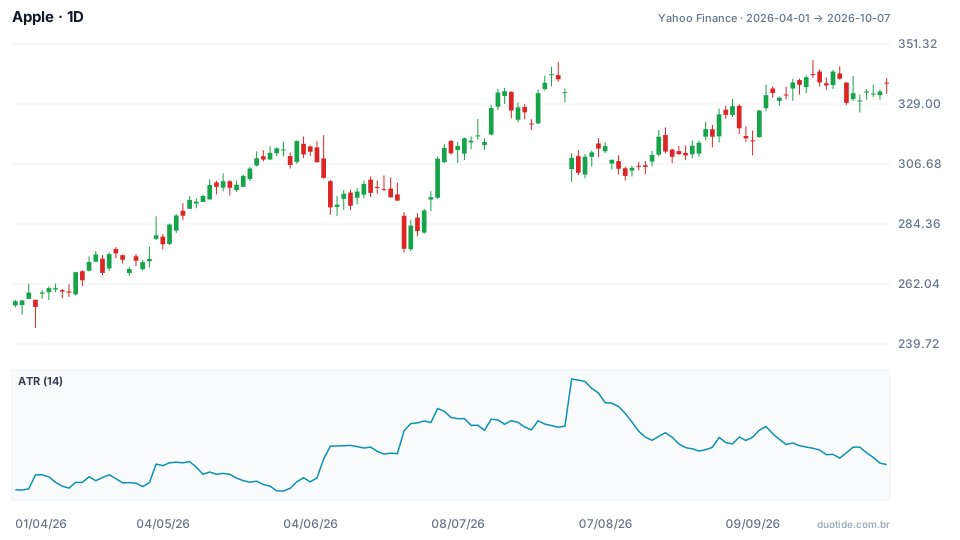
The chart shows Apple between April 1, 2026 (close of US$255.63) and October 7, 2026 (US$336.67), a gain of 31.7% over the period. Below the price sits the 14-period ATR, which measures the average range of the last 14 sessions. It helps answer the question every beginner should be asking on demo: where should the stop go, and how many shares can I buy?
Situation 1: the stop got triggered, and with a gap
Suppose a demo account set up with US$10,000, the same amount the person plans to use on the real account, and a rule of risking at most 1% per trade, that is, US$100.
- Entry on May 29, 2026, at the close: US$312.06. The day's ATR: US$5.57.
- Stop at a distance of 2 ATR: 2 × 5.57 = US$11.14 → stop at 312.06 − 11.14 = US$300.92.
- Position size: 100 ÷ 11.14 = 8.98 → 8 shares (always round down). Planned risk: 8 × 11.14 = US$89.12.
What happened next: on June 9 the stock opened at US$300.28, already below the stop. The order would have filled near the open, with a loss of 312.06 − 300.28 = US$11.78 per share, or US$94.24 total. The loss came in bigger than the planned US$89.12 because of the gap. In the following days the low reached US$287.38 (June 10), so the stop did prevent a bigger loss. That's a lesson worth learning on demo: a stop limits the loss, but it doesn't guarantee the exact price.
Situation 2: volatility changed the position size
On July 31, 2026, Apple closed at US$308.91, a price similar to May's, but the ATR stood at US$9.87, the highest value of the period. With the same rule, the stop sits at 2 × 9.87 = US$19.74 (at US$289.17) and the position drops to 100 ÷ 19.74 = 5.07 → 5 shares. Over the next ten sessions the low was US$300.57, far from the stop, and on August 14 the stock closed at US$305.93: a result of 5 × (305.93 − 308.91) = −US$14.90.
Notice the main point: with the market more turbulent, the rule called for buying fewer shares to keep the risk around US$100. Anyone trading demo with the same number of shares every time, without looking at volatility, doesn't train for this. The examples describe what happened, not what will happen.
How to use a demo account
Set a learning goal, not a profit goal
For example: for two weeks, practice only entries on trend pullbacks on the daily chart. A profit goal on demo leads to doubling down to recover, which teaches nothing.
Use your real balance and position size
If you plan to start with R$5,000, set the demo to that amount, if the platform allows it, or simply trade as if it were your balance. Winning with a virtual balance of R$100,000 and huge positions says nothing about how you'll behave with your own money.
Log every trade
A simple spreadsheet is enough: asset, date, reason for the entry, stop, target, size, and result. Without a log, memory keeps the wins and forgets the mistakes.
Evaluate with a large enough sample
Twenty or thirty trades say far more than three or four. Suppose 30 trades with 12 winners and 18 losers, an average gain of R$40.00 and an average loss of R$15.00: (12 × 40) − (18 × 15) = 480 − 270 = a positive R$210.00. A 40% win rate can be profitable if the gain-to-loss ratio is favorable, and that's the kind of conclusion demo trading helps you see.
When to move to real money
There's no magic number of days. A few signs help: the method was followed across dozens of trades without changing the stop or target midway, you know how much you'd lose on each trade before entering, and the logged results make sense. When you move over, start with positions much smaller than the ones on demo.
Limitations
On demo, execution tends to be perfect: no queue, no delay, and, depending on the platform, without the same costs and slippage as a real account. Gaps, like the one on June 9 in the example, and wider spreads around news events can look smaller than they really are. Treat the demo result as a ceiling, not a forecast.
Common mistakes on a demo account
- Trading with a virtual balance much larger than the capital you actually have.
- Switching strategies every two trades, with no sample big enough to know if something works.
- Ignoring volatility and always using the same number of shares or lots.
- Not logging trades and judging the training by memory.
- Staying on demo for years waiting for perfection, or leaving it after one lucky week.
- Concluding the demo result will repeat exactly the same way on a real account.
To get started, open the chart for an asset you follow on a demo account, add the 14-period ATR, and calculate, before every entry, the stop and position size as in the Apple example. Log everything for a few weeks and compare the planned risk with what actually happened: that log is what turns demo trading into learning.
Practice before you risk. Open your Duotide account and test your ideas on the demo account with US$10,000 in virtual funds.
Create free accountUpdated:
Editorial character of the Duotide newsroom. Articles are written by the team with the help of artificial intelligence; prices and charts come from real market data. Answers the first questions of those just starting out: account, platform, basic concepts and common mistakes.
Was this article helpful?
Be the first to rate it.
Comments
- No comments yet. Be the first to comment.
Ready to put it into practice?
Open your account and practice on the demo account with US$10,000 in virtual funds, without risking money.
- Secure platformProtected login and identity verification
- Multilingual supportHelp available every day
- Free demo accountUS$10,000 virtual to practice
Trading involves the risk of losing the capital invested.
