

 Português pt
 Español es
 العربية ar
 বাংলা bn
 Deutsch de
 Filipino fil
 Français fr
 हिन्दी hi
 Bahasa Indonesia id
 Italiano it
 Русский ru
 Svenska sv
 ไทย th
 Türkçe tr
 Tiếng Việt vi
 简体中文 zh
Updated:
OptionsHow Binary Options Work: Payout, Risk, and a Real Example
 Naomi TanakaEditorial character · Analysis Desk

Quick answer
In a binary option, the trader picks whether an asset's price will be above or below the entry price at the end of a fixed time frame. A correct call pays a fixed percentage (the payout, usually 70% to 90%); a wrong call loses the entire entry amount. With an 85% payout, you need to win at least 54.1% of the time just to break even, which makes the product high-risk.
Binary options are often presented as the simplest way to trade: instead of deciding when to enter and when to exit, the trader just picks a direction and a time frame. When the time frame ends, the result is automatic. The mechanics really are simple, but the math behind them works against the trader, and understanding that math is the first step before any trade.
In this guide we explain the mechanics, calculate the win rate needed to break even, and use real daily GBP/USD closes (British pound against the US dollar, Yahoo Finance) from April to October 2026 to show what that math means in practice.
What a binary option is
A binary option is a contract with only two possible outcomes. The trader picks an asset, an entry amount, and an expiration time, which can range from a few seconds to a few days, and answers one question: by the end of that time, will the price be above or below the entry price?
- Right call: gets back the amount invested plus a fixed percentage, called the payout, usually between 70% and 90%.
- Wrong call: loses the entire amount invested.
- Size of the move doesn't matter: the price can move one pip or a hundred pips in your favor, the gain is the same.
It's this asymmetry, winning less than what's risked on each correct call, that defines the product's risk.

How to calculate the break-even win rate
With an 85% payout, a R$ 100 entry pays R$ 85 in profit on a win and takes R$ 100 on a loss. To break even, the gains need to cover the losses:
- Break-even rate = loss ÷ (gain + loss)
- Break-even rate = 100 ÷ (85 + 100) = 100 ÷ 185 = 54.1%
- With an 80% payout: 100 ÷ 180 = 55.6%
- With a 70% payout: 100 ÷ 170 = 58.8%
In other words, winning more often than losing isn't enough. You need to win well more than half the time, consistently, just to avoid losing money. In a short-term move that behaves a lot like a coin toss, that's very hard to do.
Real example: 135 days of GBP/USD
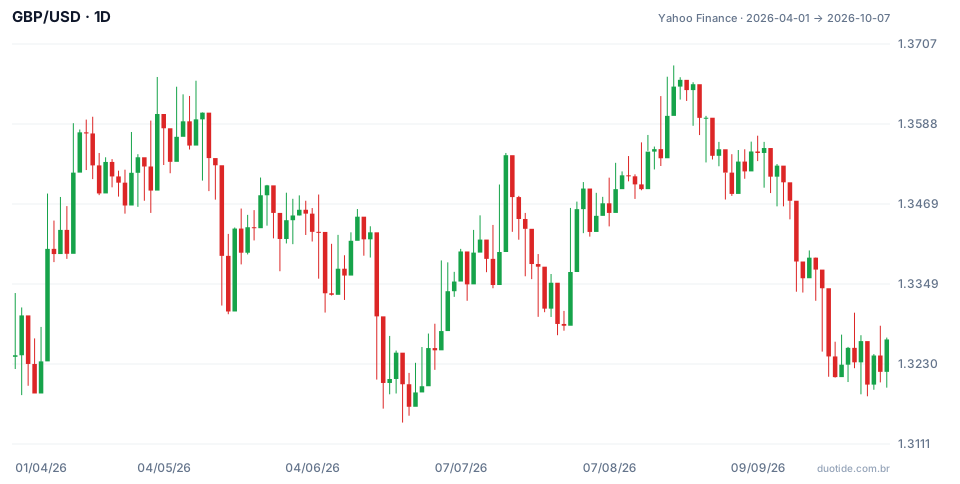
The chart shows daily GBP/USD candles from April 1, 2026 (1.32433) to October 7, 2026 (1.32668). Six months later, the pair was practically in the same place: up 0.18%. Along the way, it went from a low of 1.31430 on June 24 to a high of 1.36750 on August 21. Imagine a daily binary option of R$ 100 per day, with an 85% payout, betting on the direction of the next day's close.
Always betting on a rise
Among the 135 pairs of consecutive closes, the pair closed above the previous day 64 times and below it 71 times. Someone always betting on a rise would have 64 wins (64 × R$ 85 = R$ 5,440) and 71 losses (71 × R$ 100 = R$ 7,100): a loss of R$ 1,660.
Always betting on a drop, the direction that happened most
Even picking, after the fact, the side that won most often, the math still ends in the red: 71 wins (R$ 6,035) against 64 losses (R$ 6,400), a loss of R$ 365. The win rate was 52.6%, below the 54.1% that an 85% payout requires.
July: six straight drops
From July 17 to July 24, GBP/USD closed lower for six straight days, going from 1.35413 on July 16 to 1.33127 on July 24, about 229 pips. Someone betting on a rise every day waiting for the turn would have lost six entries in a row. Someone using martingale, doubling the bet after each loss (R$ 100, 200, 400, 800, 1,600, and 3,200), would have lost R$ 6,300 trying to recover R$ 100. Streaks like that aren't rare over 135 days.
One last detail that teaches a lot: testing different rules on the same period, one of them, always betting against the previous day's direction, would have won 56.7% of the time. This isn't a strategy that's been discovered. When many rules are tested on the same data, some will always seem to work by chance, and nothing guarantees it will repeat in the next period.

How to evaluate binary options carefully
Do the payout math before anything else
Before any chart analysis, calculate the win rate that breaks even with the payout on offer. If you don't have a long, recorded track record showing you win above that rate, the expected result is negative.
Be wary of very short time frames
In expirations of 1 minute or less, price movement is dominated by noise. Indicators and chart patterns have too little time to make sense, and the outcome gets even closer to a coin flip.
Check who's offering the product
In Brazil, the CVM (the securities regulator) has already published alerts about companies offering binary options to the public without authorization to operate in the country. In several other countries the product is banned or restricted for retail investors. Knowing who is on the other side of the trade is part of assessing the risk.
Limitations of the example
The example uses daily closes and a fixed 85% payout. With shorter time frames and lower payouts, the break-even rate rises. The results describe what happened with GBP/USD in that period, not what will happen in another one.
Common mistakes in binary options
- Thinking that winning more than half the time is enough: with an 85% payout, you need to clear 54.1%.
- Using martingale to recover losses: a streak of six losses, like July's on GBP/USD, multiplies the loss by 63.
- Trusting strategies tested only on the past: with many rules tested, some will always work by chance.
- Trading second-long expirations as if they were technical analysis.
- Ignoring who offers the product and under what regulation.
- Risking money you'll need: the loss on every wrong call is 100% of the entry amount.
If you want to understand the mechanics on your own, use only a demo account and log every trade with date, direction, time frame, and result. After 100 trades, compare your win rate with the payout's break-even rate. That number is worth more than any promise of a ready-made signal.
Practice before you risk. Open your Duotide account and test your ideas on the demo account with US$10,000 in virtual funds.
Create free accountUpdated:
Editorial character of the Duotide newsroom. Articles are written by the team with the help of artificial intelligence; prices and charts come from real market data. Explains charts, indicators and trading strategies: how they work, where they fail and how to test them first.
Was this article helpful?
Be the first to rate it.
Comments
- No comments yet. Be the first to comment.
Ready to put it into practice?
Open your account and practice on the demo account with US$10,000 in virtual funds, without risking money.
- Secure platformProtected login and identity verification
- Multilingual supportHelp available every day
- Free demo accountUS$10,000 virtual to practice
Trading involves the risk of losing the capital invested.
