

 Português pt
 Español es
 العربية ar
 বাংলা bn
 Deutsch de
 Filipino fil
 Français fr
 हिन्दी hi
 Bahasa Indonesia id
 Italiano it
 Русский ru
 Svenska sv
 ไทย th
 Türkçe tr
 Tiếng Việt vi
 简体中文 zh
Updated:
BeginnersHow to Start Trading With Little Money in 2026
 Marina CostaEditorial character · Beginner's Guide
Quick answer
You can start trading with little money as long as the capital is treated as a learning budget, not a bet. The core rule is to risk at most 1% to 2% of the balance per trade, calculate the position size from the stop, and avoid high leverage. Training first on a demo account and logging every trade rounds out the plan.
Almost everyone starts out trading with little money, and that's not a problem. The problem is treating a small amount of capital as a bet to multiply quickly, instead of a learning budget. With US$ 100, or the equivalent in reais, you can learn the most important part of the craft: controlling the risk of every trade.
In this guide we build a plan for a small account and run the numbers with real ether data (ETH/USDT on Binance, April through October 2026), an asset many beginners pick precisely because it lets you buy fractions.
What changes when capital is small
With a small account, the gain in absolute terms is also small, even when the trade works out. Anyone promising to turn little into a lot quickly is selling high risk, not a method. The two things that weigh most on a small account are:
- Fixed costs: a minimum fee of US$ 1 per trade, in a hypothetical example, is 1% of a US$ 100 account. Ten trades cost 10% of the balance before any result.
- The temptation of leverage: with little money, leverage looks like the shortcut. It's also the fastest way to wipe out the account.

How to calculate each position's size
The rule that protects a small account the most is risking a fixed fraction of the balance per trade. For US$ 100, risking 2% means losing at most US$ 2 if the stop is hit. Position size comes from the stop, not the other way around:
- Risk per trade: balance × percentage. US$ 100 × 2% = US$ 2.
- Stop distance: here, 1.5 times the 14-period ATR, the asset's average daily range.
- Size: risk ÷ stop distance.
Example with ether's real ATR
On October 7, 2026, ETH closed at US$ 2,574.14 with an ATR of US$ 86.64. Stop = 1.5 × 86.64 = US$ 129.96. Size = 2 ÷ 129.96 = 0.01539 ETH, a position of about US$ 39.61. If the stop is hit, the loss is US$ 2, not US$ 39.61.
Real example: ether in 2026
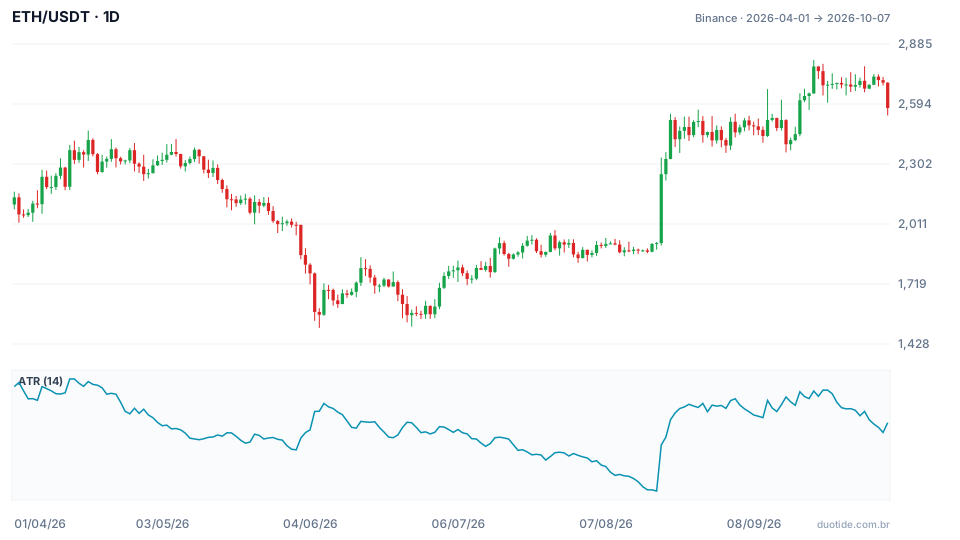
The chart shows ETH/USDT with the 14-period ATR. The asset rose 20.27% over the window, from US$ 2,140.35 to US$ 2,574.14, but the path included a deep drop and a strong recovery.
The drop from April to June
The period's low was US$ 1,505.68, on June 6, 29.7% below the April 1 close. Anyone who put the full US$ 100 into ETH on April 1 would have watched the balance come close to US$ 70.35. With 5x leverage, a 20% drop would have already wiped out the entire balance, well before the low. With the 2% rule and a stop, each losing trade would cost at most US$ 2.
Size changes with volatility
On April 14, the ATR reached US$ 112.51, the period's highest, with ETH at US$ 2,322.44. The same US$ 2 risk gave 0.01185 ETH, about US$ 27.52. On August 18, the ATR fell to US$ 46.24, the period's lowest, with the price at US$ 1,917.85: the position grew to 0.02884 ETH, about US$ 55.30. On busy days the position shrinks; on calm days, it grows. The money risk stays the same.
The recovery through September
From June's low to the US$ 2,807.34 high on September 21, ETH rose 86.4%. Moves like that are what attract beginners, but only those who still had a balance left after the drop got to take part in them.

How to start with little money, step by step
1. Train on a demo account
Before putting in money, use a demo account for a few weeks with the same amount you plan to deposit. The goal is to learn the platform and follow the risk rule without exception.
2. Pick a few assets that accept fractions
With little capital, you need assets that allow positions small enough to respect the 1% to 2% risk. Focus on one or two to learn how they behave. Also check the minimum order size: if the smallest possible position is bigger than the size the risk rule calculates, that asset doesn't fit your account yet.
3. Know every cost
Spread, commission, minimum fee, and the cost of holding a position open overnight. On a small account, they weigh proportionally more.
4. Log everything
Note the entry, stop, target, size, and result of every trade. That history is what will tell you whether it makes sense to increase the capital. A good rule of thumb is to only think about depositing more after a few dozen logged trades in which the risk rule was followed every single time, regardless of the result.
Limitations
The ATR describes past volatility and can change suddenly. The stop can be filled at a worse price during sharp moves. And no risk rule turns a bad strategy into a good one: it just buys you time to find that out without losing everything. The examples describe what happened, not what will happen.
Common mistakes among those starting with little money
- Using high leverage to make up for the small capital.
- Putting the entire balance into a single trade.
- Ignoring fixed costs that, proportionally, eat up a good chunk of the account.
- Depositing more money to recover losses, instead of reviewing the method.
- Measuring success by the money gained, instead of by the discipline of following the plan.
The best first step is a demo account: apply the 2% rule with the ATR of the asset you chose, log every trade for a month, and only then decide if, when, and with how much you'll trade for real.
Practice before you risk. Open your Duotide account and test your ideas on the demo account with US$10,000 in virtual funds.
Create free accountUpdated:
Editorial character of the Duotide newsroom. Articles are written by the team with the help of artificial intelligence; prices and charts come from real market data. Answers the first questions of those just starting out: account, platform, basic concepts and common mistakes.
Was this article helpful?
Be the first to rate it.
Comments
- No comments yet. Be the first to comment.
Ready to put it into practice?
Open your account and practice on the demo account with US$10,000 in virtual funds, without risking money.
- Secure platformProtected login and identity verification
- Multilingual supportHelp available every day
- Free demo accountUS$10,000 virtual to practice
Trading involves the risk of losing the capital invested.
