

 Português pt
 Español es
 العربية ar
 বাংলা bn
 Deutsch de
 Filipino fil
 Français fr
 हिन्दी hi
 Bahasa Indonesia id
 Italiano it
 Русский ru
 Svenska sv
 ไทย th
 Türkçe tr
 Tiếng Việt vi
 简体中文 zh
Updated:
BeginnersWhat to Learn From Peter Lynch and Jesse Livermore: 3 Trading Books
 Marina CostaEditorial character · Beginner's Guide

Quick answer
Peter Lynch teaches you to invest in businesses you understand, starting from what you observe day to day and confirming it with the numbers, with years of patience. Jesse Livermore teaches you to follow the price trend and cut losses fast. The two lessons complement each other, but neither guarantees a result: knowing the brand didn't save anyone who bought Nike in 2021, and Livermore's own discipline didn't stop him from going broke more than once.
Few authors sum up two opposite approaches to the market as well as Peter Lynch and Jesse Livermore. Lynch built his career as a long-term investor, looking for good companies before the market recognized them. Livermore was one of the first great speculators, reading price behavior decades before technical analysis got that name.
In this article we summarize the three books that tell these ideas and put the main lessons to the test with real prices (Yahoo Finance) from two brands any consumer knows: Nvidia and Nike.
The three books
One Up on Wall Street (1989)
Lynch ran Fidelity's Magellan Fund from 1977 to 1990, a period in which it became one of the largest funds in the United States. In the book, he argues that the ordinary investor has an edge: seeing, in daily life, products, stores, and services that haven't yet reached analysts' reports. It's also where the term ten-bagger comes from, a stock that multiplies its value by ten.
Beating the Street (1993)
Written after he left the fund, it shows how Lynch picked stocks in practice, with examples of companies he bought and the reasoning behind each one. The main message: everyday observation is the starting point, but the decision comes from analyzing the balance sheet, debt, and earnings growth.
Reminiscences of a Stock Operator (1923)
Written by Edwin Lefèvre, it tells, under a fictional name, the story of Jesse Livermore, who got his start in Boston's bucket shops and made fortunes betting on the market's collapse in 1907 and in 1929. The book is about reading trends, the patience to wait for the right moment, and, above all, the mistakes that made him lose everything more than once. Livermore went broke several times and died in 1940 in difficult financial circumstances.

What each one teaches
Lynch: invest in what you understand
Understanding the business is the start, not the end. Liking the product isn't enough: you need to know how the company makes money, how much it owes, and whether its profit is growing. Lynch also insisted on being patient with good companies, because the big gains take years.
Livermore: follow the price and cut your losses
Livermore said the big money is made by waiting, not by trading all the time. His most-quoted rules: trade with the trend, add to a position only once it's already profitable, and get out fast when the market proves you wrong.
Real example: both lessons applied to Nvidia and Nike
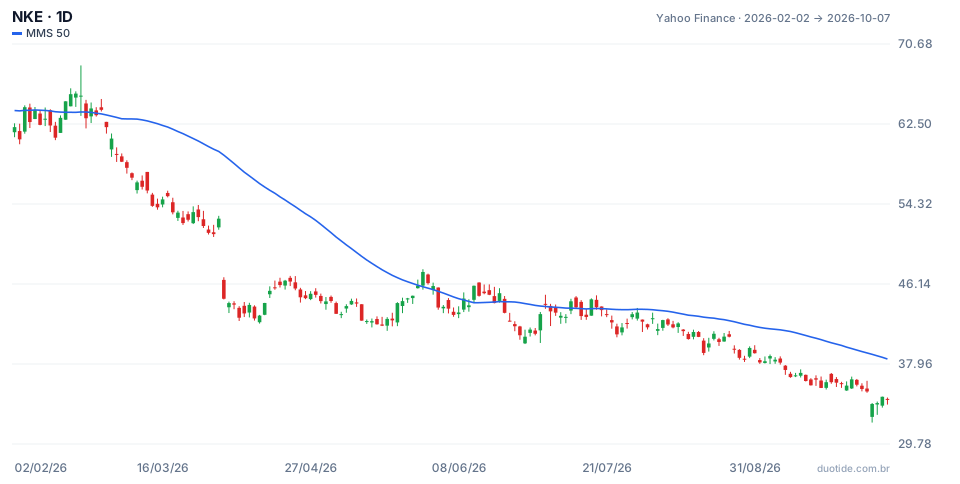
The chart shows Nike from February 2, 2026 to October 7, 2026 with the 50-day moving average. The situations below use the full five-year data series for both stocks and describe what happened, without predicting anything.
Nvidia: a ten-bagger that took a strong stomach
Nvidia closed at $20.83 on October 8, 2021 and at $237.47 on October 7, 2026: the price multiplied by 11.4. It's the kind of stock Lynch describes. But the path wasn't straight. From the close of $33.38 on November 29, 2021, the stock fell to $11.23 on October 14, 2022, a 66% drop. Anyone who bought at the top and held, like a Lynch-style investor, ended up with the price multiplied by 7.1. Anyone using Livermore's rule with a 10% stop would have exited on December 6, 2021, at $30.04, protected from the drop, and would only have captured the rest of the rally by buying back in once the trend turned.
Nike: the well-known brand that wasn't enough
Nike is the perfect example of a company everyone knows. The stock closed at $177.51 on November 5, 2021 and at $34.36 on October 7, 2026, down 80.6%. Knowing the product protected no one; the analysis Lynch called for (sales, margins, competition) was what mattered. A 10% stop from the top, on the other hand, would have triggered on December 20, 2021, with a close of $156.98, a loss of 11.6%.
Nike in 2026: Livermore's trend
On the chart, Nike went from $62.18 on February 2, 2026 to $34.36 on October 7, down 44.7%. On April 1, the stock was at $44.63, well below the 50-day average ($59.31). Of the period's 172 sessions, it closed above the average in only 21, and every attempt to stay above it, such as on May 28 and in July, lasted just a few days. Anyone following Livermore's rule of buying only with the trend wouldn't have entered.

How to put these lessons into practice
Start with what you observe
Use Lynch's idea as an initial filter: note down companies whose products you see growing. Then study the numbers before making any decision.
Set your exit before your entry
From Livermore's school of thought, the most useful rule for beginners is knowing, before entering, where you'll exit if you're wrong. The Nike example shows the difference between losing 11.6% and losing 80.6%.
Pick a time horizon and stick to it
The Nvidia case shows that the two schools of thought can reach opposite conclusions about the same stock. The problem is mixing them: buying like a long-term investor and selling in a panic like a short-term trader, or the other way around.
Limitations
Both are subject to survivorship bias: we remember the ten-baggers and the 1929 calls that paid off, not the hundreds of stocks that never recovered. The market has also changed a lot since 1923 and since the Magellan years, and neither book is a manual to follow to the letter.
Common mistakes when applying Lynch and Livermore
- Buying a stock just because you like the product, without looking at the company's numbers.
- Copying Livermore's aggressive trades without copying what he himself learned about losses.
- Picking success stories after the fact and thinking they were obvious at the time.
- Switching methods mid-trade as the price moves.
- Reading the books as a promise of results: they tell what happened, not what will happen.
A good way to test these ideas is on a demo account: pick two or three companies you know, decide for each one whether the approach is long-term or trend-following, with the exit set in advance, and record the result for a few months. Your own track record will show which style fits you.
Practice before you risk. Open your Duotide account and test your ideas on the demo account with US$10,000 in virtual funds.
Create free accountUpdated:
Editorial character of the Duotide newsroom. Articles are written by the team with the help of artificial intelligence; prices and charts come from real market data. Answers the first questions of those just starting out: account, platform, basic concepts and common mistakes.
Was this article helpful?
Be the first to rate it.
Comments
- No comments yet. Be the first to comment.
Ready to put it into practice?
Open your account and practice on the demo account with US$10,000 in virtual funds, without risking money.
- Secure platformProtected login and identity verification
- Multilingual supportHelp available every day
- Free demo accountUS$10,000 virtual to practice
Trading involves the risk of losing the capital invested.
