

 Português pt
 Español es
 العربية ar
 বাংলা bn
 Deutsch de
 Filipino fil
 Français fr
 हिन्दी hi
 Bahasa Indonesia id
 Italiano it
 Русский ru
 Svenska sv
 ไทย th
 Türkçe tr
 Tiếng Việt vi
 简体中文 zh
Updated:
BeginnersStock Market Terms for Beginners, Explained in Practice
 Marina CostaEditorial character · Beginner's Guide

Quick answer
The basic stock market terms are stock (a slice of a company), ticker (the code, like AAPL or PETR4), bid and ask (the best buy and sell prices), spread (the difference between them), market and limit orders, volume, and market cap. Understanding these terms helps you know how much it costs to enter and exit a trade and what each order does.
The stock market has a vocabulary problem. Nobody quits because the ideas are too complicated: they quit because every sentence seems to require knowing five other words already. The stock opened with a gap, dropped on high volume, and the spread widened after earnings isn't an advanced sentence, it's ordinary market language. For a beginner, it feels like walking into a conversation that's already halfway done.
This text isn't a complete dictionary, it's a starting point. So the terms don't stay abstract, we use Apple's (AAPL, on the Nasdaq) real daily quotes between May and October 2026, with numbers you can check on the chart.
What a stock is
A stock represents a slice of ownership in a company. When you buy a stock, you're buying a small piece of the business, not the company's product or a loan to it. If the company does well and more investors want to own that stock, the price tends to rise; if it disappoints, or the market expects trouble, the price can fall.
Number of shares
The dollar result depends on how many shares you hold. On May 1, 2026, Apple stock closed at $280.14; on October 7, 2026, at $336.67. The difference was $56.53 per share, or 20.2%. With 1 share, the gain would have been $56.53; with 10 shares, $565.30. The stock's move was the same; the position size changed the result. This is the past: the same period could have ended in the negative.
Ticker
The ticker is the short code that identifies the asset on an exchange: AAPL for Apple on the Nasdaq, PETR4 or VALE3 on the Brazilian exchange. It makes platforms faster to use, but it also causes confusion between similarly named companies and between different share classes of the same company (PETR3 and PETR4, for example). Before confirming an order, check that the ticker really is the one for the company you want.
Open, high, low, and close
Every candle on a chart sums up a period with four prices. Look at Apple's July 31, 2026:
- Open: $304.81, the first price traded that day.
- High: $310.69, the day's highest price.
- Low: $300.00, the lowest.
- Close: $308.91, the last price, which is used to calculate the day's change.
Gap
The day before, on July 30, the stock had closed at $333.43. Opening at $304.81 means an 8.6% gap down: the price jumped from one level to another without trading in between. At the close, the day's drop was 7.35%. With 10 shares bought at $333.43, the loss would be $245.20 on the day. A stop placed at $320, for example, wouldn't have gotten out at $320: the first available trade was already near $304.81.

Real example: Apple's volume and price in 2026
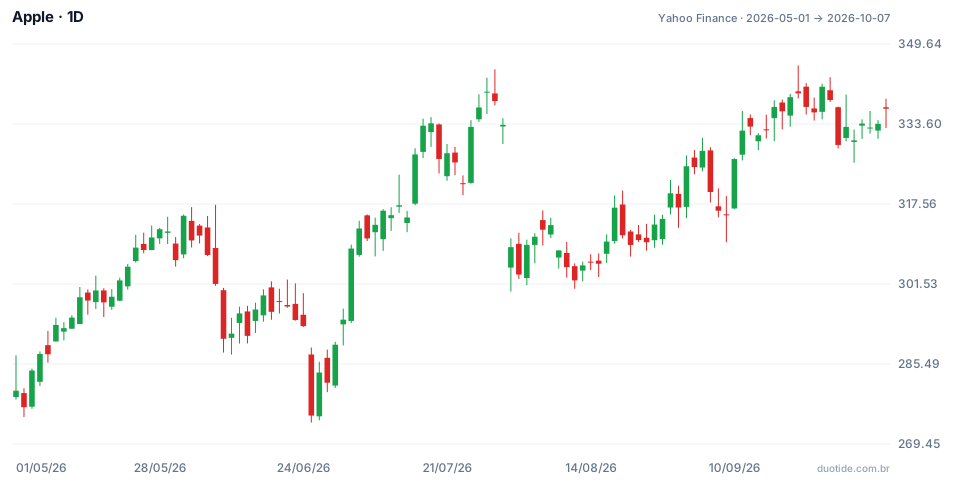
The chart shows AAPL's daily candles. Volume doesn't show up on it, but it comes in the same daily data. Two practical readings:
Volume above normal
Volume is the number of shares traded in a period. On July 31, 132.5 million Apple shares traded, against an average of 50.8 million over the previous 20 sessions, about 2.6 times normal. High volume shows that many participants reacted at the same time; it doesn't say whether that reaction was right. In the days that followed, volume fell back (34.4 million on August 7) and the stock closed at $313.33, above the July 31 close.
The period's high and low
Between May and October, the low was $273.75 on June 25 and the high was $345.34 on September 22. These are references many traders use as support and resistance, regions where the price has already paused before.
How to use the terms when trading
Bid, ask, and spread
The bid is the highest price some buyer is offering at that moment. The ask is the lowest price some seller will accept. The spread is the difference between the two. In a hypothetical example with a bid of $336.60 and an ask of $336.65, the spread is $0.05: anyone buying right away pays near the ask; anyone selling right away receives near the bid. Heavily traded stocks, like Apple, usually have a tight spread; thinly traded stocks have a wide one. The spread doesn't show up as a separate charge, but it's a real cost on every entry and exit.
Market order and limit order
A market order buys or sells at the best available price, right away: it prioritizes execution. A limit order sets the maximum price you'll pay on a buy, or the minimum you'll accept on a sell: it prioritizes price, with the risk of not getting filled. On a day like July 31, a market order at the open would have been filled near $304.81; a limit buy order at $298 wouldn't have been filled, because the low was $300.00.
Market cap
Market cap = stock price × number of shares outstanding. In a hypothetical example, a company with 1 billion shares at R$ 50 is worth R$ 50 billion. That's why the price alone is misleading: a R$ 20 stock can belong to a much bigger company than one with a R$ 200 stock, if it has far more shares outstanding. Indexes like the S&P 500 give more weight to companies with a bigger market cap.
Limitations
Knowing the terms doesn't tell you where the price is going. High volume, a gap, or a breakout above a high are descriptions of what happened; they help you decide with more clarity, not predict.
Common mistakes beginners make
- Assuming a low-priced stock is cheap, without looking at market cap.
- Typing the wrong ticker or mixing up share classes of the same company.
- Using a market order on a thinly traded asset and paying a wide spread.
- Believing a stop guarantees the exit price, even with a gap.
- Reading high volume as a buy or sell signal, without looking at the context.
- Forgetting that the examples above describe what happened, not what will happen.
To practice without risking money, open a demo account, pick a stock, and over a few weeks write down the open, the close, the volume, and the spread you see at the time of each order. Test market and limit orders and record the price each one was filled at. The terms become natural once they turn into decisions.
Practice before you risk. Open your Duotide account and test your ideas on the demo account with US$10,000 in virtual funds.
Create free accountUpdated:
Editorial character of the Duotide newsroom. Articles are written by the team with the help of artificial intelligence; prices and charts come from real market data. Answers the first questions of those just starting out: account, platform, basic concepts and common mistakes.
Was this article helpful?
Be the first to rate it.
Comments
- No comments yet. Be the first to comment.
Ready to put it into practice?
Open your account and practice on the demo account with US$10,000 in virtual funds, without risking money.
- Secure platformProtected login and identity verification
- Multilingual supportHelp available every day
- Free demo accountUS$10,000 virtual to practice
Trading involves the risk of losing the capital invested.
