

 Português pt
 Español es
 العربية ar
 বাংলা bn
 Deutsch de
 Filipino fil
 Français fr
 हिन्दी hi
 Bahasa Indonesia id
 Italiano it
 Русский ru
 Svenska sv
 ไทย th
 Türkçe tr
 Tiếng Việt vi
 简体中文 zh
Updated:
MarketsWhat Spread Betting Is and How It Works
 Rafael AzevedoEditorial character · Markets Desk

Quick answer
Spread betting is a way to trade an asset's price movement without buying it: you choose the direction and a value per point, and the result is that value multiplied by the points the price moved. The cost is built into the spread between the buy and sell price. Since the exposure is far larger than the capital deposited, the trade is leveraged and losses can exceed the amount set aside for it.
Among financial market trading models, spread betting is one of the least understood by beginners. The idea seems simple: instead of buying the asset, you bet on the direction and size of the price move and win or lose in proportion to that move. That simplicity hides risks that need to be clear before any trade.
In this guide we use the S&P 500's real daily moves between April and October 2026 to show, in reais per point, what an ordinary move and a sharp one represent.
What spread betting is
It's a derivative where the platform offers a buy price and a sell price for an asset, with a gap between them, the spread. You choose to buy, if you think the price will rise, or sell, if you think it will fall, and set a value per point instead of a quantity of units. There's no ownership of the asset: only exposure to its movement.
The product is offered mainly in the United Kingdom and Ireland, where it has its own tax treatment. In other countries, the same logic shows up in similar products, like contracts for difference.

How to calculate the result
Result = value per point × (exit price − entry price), on a buy. On a sell, the sign flips. The spread comes in as a cost: you buy at the higher price and sell at the lower one, so the price needs to move at least the spread's distance in your favor for the trade to break even.
Example with the S&P 500
The index closed April 1, 2026 at 6,575.32 points and October 7, 2026 at 7,801.77. A R$2-per-point buy held over that stretch would have:
- Change: 7,801.77 − 6,575.32 = 1,226.45 points.
- Gross result: 1,226.45 × R$2 = R$2,452.90, before the spread and the cost of keeping the position open for months.
- Final exposure: 7,801.77 × R$2 = R$15,603.54, as if the person had that amount invested in the index.
The same math applies in reverse: a R$2-per-point sell over the same stretch would have lost R$2,452.90.
Real example: the S&P 500 day by day
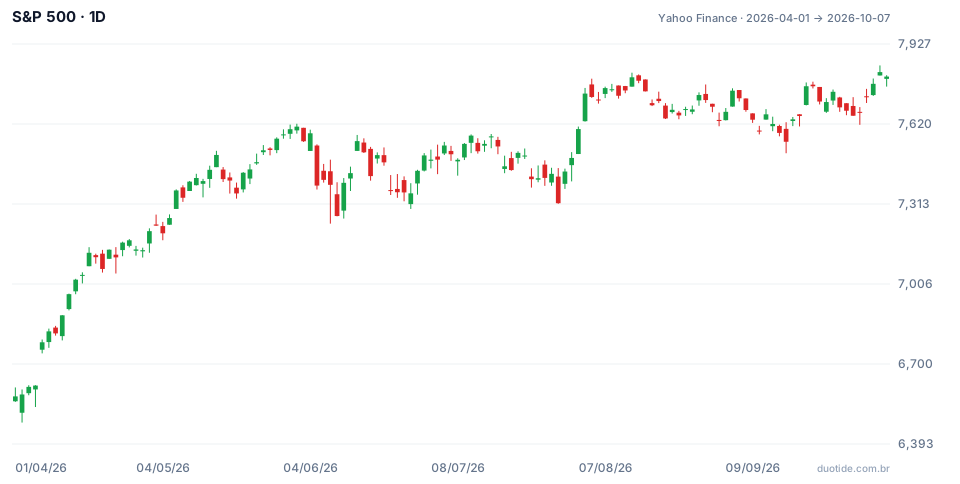
Over the period, the index rose 18.65%, from a low of 6,474.94 points (April 2) to a high of 7,844.52 (October 6). The accumulated gain hides the daily swing, which is what decides whether a leveraged position survives.
An average day
The average close-to-close move, in absolute value, was 44.62 points. At R$2 per point, that's about R$89.24 of swing on an ordinary day, up or down.
The worst day
On June 5 the index fell from 7,584.31 to 7,383.74 points: −200.57 points, or −2.64%. A R$2-per-point buy would lose R$401.14 in a single session. If the platform required, say, a margin of 5% of the exposure (7,584.31 × R$2 × 5% = about R$758 with the index at that level), that loss would eat up more than half the margin in one day. On June 10 came another drop of 119.66 points.
The best day
On April 8 the index rose 165.96 points (+2.51%), from 6,616.85 to 6,782.81. At R$2 per point, that's R$331.92 in favor of anyone long and against anyone short. The numbers describe what happened in the period, not what will happen.

How to use spread betting with risk control
Calculate the value per point from the maximum loss
First decide how much you accept losing, then the stop distance in points, and only then the value per point. With a maximum loss of R$200 and a 100-point stop on the S&P 500, the value per point is R$2. With a 50-point stop, close to the average daily move, the stop would get triggered often by nothing but noise.
Think about exposure, not margin
The required deposit is small next to the exposure. Anyone looking only at the margin underestimates the risk: in the example, about R$758 of margin controlled more than R$15,000 of exposure.
Include the costs
The spread is paid on every entry, and positions held overnight usually carry a financing cost. On long trades, that cost can add up to something meaningful.
Differences from buying the asset outright
Anyone who buys the asset owns it, and generally the maximum loss is the amount invested. With spread betting, because of the leverage, the loss can exceed the amount set aside for the trade if the market moves sharply and the stop doesn't fill at the expected price, as in opening gaps.
Limitations
The product isn't available in every country, and margin rules, costs, and client protection vary by jurisdiction. Regular stops don't guarantee the price on gaps; some platforms offer guaranteed stops, at an extra cost.
Common mistakes in spread betting
- Choosing the value per point by the gain you want, instead of the loss you accept.
- Looking at the deposited margin as if it were the total risk.
- Placing the stop within the day's normal swing.
- Ignoring the spread and financing cost on long trades.
- Trading without a stop because the first trade moved in your favor.
To practice, use a demo account and simulate point-based trades on an index you follow: before every entry, write down the maximum loss, the stop distance, and the resulting value per point. Also log each week's biggest daily move and see how much it would represent in your position.
Practice before you risk. Open your Duotide account and test your ideas on the demo account with US$10,000 in virtual funds.
Create free accountUpdated:
Editorial character of the Duotide newsroom. Articles are written by the team with the help of artificial intelligence; prices and charts come from real market data. Follows the news that moves prices — rates, stock markets, companies and commodities — explained without jargon.
Was this article helpful?
Be the first to rate it.
Comments
- No comments yet. Be the first to comment.
Ready to put it into practice?
Open your account and practice on the demo account with US$10,000 in virtual funds, without risking money.
- Secure platformProtected login and identity verification
- Multilingual supportHelp available every day
- Free demo accountUS$10,000 virtual to practice
Trading involves the risk of losing the capital invested.
