

 Português pt
 Español es
 العربية ar
 বাংলা bn
 Deutsch de
 Filipino fil
 Français fr
 हिन्दी hi
 Bahasa Indonesia id
 Italiano it
 Русский ru
 Svenska sv
 ไทย th
 Türkçe tr
 Tiếng Việt vi
 简体中文 zh
Updated:
OptionsWhat Binary Options Are and How They Work
 Naomi TanakaEditorial character · Analysis Desk

Quick answer
Binary options are fixed-term contracts with only two outcomes: if the price prediction is right at expiration, you get a return set in advance, usually between 70% and 90% of the amount staked; if it's wrong, you lose the whole amount. Since the gain is smaller than the loss, winning half the time results in a loss: with an 80% return, you need to win more than 55.6% of the time just to break even.
The format attracts beginners because it looks simple: pick an asset, say whether the price will be above or below a level at a given time, and know in advance how much you can win or lose. That simplicity hides math that works against the trader, and it's worth understanding that math before anything else.
In this guide we explain the contract's mechanics and run a test with EUR/USD's real daily quotes between April and October 2026, to show what the payout asymmetry does even to someone who's right more than half the time.
What Binary Options Are
A binary option is a contract with three elements: the reference asset, the entry price (or a chosen level), and the expiration time, which ranges from seconds to days. At expiration, all that matters is which side of the level the price ended up on. Whether it ended 1 pip or 100 pips in your favor, the payout is the same. If it ended against you, even by a single pip, you lose everything you put into that trade.
The Difference From a Traditional Option
In a traditional option, traded on an exchange, the contract's value tracks the asset's price and the time left to expiration, and you can sell it beforehand at the current price. The gain grows as the price moves in your favor. In a binary, the gain is fixed, and the result is only decided at the end of the term.

How to Calculate the Break-Even Win Rate
The math comes straight from the payout. If the return on a win is r (as a fraction of the amount staked) and the loss on a miss is the whole amount, the minimum win rate to break even is:
- Break-even rate = 1 ÷ (1 + r)
- 70% return: 1 ÷ 1.70 = 58.8%
- 80% return: 1 ÷ 1.80 = 55.6%
- 90% return: 1 ÷ 1.90 = 52.6%
With R$ 100 per trade and an 80% return, ten trades with five wins and five losses bring in 5 × R$ 80 = R$ 400 and cost 5 × R$ 100 = R$ 500. Result: a R$ 100 loss, while winning half the time.
Real Example: a Test With EUR/USD
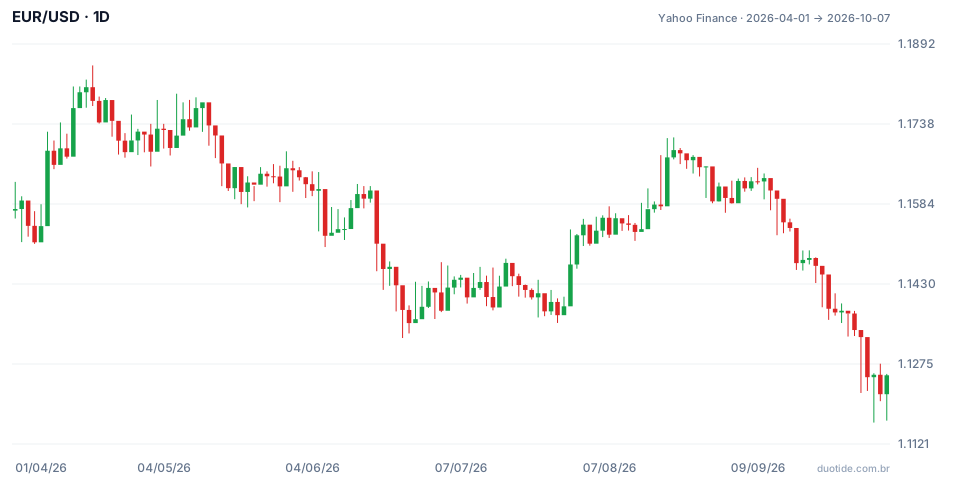
Between 04/01/2026 and 10/07/2026 EUR/USD fell from 1.15742 to 1.12535. Over that span there were 135 daily closing moves: 62 up days and 73 down days. Let's imagine three traders who each place one R$ 100 binary a day, expiring at the next close, with an 80% return.
The One Who Always Bet on Up
This trader won 62 times and lost 73: 62 × R$ 80 = R$ 4,960 in gains and 73 × R$ 100 = R$ 7,300 in losses. A loss of R$ 2,340. Along the way, they lost five days in a row, the period's longest losing streak.
The One Who Always Bet on Down
This trader was on the side of the trend and won 73 of 135, or 54.1% of the time. More than half, and even so: 73 × R$ 80 = R$ 5,840 in gains against 62 × R$ 100 = R$ 6,200 in losses. A loss of R$ 360. To break even at an 80% return, they'd need a 55.6% win rate, that is, 75 wins out of 135 (75 × R$ 80 = R$ 6,000, matching the 60 losses of R$ 100).
The Size of the Move Doesn't Count
The median daily move over the period was 21.1 pips, and on 16 of the 135 days the pair moved less than 5 pips between one close and the next. On those days, a binary's result was decided by a tiny difference, practically noise. A regular trade would have won or lost a little; the binary wins or loses everything.
The test uses daily expiration. On second- or minute-long expirations, noise weighs even more, and winning above the break-even rate gets harder. These numbers describe what happened in this period and don't indicate what will happen.

How to Evaluate a Binary Option Before Trading
Start With the Offered Return
Before looking at the chart, calculate the break-even rate using that asset's and that expiration's return. If you have no evidence you can win above it, the trade has a negative expectancy.
Measure Your Real Win Rate
Log at least 50 trades, including the losing ones, before concluding anything. A handful of trades fit well within chance.
Set a Session Limit
Since each contract can lose 100% of the amount staked, set in advance how much you're willing to lose in a day, and stop once you reach it.
Limitations
No analysis changes the payout asymmetry. Short expirations bring the result closer to a coin flip, and the return can vary by asset and time of day. In several countries, including for retail audiences, the product carries regulatory restrictions; check the rules that apply to you.
Common Mistakes With Binary Options
- Thinking that winning more than half the time is enough, without calculating the break-even rate.
- Doubling the stake after a loss to recover, which speeds up the damage during bad streaks.
- Trading second-long expirations, where the result is almost entirely noise.
- Judging the strategy by a handful of winning trades.
- Treating the product as an investment or a source of income.
Before putting in money, use a demo account to log every trade in a spreadsheet with asset, time, offered return, and result. After a few dozen, compare your win rate with the break-even rate. If the number doesn't add up, the problem isn't the next trade, it's the math.
Practice before you risk. Open your Duotide account and test your ideas on the demo account with US$10,000 in virtual funds.
Create free accountUpdated:
Editorial character of the Duotide newsroom. Articles are written by the team with the help of artificial intelligence; prices and charts come from real market data. Explains charts, indicators and trading strategies: how they work, where they fail and how to test them first.
Was this article helpful?
Be the first to rate it.
Comments
- No comments yet. Be the first to comment.
Ready to put it into practice?
Open your account and practice on the demo account with US$10,000 in virtual funds, without risking money.
- Secure platformProtected login and identity verification
- Multilingual supportHelp available every day
- Free demo accountUS$10,000 virtual to practice
Trading involves the risk of losing the capital invested.
