

 Português pt
 Español es
 العربية ar
 বাংলা bn
 Deutsch de
 Filipino fil
 Français fr
 हिन्दी hi
 Bahasa Indonesia id
 Italiano it
 Русский ru
 Svenska sv
 ไทย th
 Türkçe tr
 Tiếng Việt vi
 简体中文 zh
Updated:
OptionsWhat Exotic Options Are and How They Work
 Naomi TanakaEditorial character · Analysis Desk

Quick answer
Exotic options are options with payout rules different from traditional options: the result can depend on the price touching a barrier, on the average price over the period, on the high reached, or on an all-or-nothing condition. With the same asset, the same strike, and the same expiration, two options can pay very different amounts just because of these rules, which is why you need to understand the whole contract before trading.
After understanding the traditional option, the call or the put with a strike price and an expiration date, it's common to run into names like knock-out, Asian, or lookback. These are exotic options, almost always traded over the counter, designed for specific hedging or speculation needs.
The best way to understand the difference is to see each type's payout on the same price path. We used gold's real daily quotes (the futures contract on the Comex) between 04/01/2026 and 10/07/2026 and calculated how much each hypothetical contract would have paid, per ounce.
What Exotic Options Are
The traditional option, called vanilla, only looks at the price at expiration: the put pays strike − final price, if positive; the call pays final price − strike, if positive. The exotic adds conditions about the price's path or changes the shape of the payout. The most common ones:
- Barrier: the option comes into existence (knock-in) or ceases to exist (knock-out) if the price touches a defined level.
- Asian: the payout uses the average of the observed prices, not just the final price.
- Lookback: the payout uses the period's high or low.
- Digital: pays a fixed amount if a condition is met, and nothing if it isn't.

Real Example: Six Contracts on the Same Gold
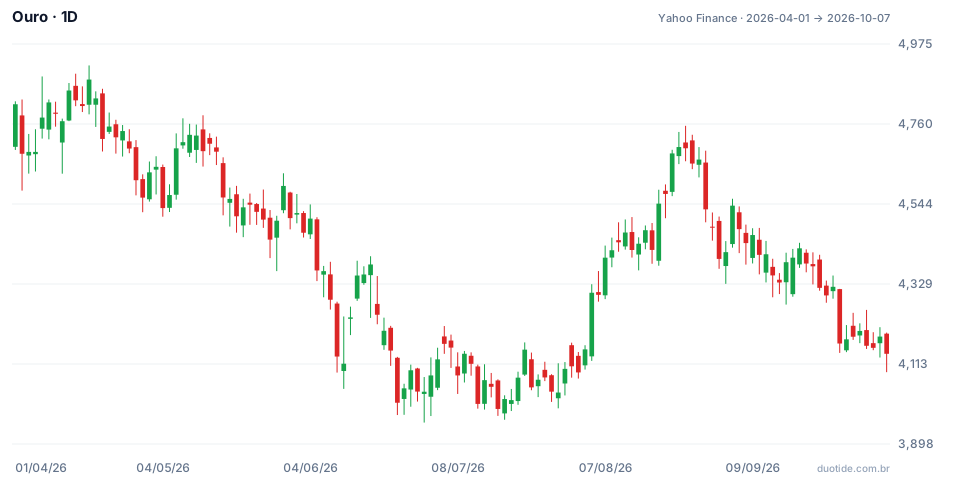
Gold opened the window at $4,813.10 on 04/01/2026, hit an intraday high of $4,917.70 on 04/17, a low of $3,955.40 on 06/30, and closed 10/07 at $4,140.70, down 14.0%. All the contracts below are hypothetical, starting on 04/01 and expiring on 10/07.
Traditional Put, Strike $4,800
Pays 4,800 − 4,140.70 = $659.30 per ounce. It's the reference point for comparing the others.
Put With a Knock-Out Barrier at $4,900
Same strike, but the option stops existing if gold touches $4,900. The barrier sat only 1.8% above the starting price. On 04/17 the day's high reached $4,917.70, even though the close was $4,879.60. In a contract that watches the price continuously, the intraday touch is enough: the option died in April and paid zero, while the traditional put paid $659.30. The drop it was supposed to protect against happened later.
Put With a Knock-In Barrier at $4,000
Here the option only comes into existence if gold touches $4,000. The 06/24 low was $3,975.70, the barrier was hit, and the option paid the same $659.30 as the traditional one. If the bottom had stopped at $4,010, it would have paid zero. Barrier options usually cost less than traditional ones precisely because they can end up worthless over details like these.
Asian Put, Strike $4,800
This uses the average of the period's 131 daily closes, which was $4,405.45. It pays 4,800 − 4,405.45 = $394.55, less than the traditional one, because the average includes the months when gold was still high. The average smooths out gains and losses and reduces the effect of a single price near expiration.
Floating-Strike Lookback Put
Pays the difference between the period's highest close and the final close: 4,879.60 (04/17) − 4,140.70 = $738.90, the biggest payout on the list. It's like selling at the top in retrospect, which is why it's usually the most expensive to buy.
Put Digital at $4,500
Pays a fixed amount, say $100, if gold ends below $4,500. Since it closed at $4,140.70, it paid the $100. It would have paid the same if gold had closed at $4,499 or at $3,000.
Six contracts, the same asset, the same period: payouts ranging from zero to $738.90. These numbers describe the path gold took over this interval and don't indicate what will happen over another.
What the Example Teaches
The knock-out put and the knock-in put had the same strike and the same expiration as the traditional one, and one paid zero while the other paid out in full. The entire difference lay in the path: one intraday touch in April and another at the end of June. That's why, when evaluating an exotic, having an opinion about where the price will end up isn't enough; you need an opinion about where it will pass through on the way there, which is much harder.
How to Evaluate an Exotic Option
Read the Observation Rule
On a barrier, does the contract watch the price continuously, only at the close, or on specific dates? In the example, that decided between zero and $659.30.
Compare With the Equivalent Vanilla
Ask how much the traditional option with the same strike and term would cost. If the exotic is cheaper, find out in which scenarios it stops paying.
Check the Liquidity
Many exotics are traded over the counter, with a single counterparty. Exiting before expiration can be difficult or expensive.
Limitations
Pricing depends on volatility and path models that are more complex than traditional options', making it hard for a non-specialist to judge whether the price is fair. The example ignores each contract's cost, which changes the net result significantly.

Common Mistakes With Exotic Options
- Treating a barrier option as if it were just a cheaper traditional option.
- Not checking whether an intraday touch counts for the barrier.
- Comparing only the size of the payout and ignoring the probability of it happening.
- Buying an over-the-counter contract without knowing how, and at what price, you can exit early.
- Assuming the price's past path will repeat.
To practice, choose an asset in a demo account, set a strike, a barrier, and an expiration on paper, and follow the price up to that date, noting what each option type would have paid. Repeating the exercise over a few periods shows, better than any definition, how the rules change the result.
Practice before you risk. Open your Duotide account and test your ideas on the demo account with US$10,000 in virtual funds.
Create free accountUpdated:
Editorial character of the Duotide newsroom. Articles are written by the team with the help of artificial intelligence; prices and charts come from real market data. Explains charts, indicators and trading strategies: how they work, where they fail and how to test them first.
Was this article helpful?
Be the first to rate it.
Comments
- No comments yet. Be the first to comment.
Ready to put it into practice?
Open your account and practice on the demo account with US$10,000 in virtual funds, without risking money.
- Secure platformProtected login and identity verification
- Multilingual supportHelp available every day
- Free demo accountUS$10,000 virtual to practice
Trading involves the risk of losing the capital invested.
