

 Português pt
 Español es
 العربية ar
 বাংলা bn
 Deutsch de
 Filipino fil
 Français fr
 हिन्दी hi
 Bahasa Indonesia id
 Italiano it
 Русский ru
 Svenska sv
 ไทย th
 Türkçe tr
 Tiếng Việt vi
 简体中文 zh
Updated:
BeginnersWhat Is a Stop-Limit Order and How It Differs From a Stop
 Marina CostaEditorial character · Beginner's Guide
Quick answer
A stop-limit order is an order with two prices: the stop, which triggers the order when the market reaches it, and the limit, the worst price accepted for execution. Unlike a plain stop, which executes at any price once triggered, the stop-limit controls the price, but may not execute if the market jumps past the limit, for example in an opening gap.
The order screen on any platform shows several order types with similar names, and the stop-limit is one of the most confusing. It combines two ideas into one: a price that triggers the order and a limit price for its execution. Most of the time, it works as expected. The problem shows up exactly on the days when protection is needed most.
In this guide we explain how the order works and show, with two real Tesla stock gaps (TSLA, daily Yahoo Finance data) in 2026, what would have happened with a stop-limit versus a market stop.
What a Stop-Limit Order Is
A stop-limit order has two prices:
- Stop price (trigger): when the market reaches it, the order is activated.
- Limit price: once activated, the order becomes a limit order, which only executes at that price or better. On a sell, the limit is the minimum price accepted; on a buy, the maximum.
A plain stop order, also called a market stop, has only the trigger. Once activated, it becomes a market order, which executes at the best available price, whatever that is.
The trade-off is straightforward: the stop-limit controls the price but may not execute; the market stop guarantees execution but not the price.

How It Works in Practice
A typical stop-limit sell protects a long position. Suppose you bought a stock at $100 and set the stop at $95 and the limit at $94. If the price falls to $95, the platform sends a sell order limited at $94. If there are buyers between $95 and $94, you get out. If the price jumps straight from $96 to $92, the order is triggered, but it sits in the book waiting for a price of $94 or more, and you stay in the position.
There's also the stop-limit buy, used to enter on breakouts: a stop above resistance and a limit a bit above the stop, so you don't overpay if the price spikes.
Real Example: Two Tesla Gaps in 2026
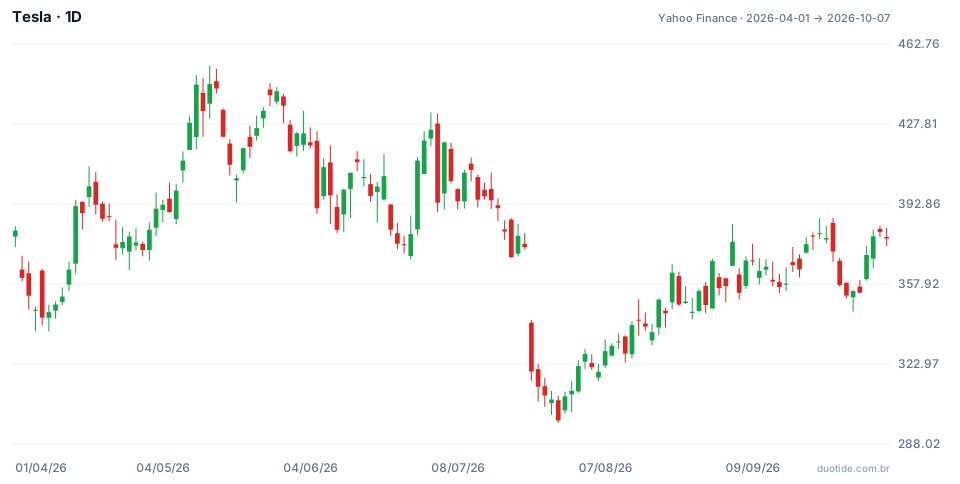
Between 04/01 ($381.26) and 10/07 ($377.81) Tesla's stock ended up practically flat, with a −0.9% change. Along the way, it ranged from $453.40 (05/13 high) to $297.38 (07/29 low). Two days in this period show the difference between order types well.
July 23: the Gap That Jumped Past the Limit
On 07/22 TSLA closed at $374.01. Imagine someone long at that price, with a stop-limit sell with a stop at $360 and a limit at $355, meaning they accepted losing up to $14.01 per share at the trigger. The next day, the stock opened at $341.00, 8.83% below the previous close. The day's high was $342.11 and the close, $319.69.
- Stop-limit: the stop triggered at the open, but the price never came back to $355. The order didn't execute. By the day's close, the loss stood at $54.32 per share (−14.5%), almost four times what was planned. On 07/29 the stock reached $297.38.
- Market stop: would have executed near the open, around $341.00, with a loss of about $33.01 per share. Worse than planned, but with the position closed out.
With 100 shares, the difference by the end of the day would be about $2,131 between the two orders.
September 4: When the Stop-Limit Executes
On 09/03 TSLA closed at $376.37. On 09/04 it opened at $362.07, reached $351.32, and closed at $354.08. A stop-limit sell with a stop at $365 and a limit at $360 would have triggered at the open and, since the opening price was above the limit, executed around $362.07. Here the limit did its job of avoiding a sale far below expectations.
There's a detail that applies to any stop: in the next session, 09/08, the stock closed at $368.16, above the exit price. Protection isn't prediction; it limits the loss in the bad scenario, and sometimes it gets you out right before a recovery.

How to Use the Stop-Limit Order
Distance Between Stop and Limit
The closer the limit is to the stop, the more you control the price and the greater the risk of not executing. In the July example, a limit at $340 would have executed near the $341.00 open; the one at $355 didn't execute. A practical reference is the asset's volatility: on 07/22 Tesla's 14-day ATR was $16.06, and the example's stop was less than one ATR from the price.
When It Makes the Most Sense
On very liquid assets, during hours with good volume, and for breakout entries, where overpaying is the bigger risk. For entries, not executing only costs you a missed opportunity.
When It's Risky
As protection on a position in assets that tend to open with a gap, like stocks around earnings season, and ahead of major news. For Tesla, between April and October, 53 of the 131 sessions opened more than 1% away from the previous close.
Limitations
No order eliminates gap risk. The market stop gets you out, but it may get you out much worse; the stop-limit may simply not get you out at all. On top of that, every platform has its own rules for how long an order stays valid and when it can trigger, and it's worth reading those rules before relying on the protection.
Common Mistakes With the Stop-Limit Order
- Thinking the stop-limit guarantees an exit: it guarantees the price, not the execution.
- Setting the limit right next to the stop on volatile assets.
- Forgetting about a triggered but unfilled order sitting in the book, with the position still open.
- Using the same distance between stop and limit on any asset and in any volatility phase.
- Forgetting that the examples above describe what happened, not what will happen.
To practice without risking money, use a demo account and place both order types on the same asset, with the same stop. Log, over a few weeks, how many times each one executed, at what price, and what the price did afterward. It's the cheapest way to find out which one fits your style.
Practice before you risk. Open your Duotide account and test your ideas on the demo account with US$10,000 in virtual funds.
Create free accountUpdated:
Editorial character of the Duotide newsroom. Articles are written by the team with the help of artificial intelligence; prices and charts come from real market data. Answers the first questions of those just starting out: account, platform, basic concepts and common mistakes.
Was this article helpful?
Be the first to rate it.
Comments
- No comments yet. Be the first to comment.
Ready to put it into practice?
Open your account and practice on the demo account with US$10,000 in virtual funds, without risking money.
- Secure platformProtected login and identity verification
- Multilingual supportHelp available every day
- Free demo accountUS$10,000 virtual to practice
Trading involves the risk of losing the capital invested.
