

 Português pt
 Español es
 العربية ar
 বাংলা bn
 Deutsch de
 Filipino fil
 Français fr
 हिन्दी hi
 Bahasa Indonesia id
 Italiano it
 Русский ru
 Svenska sv
 ไทย th
 Türkçe tr
 Tiếng Việt vi
 简体中文 zh
Updated:
BeginnersWhat Is Day Trading and Who It's For
 Marina CostaEditorial character · Beginner's Guide
Quick answer
Day trading is a trade opened and closed within the same session, with no position carried to the next day. It eliminates overnight gap risk, but it demands screen time, a defined risk before every entry, and control over costs. It suits people with real availability during market hours; for those who don't have it, swing trading or investing tend to fit better.
Many people come to day trading drawn by the idea of a fast result. The core idea is simple to understand, but the routine and the mental demands behind it tend to be underestimated. Speed of results also means speed of losses.
To show the real size of the moves a day trader deals with, we used the Ibovespa's real daily quotes (Yahoo Finance data) between April and October 2026 and the ATR, an indicator that measures each session's average range.
What Day Trading Is
Day trading is any trade opened and closed within the same session. The trader never carries a position to the next day, no matter what happens.
Day Trading, Swing Trading, and Investing
- Long-term investing: the position lasts months or years and seeks the growth of a business or an economy.
- Swing trading: the position lasts from a few days to a few weeks and seeks a move within a bigger trend.
- Day trading: everything happens in minutes or hours, and the position is closed out before the close.
Why Closing Out the Same Day Changes Everything
Closing everything out before the close eliminates gap risk, when the price opens the next day quite different from the previous close because of overnight news. In exchange, the day trader gives up any move that takes more than one day to play out, and has to find the opportunity, and exit it, within a short window.

How Much the Market Moves in a Day: the Math
In Brazil, one of the most used instruments for day trading is the mini-index futures contract, which tracks the Ibovespa. Each point of movement is worth R$ 0.20 per contract. With that, you can translate the index's move into money:
- Result per contract = points moved × R$ 0.20.
- On 10/07/2026 the Ibovespa's 14-day ATR was 4,031 points. A typical day's move: 4,031 × 0.20 = R$ 806.20 per contract.
- On 07/21/2026 the ATR was at the period's lowest level, 2,194 points: 2,194 × 0.20 = R$ 438.80 per contract.
The same single-contract position carried almost double the daily risk in October compared with July. Anyone who always keeps the same size ignores this difference.
Real Example: the Ibovespa in 2026
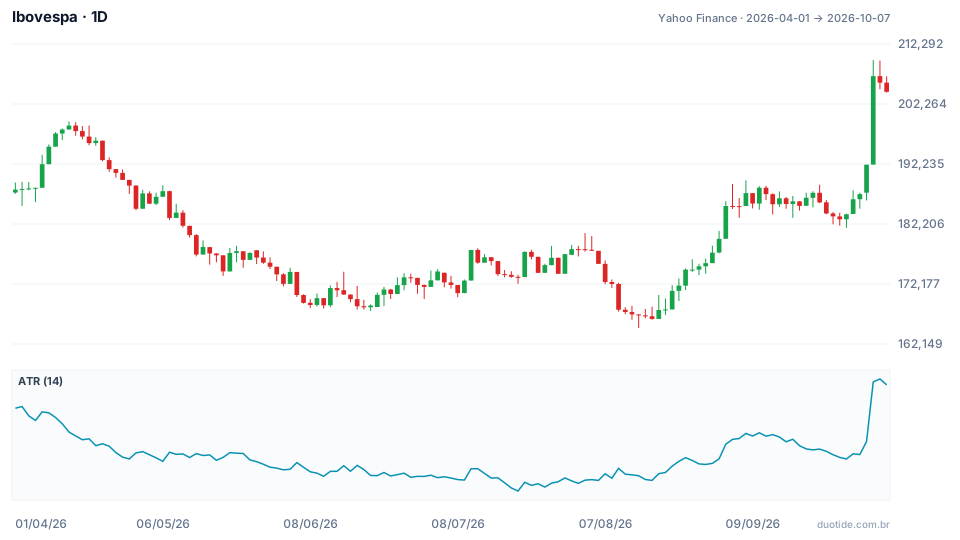
The chart shows the Ibovespa, which went from 187,953 points on 04/01 to 204,302 on 10/07, with the 14-day ATR below it. Three sessions show the variety of days a day trader faces:
July 21: the Calm Day
Between the low and the high, the index moved only 1,501 points, about R$ 300 per mini-index contract. On a day like this, opportunities are small and each trade's costs weigh proportionally more.
September 2: the Trend Day
The index opened at 179,734 points, climbed to 186,028, and closed at 185,205. That's a range of 6,294 points, 3.5% in a single session. Anyone trading against the day's direction, trying to guess the top, piled up losses several times throughout the afternoon.
October 5: the Outlier Day
In the first session after the 10/04 first-round election, the index went from 192,138 to 209,606 points and closed at 206,912, up 7.7% from the previous close. The 17,468-point range equals R$ 3,493.60 per contract, more than six times the period's average range (2,780 points). The ATR jumped and reached 4,134 on 10/06, the window's highest value. A day trader short without a stop that day could have lost, on a single contract, the equivalent of several months of small gains.
What Day Trading Really Demands
Screen Time
Watching the market throughout trading hours, with decisions made in minutes. Anyone with another job during the same hours will struggle to do this well.
Risk Defined Before Entering
An example with the numbers above: in a R$ 5,000 account, risking 1% per trade means losing at most R$ 50. With one mini-index contract, that gives a 250-point stop, about 6% of October's ATR. A stop that's too tight gets hit by noise; a wider stop requires a smaller position or a bigger account.
Costs and Taxes
Every entry and exit pays costs. If each trade costs R$ 2 and you make 15 a day, that's R$ 30 before any result, or R$ 600 over 20 sessions. In Brazil, day-trading profit is taxed at 20%, with 1% withheld at the source.
Emotional Control
Deciding while the price moves on the screen demands more discipline than deciding with time to think. Without written rules, day trading turns into a string of reactions.
Who It Makes Sense For
For those with real time during trading hours, enough capital that costs don't eat up the result, and a willingness to review their own track record. For those without that time, swing trading or investing usually fit the routine better.
Limitations of the Math Above
The ATR is calculated on the spot index; the mini-index futures contract tracks it closely but can open with a difference from the previous close. And the numbers are from a specific period.
Common Mistakes Beginners Make in Day Trading
- Choosing the style for the promise of a fast result, without considering the fast loss.
- Trading without a stop because the position will be closed out at the end of the day anyway.
- Keeping the same position size on calm days and on days like 10/05.
- Ignoring costs and taxes when calculating the result.
- Increasing position size after a loss to make it back the same day.
- Forgetting that the examples above describe what happened, not what will happen.
Before deciding, simulate the routine in a demo account: set aside trading hours for a few weeks, define the risk of each trade before entering, and log every one of them, with costs included. If you can't keep your attention and your rules without hurting your other responsibilities, the problem isn't the method, it's the style.
Practice before you risk. Open your Duotide account and test your ideas on the demo account with US$10,000 in virtual funds.
Create free accountUpdated:
Editorial character of the Duotide newsroom. Articles are written by the team with the help of artificial intelligence; prices and charts come from real market data. Answers the first questions of those just starting out: account, platform, basic concepts and common mistakes.
Was this article helpful?
Be the first to rate it.
Comments
- No comments yet. Be the first to comment.
Ready to put it into practice?
Open your account and practice on the demo account with US$10,000 in virtual funds, without risking money.
- Secure platformProtected login and identity verification
- Multilingual supportHelp available every day
- Free demo accountUS$10,000 virtual to practice
Trading involves the risk of losing the capital invested.
