

 Português pt
 Español es
 العربية ar
 বাংলা bn
 Deutsch de
 Filipino fil
 Français fr
 हिन्दी hi
 Bahasa Indonesia id
 Italiano it
 Русский ru
 Svenska sv
 ไทย th
 Türkçe tr
 Tiếng Việt vi
 简体中文 zh
Updated:
MarketsWhat Is Pre-Market Trading and How It Works
 Rafael AzevedoEditorial character · Markets Desk

Quick answer
Pre-market is electronic trading in US stocks before the official open, generally from 4 a.m. to 9:30 a.m. New York time. With few participants, spreads are wide and a large order can move the price easily. That's why the pre-market move works as a gauge of the reaction to news, not as the market's final verdict.
You've probably seen a stock jump 5% or 6% hours before the market opens. This move happens in a window called pre-market, a trading period before the regular session that tends to confuse people just starting to follow the US stock market.
In this guide we explain how this window works and show, with Nvidia's real daily quotes (NVDA, Yahoo Finance data) between April and October 2026, what happened in the regular session after gap openings, which is where the pre-market move shows up on the daily chart.
What Pre-Market Is
Pre-market is the electronic trading that happens before the official open of US exchanges, generally between 4 a.m. and 9:30 a.m. New York time. There's also the after-market, after the 4 p.m. close.
The difference isn't just about the clock. During this window there are few active participants, and each order carries proportionally more weight on the price.
Why the Price Behaves Differently
- There are far fewer people trading, so a large order moves the price more forcefully.
- Spreads tend to be wider, which makes entering and exiting more expensive.
- Orders may be only partially filled, or not filled at all.
- Many platforms only accept limit orders outside regular hours.
- Liquidity tends to grow as the open approaches.
What Usually Moves the Pre-Market
The strongest moves come from events outside the trading session: quarterly earnings released after the close or before the open, economic data like inflation and employment, which in the US usually come out at 8:30 a.m. New York time, corporate news, and decisions from other countries' central banks.

How to Calculate the Opening Gap
The daily chart doesn't show the pre-market, but it shows its result: the difference between the previous day's close and the regular session's open, which comes out of the opening auction after all the early trading. The calculation is:
- Gap (%) = (open ÷ previous close − 1) × 100
- Example with Nvidia on 08/27/2026: 08/26 close at $209.66 and open at $222.86.
- 222.86 ÷ 209.66 = 1.0630 → a gap of +6.3%.
Real Example: Four Nvidia Gaps in 2026
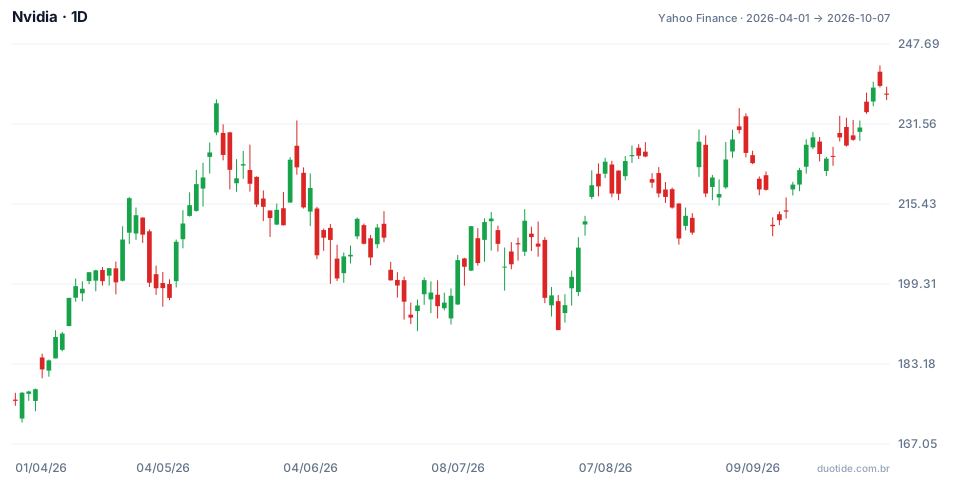
Between 04/01 ($175.75) and 10/07 ($237.47), Nvidia's stock rose 35.1%, with a low of $171.37 on 04/02 and a high of $243.37 on 10/06. On 55 of the 131 sessions, the open sat more than 1% away from the previous close. Four of those days show that pre-market doesn't decide the day:
August 27: the Gap That Kept Going
An open at $222.86, 6.3% above the previous close. The regular session went further: a high of $230.47 and a close at $227.98, up 8.7% on the day, with 298.9 million shares traded, the period's highest volume.
April 8: the Gap That Lost Steam
A 04/07 close at $178.10 and an open at $184.50, a +3.6% gap. The stock closed at $182.08: still up 2.2%, but below the open. Anyone buying at the open, riding the pre-market momentum, would have ended the day at a loss.
April 28: the Downside Gap That Was Partly Recovered
A 04/27 close at $216.61 and an open at $209.49, a −3.3% gap. The close came in at $213.17, down 1.6%: half of the gap was recovered during the session.
September 14: the Monday Gap
Nvidia closed Friday, 09/11, at $218.29 and opened Monday at $211.24, a −3.2% gap. The day ended at $210.96, down 3.4%. Here the opening price held almost exactly through the end of the session.
The four cases have similarly sized gaps and different outcomes: in one, the regular session extended the move; in another, it gave back part of it; in the other two, it recovered half or held the opening price. Pre-market anticipated the direction of the open, but it didn't say where the day would end. These cases describe what happened, not what will happen.

How to Use the Pre-Market
As a Source of Information
More experienced traders use the pre-market to gauge the initial reaction to a piece of news and prepare for the open, more than to trade large positions.
Watch the Volume
A move with little volume behind it carries less weight than one with meaningful volume. Compare it with what happens in the first minutes of the regular session, when liquidity really picks up.
Be Wary of Extremes
The bigger the move before the open, the greater the chance it's distorted by low liquidity, as 04/08 showed.
Limitations
Access to pre-market and the hours available vary by platform and account type. The daily data used here shows the official open, not minute-by-minute pre-market quotes, and it doesn't identify the cause of each gap.
Common Mistakes in Pre-Market
- Treating the pre-market price as the day's final price.
- Using a market order with a wide spread and little liquidity.
- Buying at the open just because the stock rose beforehand.
- Ignoring the volume behind the move.
- Forgetting the time zone difference and US daylight saving time.
- Forgetting that the examples above describe what happened, not what will happen.
To practice without risking money, follow a few stocks with opening gaps in a demo account and note, over a few weeks, the gap's size, the volume, and where the price closed. Your own record will show how often the anticipated move actually held.
Practice before you risk. Open your Duotide account and test your ideas on the demo account with US$10,000 in virtual funds.
Create free accountUpdated:
Editorial character of the Duotide newsroom. Articles are written by the team with the help of artificial intelligence; prices and charts come from real market data. Follows the news that moves prices — rates, stock markets, companies and commodities — explained without jargon.
Was this article helpful?
Be the first to rate it.
Comments
- No comments yet. Be the first to comment.
Ready to put it into practice?
Open your account and practice on the demo account with US$10,000 in virtual funds, without risking money.
- Secure platformProtected login and identity verification
- Multilingual supportHelp available every day
- Free demo accountUS$10,000 virtual to practice
Trading involves the risk of losing the capital invested.
