

 Português pt
 Español es
 العربية ar
 বাংলা bn
 Deutsch de
 Filipino fil
 Français fr
 हिन्दी hi
 Bahasa Indonesia id
 Italiano it
 Русский ru
 Svenska sv
 ไทย th
 Türkçe tr
 Tiếng Việt vi
 简体中文 zh
Updated:
StocksAI stocks: 5 categories to organize your watchlist
 Rafael AzevedoEditorial character · Markets Desk

Quick answer
AI stocks don't form a single sector: they can be organized into five categories, which are chips, cloud and infrastructure, energy and cooling for data centers, software with embedded AI, and emerging applications, such as robotics. Each category carries different risks, and splitting the list by them helps avoid concentrating everything in the same factor. This isn't investment advice.
Talking about artificial intelligence stocks gives the impression that there's a single sector, but the label lumps together very different businesses. A company that makes chips has exposure to AI very different from one that supplies power to data centers, and both are different from a software company that simply added AI features to a product that already existed.
A useful way to organize your watchlist is to think in categories within the AI value chain. This article presents five of them and uses Nvidia's real quotes from 2026 to show how much a stock tied to the theme can swing. Nothing here is a recommendation to buy or sell any asset.
What AI stocks are
These are stocks of companies whose revenue depends, to a meaningful degree, on the development or use of AI. How much that dependence weighs varies a lot: for some, AI is the main sales driver; for others, it's a complement to an older business. Splitting them by category helps you understand where the exposure comes from and what kind of news each company reacts to.

The 5 categories
1. Processing: who makes the computing power
Companies that develop the chips and accelerators used to train and run AI models. It's the category most directly tied to demand for computing power, and also the most concentrated, with a few suppliers serving most of the market. Nvidia, used in the chart below, belongs to this group.
2. Cloud and data infrastructure
Large providers that rent out processing capacity to companies and developers. They run data centers at a global scale and invest heavily in new capacity to meet AI demand.
3. Energy and cooling for data centers
Training and running models consumes a lot of energy and generates a lot of heat. This category includes suppliers of power systems, cooling, and physical infrastructure. It's a less visible business than chips, but nothing works without it.
4. Software and applications with embedded AI
Companies with already established software products that started incorporating automation, content generation, or predictive analysis. Their AI exposure tends to be more indirect, reinforcing a business that already existed.
5. Emerging applications: robotics and autonomous vehicles
Companies that bring AI into physical products. It tends to be the category with the highest risk and volatility, because it depends on technological progress, regulatory approvals, and market adoption, any of which can take longer than expected.
Real example: how much an AI stock swung in 2026
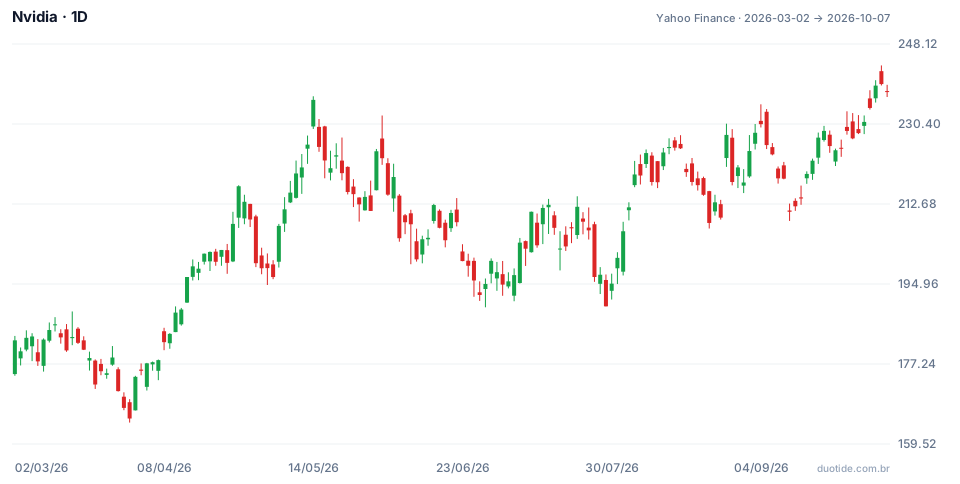
The chart shows Nvidia's stock (NVDA) from March 2, 2026 to October 7, 2026. Over that period, it went from US$ 182.48 to US$ 237.47, a gain of 30.13%. The path, however, was not a straight line.
From low to high: 48%
The period's low was US$ 164.27, on March 30; the high was US$ 243.37, on October 6. The gap between the two is 48%, in just over six months.
A 19.4% drop along the way
On May 14 the stock closed at US$ 235.74. On July 29 it closed at US$ 190.01, 19.4% lower. Anyone who bought at the May 14 close had racked up a 19.4% loss two and a half months later, in a period that, looked at start to finish, ended higher.
Days of sharp moves
On August 27 the stock rose 8.7% in a single session, from US$ 209.66 to US$ 227.98. The next day it fell 4.6%, to US$ 217.55. These numbers describe what happened in the period; they don't indicate what will happen next.

How to use the categories in practice
Classify before you track
For each company on your list, note which category it fits into and exactly what ties it to AI. Two stocks both called AI stocks can react in opposite ways to the same news, depending on whether they're close to the hardware, the infrastructure, or just a software layer.
Calculate the effect of concentration
A numerical example helps. Imagine US$ 10,000 invested in the theme. If it were all in a single stock that fell 19.4%, like Nvidia between May and July, the loss would be US$ 1,940. If the amount were split into five parts of US$ 2,000, one per category, and only the chips part fell 19.4%, the loss would be US$ 388, or 3.9% of the total. Diversification doesn't prevent drops: if all five fall together, the effect becomes large again. It reduces dependence on a single factor, such as chip demand.
Accept that the lines are blurry
The same company can fall into two categories, making hardware and running its own cloud, for example. The goal isn't to fit each one into a perfect box, but to understand where the AI-related revenue comes from.
Limitations
Stocks tied to the same theme tend to fall together when market sentiment toward AI shifts, which reduces the benefit of diversification. Categories also say nothing about price: a good company can still be too expensive. Quarterly earnings and fundamentals remain indispensable.
Common mistakes when building an AI stock list
- Treating every stock tied to the theme as if it were the same bet.
- Concentrating everything in the category that rose the most recently.
- Looking only at the period's overall change and ignoring the drops along the way.
- Buying on the AI label without checking how much revenue actually comes from the theme.
- Thinking that diversifying across categories eliminates the risk of the whole sector falling.
To practice without risking money, build a demo-account list with one company from each category and follow it for a few weeks. Note each one's weekly change and how they reacted to the same news. That record shows, with your own numbers, how much the categories really differ.
Practice before you risk. Open your Duotide account and test your ideas on the demo account with US$10,000 in virtual funds.
Create free accountUpdated:
Editorial character of the Duotide newsroom. Articles are written by the team with the help of artificial intelligence; prices and charts come from real market data. Follows the news that moves prices — rates, stock markets, companies and commodities — explained without jargon.
Was this article helpful?
Be the first to rate it.
Comments
- No comments yet. Be the first to comment.
Ready to put it into practice?
Open your account and practice on the demo account with US$10,000 in virtual funds, without risking money.
- Secure platformProtected login and identity verification
- Multilingual supportHelp available every day
- Free demo accountUS$10,000 virtual to practice
Trading involves the risk of losing the capital invested.
