

 Português pt
 Español es
 العربية ar
 বাংলা bn
 Deutsch de
 Filipino fil
 Français fr
 हिन्दी hi
 Bahasa Indonesia id
 Italiano it
 Русский ru
 Svenska sv
 ไทย th
 Türkçe tr
 Tiếng Việt vi
 简体中文 zh
Updated:
Strategies5 Most Used Trading Strategies: Scalping, Day Trading, Swing
 Naomi TanakaEditorial character · Analysis Desk
Quick answer
The five most used trading strategies are scalping, day trading, swing trading, trend following and position trading. The main difference between them is the trade's timeframe, which ranges from seconds to months and determines screen time, the size of the move sought and the weight of costs. The best one is the one that fits your routine and your capital.
Anyone starting to study trading runs into a list of names that seem like different strategies, but that in practice differ mainly in one thing: how long the trade stays open. That timeframe determines how many hours of screen time you need, how far the price can move against you, and how much costs weigh on the result.
Instead of describing each style in the abstract, we used the S&P 500's real daily quotes (Yahoo Finance) between January and October 2026, along with the 50- and 200-day simple moving averages, to show what each strategy would have seen in the same market.
What sets the trading strategies apart
- Timeframe: from seconds (scalping) to months (position trading).
- Screen time: the shorter the timeframe, the more hours per day.
- Size of the move sought: cents in scalping, tens of a percent in position trading.
- Weight of costs: the more trades, the more spread and commissions.

Real example: the S&P 500 in 2026
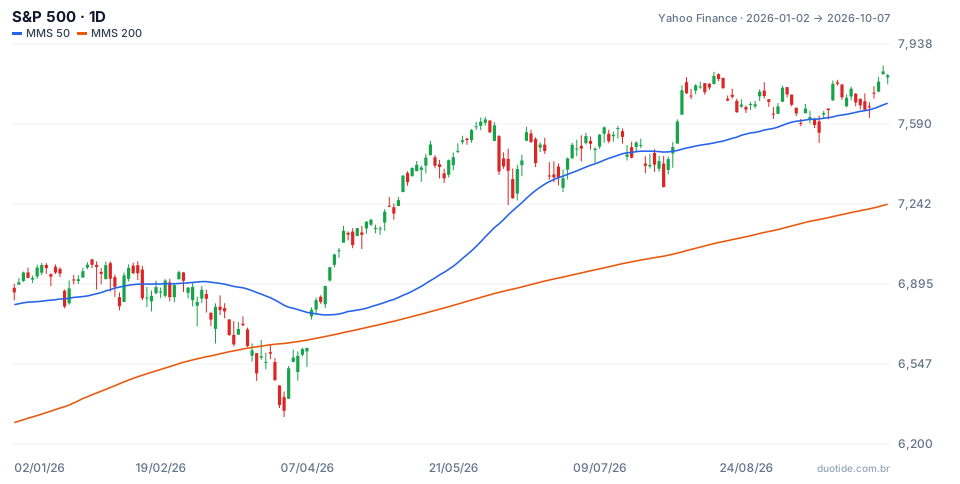
The index started the year closing at 6,858.47 points on January 2 and reached 7,801.77 on October 7, up 13.8%. Along the way there was a correction: from the close of 6,978.60 on January 27 to 6,343.72 on March 30, a drop of 9.1%. On March 19 the index closed below its 200-day average (6,606.49 versus 6,619.05) and only climbed back above it on April 8 (6,782.81 versus 6,655.00). The 50-day average, however, never crossed below the 200-day in 2026. Each strategy reads this same chart in its own way.
The 5 most used strategies
1. Scalping
Seeks small gains across many trades lasting seconds to a few minutes, in highly liquid assets. The daily chart barely matters to the scalper; what matters is the spread, execution speed and continuous attention. It's the style where costs weigh the most, because the gain per trade is small.
2. Day trading
Opens and closes everything within the same day. In 2026, the average distance between the S&P 500's daily high and low was 0.96% of the opening price. That's the room the day trader has, on average, to set a stop and a target. They don't suffer from overnight gaps, but they need to watch most of the trading session.
3. Swing trading
Holds the position for days or weeks, aiming to capture one leg of a move. One example from the chart: between the close of March 30 (6,343.72) and the close of April 17 (7,126.06), the index rose 12.3% in less than three weeks. The swing trader needs fewer hours of screen time, but has to withstand swings against the position and the risk of gaps between sessions.
4. Trend following
Trades only in the direction of the trend, without trying to predict tops and bottoms. A classic rule: long while the 50-day average is above the 200-day, and out of the market when it crosses below. In 2026 this rule stayed long the entire year, including through the 9.1% drop. In 2025 it showed the cost of the delay: the 50-day average crossed below the 200-day on April 14, 2025, with the index at 5,405.97, just a few days after the closing low of 4,982.77 on April 8, 2025. The rule only went long again on July 1, 2025, at 6,198.01, that is, 14.7% above the exit point.
5. Position trading
This is the longest timeframe: weeks to months, guided by the weekly chart and by economic factors. Someone who bought at the bullish crossover of July 1, 2025 (6,198.01) and held until October 7, 2026 (7,801.77) would have gained 25.9% on the index, riding through the 2026 correction without exiting. It demands little daily attention, but capital that can sit idle and the stomach for 10% drawdowns along the way.

How to choose between the strategies
By the time you have
Anyone working regular business hours can hardly pull off scalping or day trading well. Swing trading and trend following fit into a daily 20- to 30-minute review.
By capital
With little capital, many small costs weigh more. R$3,000 turned over in dozens of trades a day suffers from commissions and spread in a way that two or three swing trades a month don't.
By temperament
If seeing a position in the red for days keeps you up at night, long timeframes will push you to exit too early. If deciding in seconds makes you anxious, scalping isn't for you.
Limitations
No style is superior in every market. Trend following suffers in a sideways market, with signals that enter and exit losing a little each time; short-term strategies suffer from costs. The S&P 500 examples describe what happened in this period, not what's going to happen.
Common mistakes when choosing a strategy
- Jumping to a new style after every bad week, without giving any of them time to show results.
- Turning a losing day trade into a swing trade to avoid realizing the loss.
- Choosing scalping for the number of trades and ignoring the weight of costs.
- Expecting trend following to nail tops and bottoms: it always enters and exits late.
- Using the same stop size across strategies with different timeframes.
- Trading without a stop because the timeframe is long.
Choose one or two strategies that fit your routine and test them on a demo account for a few weeks, always with a stop defined before entry and small risk per trade. Log each trade with date, asset, reason and result; it's that record, not your impression, that will show which style fits you.
Practice before you risk. Open your Duotide account and test your ideas on the demo account with US$10,000 in virtual funds.
Create free accountUpdated:
Editorial character of the Duotide newsroom. Articles are written by the team with the help of artificial intelligence; prices and charts come from real market data. Explains charts, indicators and trading strategies: how they work, where they fail and how to test them first.
Was this article helpful?
Be the first to rate it.
Comments
- No comments yet. Be the first to comment.
Ready to put it into practice?
Open your account and practice on the demo account with US$10,000 in virtual funds, without risking money.
- Secure platformProtected login and identity verification
- Multilingual supportHelp available every day
- Free demo accountUS$10,000 virtual to practice
Trading involves the risk of losing the capital invested.
