

 Português pt
 Español es
 العربية ar
 বাংলা bn
 Deutsch de
 Filipino fil
 Français fr
 हिन्दी hi
 Bahasa Indonesia id
 Italiano it
 Русский ru
 Svenska sv
 ไทย th
 Türkçe tr
 Tiếng Việt vi
 简体中文 zh
Updated:
StocksAI Stocks to Watch in 2026: 7 Companies and Their Performance
 Rafael AzevedoEditorial character · Markets Desk

Quick answer
AI stocks are shares of companies whose revenue or growth outlook depends on AI, such as NVIDIA and AMD (chips), Alphabet and Amazon (cloud), Tesla (applied AI), IBM and Baidu. In 2026, through October 7, performance ranged from +201.6% (AMD) to -34.7% (Baidu). The shared label hides very different risks, and nothing here is a recommendation to buy.
Artificial intelligence stopped being the story of a single company and now spans very different businesses, from chipmakers to carmakers. Calling all of them "AI stocks" hides what actually matters: each one occupies a different spot in the chain and reacts to different news.
This guide introduces seven well-known companies, organized by their role in AI, and shows what each stock actually did in 2026, using daily quotes from Yahoo Finance through October 7, 2026. This information is educational and is not a recommendation to buy or sell.
What AI stocks are
These are stocks of companies whose revenue or growth expectations depend, to a significant degree, on AI. That includes providers of physical infrastructure (chips and data centers), companies that rent out computing capacity (cloud), companies applying AI within their own products, and companies selling AI solutions to other businesses. How much AI matters to the business varies a lot from one company to another.

Seven companies, four roles in the chain
Chips: NVIDIA and AMD
NVIDIA became known for supplying the graphics processors used to train AI models in data centers. AMD competes in the same market, with a historically smaller share. This type of company reacts sharply to news about data center demand, new chip generations and deals with major cloud providers. In 2026, through October 7, NVIDIA rose 27.3% and AMD rose 201.6%.
Cloud and search: Alphabet and Amazon
Alphabet and Amazon run some of the largest clouds in the world, renting out computing capacity for other companies to run AI models, and they build AI into search, assistants and product recommendations. Revenue is diversified, which can soften the impact of any single piece of AI news. In 2026, Alphabet rose 12.0% and Amazon rose 12.6%.
Applied AI: Tesla
Tesla uses AI outside of pure software, in autonomous driving and robotics. That kind of exposure depends on specific technical breakthroughs and regulatory approvals, and the stock tends to move more on long-term expectations than on the quarter at hand. In 2026, it fell 16.0%.
Corporate AI and China: IBM and Baidu
IBM applies AI to enterprise solutions, such as corporate cloud and healthcare. Baidu holds a leading position in China, with autonomous driving and AI-powered cloud, and it also responds to China's regulatory environment. In 2026, IBM fell 25.6% and Baidu fell 34.7%.
Practical example: what an equal-weighted portfolio showed in 2026
Suppose someone had put US$ 1,000 into each of the seven stocks at the 2025 close, US$ 7,000 in total. On October 7, 2026, based on actual closing prices, each slice would be worth:
- AMD: US$ 3,015.78 (from US$ 214.16 to US$ 645.86 per share)
- NVIDIA: US$ 1,273.30 (from US$ 186.50 to US$ 237.47)
- Amazon: US$ 1,126.07 (from US$ 230.82 to US$ 259.92)
- Alphabet: US$ 1,119.81 (from US$ 313.00 to US$ 350.50)
- Tesla: US$ 840.10 (from US$ 449.72 to US$ 377.81)
- IBM: US$ 744.44 (from US$ 296.21 to US$ 220.51)
- Baidu: US$ 652.84 (from US$ 130.66 to US$ 85.30)
The total would be US$ 8,772.34, up 25.3%. But almost all of the gain came from one stock: without AMD, the remaining US$ 6,000 would be worth US$ 5,756.56, down 4.1%. Three of the seven ended the period in the red. The "AI" label didn't guarantee similar results among them.
The risk was also different from what the hype suggests. IBM, often seen as the steadiest option in the group, had the biggest single-day drop among the seven: 25.2% on July 14, from US$ 290.23 to US$ 217.07. Baidu went on to accumulate a 48.1% drop from its January peak.

Real example: NVIDIA and the 50-day average in 2026
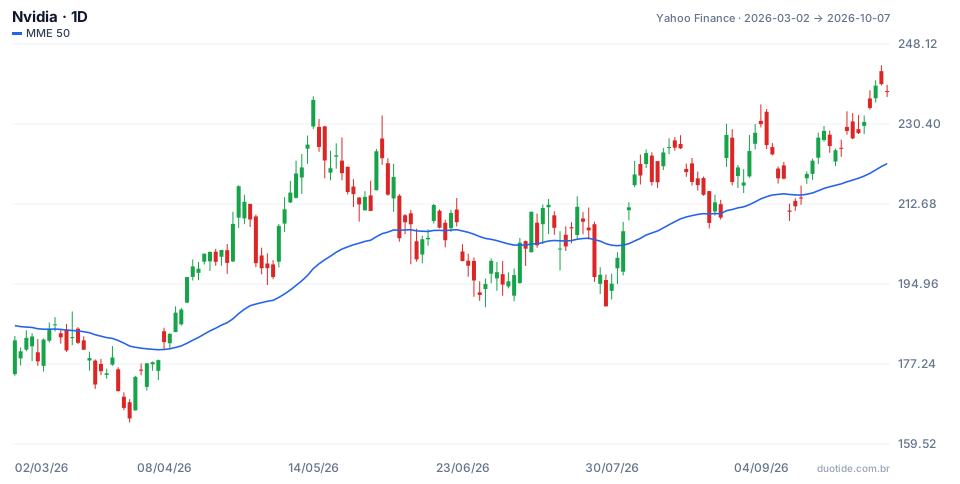
The chart shows NVIDIA's daily candles with the 50-day exponential moving average, from March to October 2026. Three stretches show how even the company most associated with AI swung around.
March and April: a bottom and a recovery
The stock closed below the average on March 12 and made the year's lowest close on March 30, at US$ 165.17. On April 8 it closed above the average again, at US$ 182.08, and ten sessions later it was at US$ 202.50, up 11.2%.
May to July: a 19% drop and plenty of false signals
From the May 14 close of US$ 235.74, NVIDIA pulled back to US$ 190.01 on July 29, a 19.4% drop. Between June 5 and August 3, the price crossed the 50-day average 16 times. During that stretch, the average stopped being any help for defining the trend.
August to October: a new rally
On August 27 the stock rose 8.7% in a single day, from US$ 209.66 to US$ 227.98. From September 17 onward it closed above the average every day, and on October 6 it marked the period's highest close, US$ 239.24. On October 7 it stood at US$ 237.47, 43.8% above the March bottom.
How to follow AI stocks
Know which part of the chain each company occupies
A drop in chip demand hits NVIDIA and AMD more directly than Alphabet or Amazon. A regulatory change in China may have no effect at all on an American company. Before following a stock, find out where its revenue actually comes from.
Watch earnings and customer spending
Big cloud companies' capital spending is the revenue of chip and infrastructure suppliers. Quarterly results and data center investment projections move the whole group.
Measure volatility before sizing a position
Stocks that rise 200% in a year can also fall 25% in a day. Size each position based on the stock's swings, not on enthusiasm for the theme.
Limitations
The numbers above describe what happened between the end of 2025 and October 7, 2026. Another period would produce a different ranking. Much of the optimism around AI may already be priced in, and interest rates, below-expectation earnings or a slowdown in data center investment hit this group harder than less expectation-driven sectors.
Common mistakes when investing in AI stocks
- Treating every "AI stock" as one block that rises and falls together: in 2026 the gap between the best and worst performer was more than 230 percentage points.
- Concentrating everything in chips and ending up exposed to a single kind of risk, the hardware investment cycle.
- Assuming a traditional company is the same as a stable stock, as IBM's 25.2% single-day drop showed.
- Picking a stock based on AI headlines while ignoring the rest of the business, which can weigh more on results.
- Using the same moving average as a fixed rule in every market phase, including sideways ones.
- Reading the 2026 numbers as a forecast: they show what happened, not what will happen.
To study the theme without risking money, build a demo-account watchlist with these seven stocks, note each one's role in the AI chain, and log how each stock reacted after every quarterly result. Within a few months it becomes clear that "AI stock" isn't a single category.
Practice before you risk. Open your Duotide account and test your ideas on the demo account with US$10,000 in virtual funds.
Create free accountUpdated:
Editorial character of the Duotide newsroom. Articles are written by the team with the help of artificial intelligence; prices and charts come from real market data. Follows the news that moves prices — rates, stock markets, companies and commodities — explained without jargon.
Was this article helpful?
Be the first to rate it.
Comments
- No comments yet. Be the first to comment.
Ready to put it into practice?
Open your account and practice on the demo account with US$10,000 in virtual funds, without risking money.
- Secure platformProtected login and identity verification
- Multilingual supportHelp available every day
- Free demo accountUS$10,000 virtual to practice
Trading involves the risk of losing the capital invested.
