

 Português pt
 Español es
 العربية ar
 বাংলা bn
 Deutsch de
 Filipino fil
 Français fr
 हिन्दी hi
 Bahasa Indonesia id
 Italiano it
 Русский ru
 Svenska sv
 ไทย th
 Türkçe tr
 Tiếng Việt vi
 简体中文 zh
Updated:
ForexBest Times to Trade Forex: Sessions and Overlaps in Brasília Time
 Naomi TanakaEditorial character · Analysis Desk

Quick answer
The best times to trade forex tend to be the ones with the most liquidity: the London session, from around 4am or 5am Brasília time, and especially the London-New York overlap, roughly 9am to 1pm. During that window, spreads tend to be narrower and pairs with the euro, pound, and dollar move more. The best time for you depends on the pair you choose and the day's news calendar.
The foreign exchange market runs 24 hours a day on business days, but that doesn't mean every hour is the same. Liquidity, spread, and the size of moves change as the major financial centers open and close. Picking the right window for the pair you trade improves the conditions of every trade before any analysis even comes into play.
In this guide you'll see the session times converted to Brasília time, why the overlap between London and New York concentrates the movement, and what real daily prices for EUR/USD, GBP/USD, and USD/JPY showed from April to October 2026.
What forex sessions are
A session is the period during which the banks and desks of a major financial center are active. There are four main ones. The times below are in Brasília time and shift by one hour when the United States, Europe, or Australia move into or out of daylight saving time, so always check your platform's clock:
- Sydney: roughly 6pm to 3am. Opens the week on Sunday night, with low volume.
- Tokyo: roughly 9pm to 6am. More liquidity for pairs with the yen, the Australian dollar, and the New Zealand dollar.
- London: roughly 4am to 1pm (5am to 2pm during European winter). It's the world's largest currency center, with heavy volume in the euro and the pound.
- New York: roughly 9am to 6pm (10am to 7pm during American winter). It concentrates volume in dollar pairs and receives most of the US economic data.
Why the London-New York overlap matters
Between New York's opening and London's close, roughly 9am to 1pm Brasília time for most of the year, the two biggest forex centers operate together. It's the window with the most participants, the narrowest spreads, and generally the cleanest moves in euro, pound, and dollar pairs. It's also the window when a lot of US data comes out, at 9:30am Brasília time for much of the year.
The Tokyo-London overlap, in the early morning hours in Brazil, is shorter and tends to move the yen and the euro crosses more. The stretch between New York's close and Tokyo's open, in the late afternoon and early evening in Brasília time, is the day's lowest-liquidity window.
Real example: how much EUR/USD moved per day in 2026
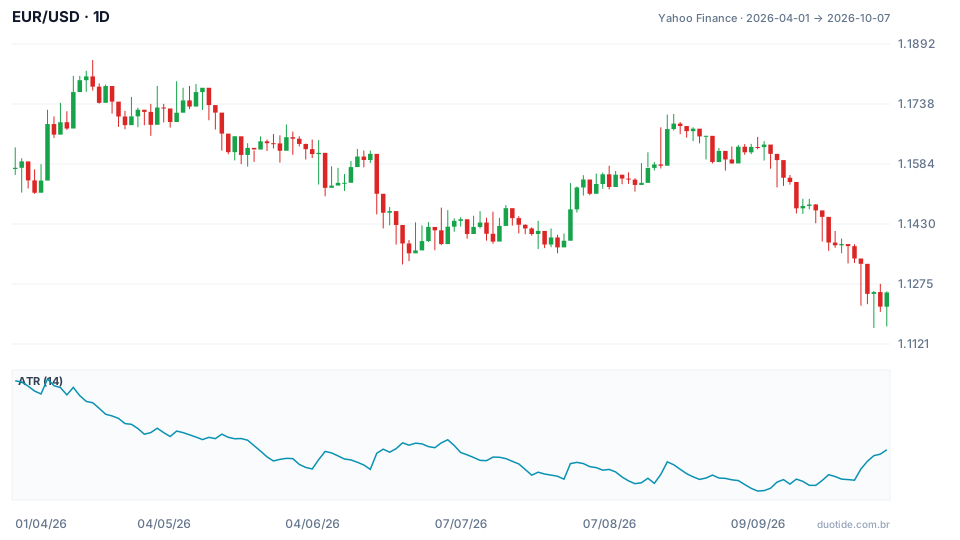
The chart shows the daily EUR/USD from April 1 to October 7, 2026 with the 14-period ATR, which measures each day's average swing. Over the period, the pair went from 1.1574 and ended at 1.1254, with a high of 1.1851 on April 17 and a low of 1.1162 on October 5. The data is daily, so it doesn't separate the sessions within the day, but it shows two things useful for anyone choosing a time window.
The range changes a lot from one period to another
The ATR reached 96.5 pips on April 8 and fell to 47.3 pips on September 9, less than half. On October 7 it was at 65.4 pips. The same time window can produce very different moves depending on the market's phase: April's London session isn't September's London session.
Some days of the week move more
Measuring the distance between each day's high and low over the period's 136 sessions, EUR/USD moved an average of 49.1 pips a day. On Thursdays the average was 56.5 pips; on Fridays, 53.0; on Tuesdays, only 42.7. On GBP/USD, the daily average was 62.6 pips, with 70.8 on Thursdays and 57.6 on Tuesdays. EUR/USD's widest-range days were October 1 (120 pips) and June 5 (114 pips); June 5 was the first Friday of June, the day the US jobs report usually comes out.
One extreme day skews the average
On USD/JPY, Thursday's average was 119.0 pips, against 60.6 on Tuesdays. But two days account for a big part of that: July 30, with 574 pips between high and low, and April 30, with 515. Without looking at the days one by one, someone would conclude Thursday is always the best day for the yen. The log needs to separate normal behavior from event days.

How to choose a time to trade forex
Start with the pair
Pairs with the euro, the pound, and the Swiss franc tend to gain volume once London opens. Pairs with the US dollar gain volume once New York opens. Pairs with the yen and the Australian dollar already see relevant activity in the Asian session. Trading EUR/USD at 8pm Brasília time means trading during the emptiest stretch for that pair.
Adjust the position size to the move
The ATR helps turn the time window into a number. With EUR/USD's ATR at 65.4 pips on October 7, a 1.5 ATR stop comes to 98 pips. On a micro lot (10,000 units), each pip is worth about $1, so the risk would be $98. Someone with a $2,000 account willing to lose 1% per trade ($20) would need 20 ÷ 98 = 0.2 micro lots, about 2,000 units. On September 9, with the ATR at 47.3 pips, the same stop would come to 71 pips and the position could be a bit larger. The more the market moves, the smaller the position needs to be to keep the same dollar risk.
Watch the economic calendar
Interest rate decisions, inflation data, and jobs reports change the behavior of any time window. Many traders avoid opening a position in the minutes before a high-impact release, when the spread widens and the price can jump several pips with no trading in between.
Limitations
A good time window is no guarantee of a good trade. Higher liquidity improves cost and execution, but it doesn't say which way the price will go. And the numbers above are averages from a specific period: in another quarter, the days and the ranges could be different.
Common mistakes when choosing a time window
- Forgetting daylight saving time in the US and Europe and trading London's or New York's open an hour early or late.
- Trading euro and pound pairs in the late afternoon in Brasília time, when liquidity is lower and the spread is wider.
- Using the same pip stop at any time and in any market phase, without checking the ATR.
- Opening a position seconds before a major economic release without having planned for that exposure.
- Drawing conclusions from averages without separating out event days, as in the USD/JPY case.
To practice, pick a pair and a time window, trade on a demo account for a few weeks, and note, for every trade, the entry time, the spread at that moment, and the result. Then compare the windows: your own log will show which time your strategy works best in with the pair you chose.
Practice before you risk. Open your Duotide account and test your ideas on the demo account with US$10,000 in virtual funds.
Create free accountUpdated:
Editorial character of the Duotide newsroom. Articles are written by the team with the help of artificial intelligence; prices and charts come from real market data. Explains charts, indicators and trading strategies: how they work, where they fail and how to test them first.
Was this article helpful?
Be the first to rate it.
Comments
- No comments yet. Be the first to comment.
Ready to put it into practice?
Open your account and practice on the demo account with US$10,000 in virtual funds, without risking money.
- Secure platformProtected login and identity verification
- Multilingual supportHelp available every day
- Free demo accountUS$10,000 virtual to practice
Trading involves the risk of losing the capital invested.
