

 Português pt
 Español es
 العربية ar
 বাংলা bn
 Deutsch de
 Filipino fil
 Français fr
 हिन्दी hi
 Bahasa Indonesia id
 Italiano it
 Русский ru
 Svenska sv
 ไทย th
 Türkçe tr
 Tiếng Việt vi
 简体中文 zh
Updated:
StocksDoes CATL's New Chinese Battery Threaten Tesla's Lead?
 Rafael AzevedoEditorial character · Markets Desk

Quick answer
In April 2026, CATL unveiled a battery with an announced range of 1,500 km and another that charges from 10% to 98% in 6.5 minutes, reinforcing China's lead in batteries. That puts long-term pressure on Tesla, but it didn't send the stock down right away: in the weeks after the announcement, TSLA rose as much as 16.7%. Competitors' technological advances tend to show up in the price over several quarters, not in a single session.
In April 2026, Chinese manufacturer CATL unveiled, at the Beijing auto show, two batteries that reignited the debate over who leads the electric vehicle race. At the same show, traditional European brands displayed cars built on Chinese platforms and software, a sign that China has started setting the standards for the entire industry.
This piece gathers the technical and financial facts disclosed at the time and shows, with Tesla's real daily quotes (TSLA, from Yahoo Finance), what the stock did in the months that followed. It isn't a buy or sell recommendation: the goal is to understand how, or whether, a competitor's technological advance reaches a stock's price.
The two batteries CATL unveiled
Condensed Qilin
Promises a range of 1,500 kilometers on a single charge, more than the distance between London and Barcelona. Compared to a conventional LFP battery of equivalent capacity, it's 400 kg lighter and takes up 225 liters less space, using semi-solid-state technology with a peak discharge power of 3,000 kilowatts.
Third-generation Shenxing
Charges from 10% to 98% in 6.5 minutes. The first 35% arrives in one minute, and 80% is reached in 3 minutes and 44 seconds. Even at −30°C, the battery goes from 20% to 98% in under ten minutes.
The financial weight behind the announcement
CATL, which together with BYD controls more than half of the global battery market, reported first-quarter 2026 revenue of 129 billion yuan, up 52%, with net profit rising 48.5%. Shares listed in Hong Kong had gained nearly 100% over the prior twelve months at that point.
The company also announced the start of mass production of sodium-ion batteries, about 30% cheaper than LFP and free of dependence on lithium, cobalt, and nickel, along with a plan to install 100,000 charging and battery-swap stations by the end of 2028.
What happened to Western manufacturers in China
According to consultancy Automobility, cited at the time, Western manufacturers' share of the Chinese market fell from 64% in 2020 to 32% in 2026, in a market where electric and hybrid vehicles already accounted for more than half of new car sales. The response was integration with Chinese technology: a German automaker unveiled a model running on an operating system from a Chinese tech company and driver assistance from another local supplier; another created a sub-brand without its traditional logo, built on a Chinese partner's platform; a third planned to launch twenty electrified models developed in China that year alone, with fifty more planned through 2030.

Real example: Tesla's stock after the announcement
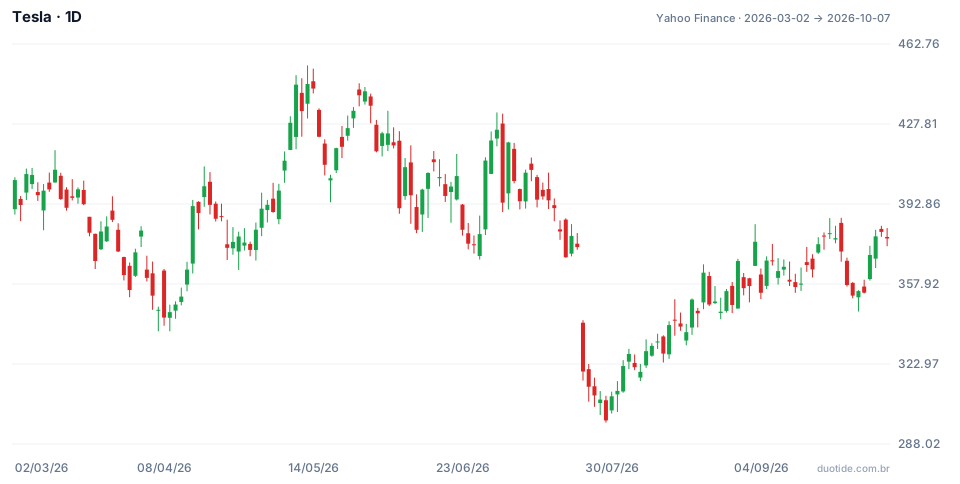
Between March 2 and October 7, 2026, Tesla went from US$ 403.32 to US$ 377.81, a drop of 6.33%, with a high of US$ 453.40 on May 13 and a low of US$ 297.38 on July 29. Three stretches help separate the news from the price.
After the show: a rally, not a drop
The stock closed April at US$ 381.63. On May 13, just a few weeks after CATL's announcement, it closed at US$ 445.27, up 16.7%. Anyone expecting an immediate, negative reaction to the news would have seen the opposite. The market processes this kind of technological advance gradually, mixed in with sales, results, and expectations about the company's other businesses.
July: the window's biggest drop
On July 23, the stock opened at US$ 341.00, well below the previous close of US$ 374.01, and closed at US$ 319.69, down 14.52% in a single session. It was the period's biggest daily move. The low came on July 29. This piece doesn't assign a cause to the move: for that, you'd need to check the news and that week's earnings release date.
From December's high to July's low
Tesla's highest recent close was US$ 489.88, on December 16, 2025. By the close of US$ 298.32 on July 29, 2026, the cumulative drop reached 39.1%. After that, the stock recovered 26.6% through October 7. Competitive pressure, brand-image wear tied to the founder's political involvement, and share losses in China, where local manufacturers compete aggressively on price, were the most-cited themes during the period.
How to interpret this kind of news
Separate the structural from the immediate
The relevant point in CATL's announcement is structural: battery leadership, previously associated with Western companies, showed concrete signs of having shifted to Chinese manufacturers. Changes like this show up in companies' numbers over several quarters, not in the next session.
Understand how the stock is priced
Tesla doesn't trade like a traditional automaker. A large part of its market value reflects expectations about software, self-driving, and energy, and the founder's image worked for years as a buffer between bad news from the car business and the stock price.
Track the data that confirms or disproves the thesis
Quarterly deliveries, automotive segment gross margin, and market share in China and Europe say more about the effect of competition than the headline of the announcement.
Limitations
The CATL and Chinese market figures cited here reflect April 2026 and may have changed since. And specifications announced at a trade show aren't the same as a product sold at scale.
Common mistakes when trading on technology news
- Selling or buying a competitor's stock on the day of the news, expecting a reaction that may take quarters, or may never come.
- Attributing every sharp price move to a single headline.
- Treating launch specifications as production at scale.
- Ignoring the size of the stock's daily moves: a −14.5% session fits within Tesla's recent history.
- Forgetting that the examples above describe what happened, not what will happen.
To practice reading news without risking money, pick a stock you follow, note down every relevant headline and that day's price on a demo account, and record what happened one and four weeks later. Investing in the automotive or technology sector carries real risk of loss, and this record helps separate what moves the price from what's just noise.
Practice before you risk. Open your Duotide account and test your ideas on the demo account with US$10,000 in virtual funds.
Create free accountUpdated:
Editorial character of the Duotide newsroom. Articles are written by the team with the help of artificial intelligence; prices and charts come from real market data. Follows the news that moves prices — rates, stock markets, companies and commodities — explained without jargon.
Was this article helpful?
Be the first to rate it.
Comments
- No comments yet. Be the first to comment.
Ready to put it into practice?
Open your account and practice on the demo account with US$10,000 in virtual funds, without risking money.
- Secure platformProtected login and identity verification
- Multilingual supportHelp available every day
- Free demo accountUS$10,000 virtual to practice
Trading involves the risk of losing the capital invested.
