

 Português pt
 Español es
 العربية ar
 বাংলা bn
 Deutsch de
 Filipino fil
 Français fr
 हिन्दी hi
 Bahasa Indonesia id
 Italiano it
 Русский ru
 Svenska sv
 ไทย th
 Türkçe tr
 Tiếng Việt vi
 简体中文 zh
Updated:
CryptoHow to Trade Cryptocurrencies: A Complete Guide for Beginners
 Rafael AzevedoEditorial character · Crypto Desk

Quick answer
Trading cryptocurrencies means trading the price swings of digital coins like bitcoin and ether, in a market that runs 24 hours a day, every day. The main feature is volatility: in 2026 ether swung, on average, about three times more per day than the S&P 500. That's why the position size needs to be smaller and the stop set before entering.
Few markets generate as much excitement, and as much confusion, as cryptocurrencies. It runs 24 hours a day, seven days a week, with moves that can be far sharper than those of stocks or traditional currencies. That attracts opportunity seekers and exposes unprepared newcomers to quick losses.
This guide explains what makes this market different and shows, with real daily quotes for ether (ETH/USDT on Binance) between April and October 2026, how much it swung and how that changes the size of a trade.
What makes the cryptocurrency market different
- It never closes: news in the middle of the night, on holidays, or on weekends moves the price while you're not watching.
- High volatility: moves of several percentage points in a day are common.
- Uneven liquidity: the best-known coins have high volume; smaller ones can have wide spreads and erratic moves.
- Its own drivers: regulation, institutional adoption, technical changes to the network, and market mood weigh more than the fundamentals used to value a company.

How to measure a cryptocurrency's volatility
One simple way is the average daily move: add up each day's percentage change, without regard to sign, and divide by the number of days. Between April 1, 2026, and October 7, 2026:
- Ether: average move of 1.83% a day, with 10 days above 5% up or down.
- S&P 500: average move of 0.60% a day, with no day above 5%.
- Ratio: ether swung about 3 times more than the index of the largest American stocks.
Another way is the width of the Bollinger Bands, which widen when volatility rises and narrow when it falls. It shows up in the chart below.
Real example: ether in 2026
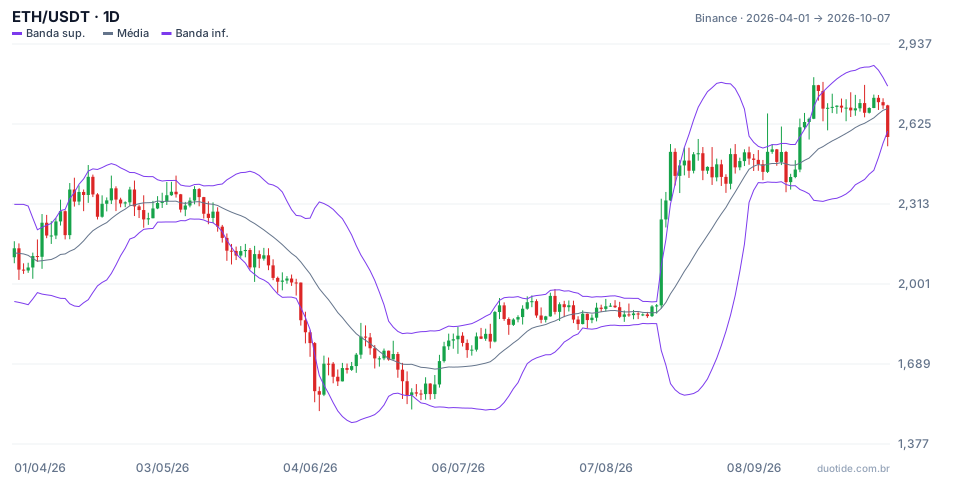
The chart shows daily ETH/USDT with 20-period, 2-deviation Bollinger Bands. Ether started the period at $2,140.35, hit a low of $1,505.68 on June 6 and a high of $2,807.34 on September 21, a distance of 86% between the extremes, and closed October 7 at $2,574.14.
June 5: a 10.6% drop in one day
ETH closed June 4 at $1,770.77 and June 5 at $1,583.40, a 10.6% drop, well below the lower band ($1,725.48). The next day it marked the period's low. A stop sized for a stock would have been hit within hours.
August: narrow bands before a jump
On August 17 the distance between the bands reached 4.5% of the average price, the narrowest of the period: ether was drifting sideways near $1,900. On August 19 it rose 17.5% in one day, from $1,917.85 to $2,252.80, and by August 27 the bands' width reached 51.8%. Calm on a crypto chart is no guarantee of calm the next day.
September and October: a partial giveback
After September's peak, ETH closed October 7 at $2,574.14, 7.3% below the September 21 close ($2,776.19) and below that day's lower band. The examples describe what happened, not what will happen.

How to build a plan before trading cryptocurrencies
Adjust position size to volatility
A $4,000.00 account, 1% risk per trade ($40.00). If a trade's stop on a stock index sits at 1.5% of the price, the position can be 40.00 ÷ 0.015 = $2,666.67. On ether, which swung about three times more, an equivalent stop sits at 4.5%, and the position drops to 40.00 ÷ 0.045 = $888.89. The risk in money is the same; the size is a third of it.
Set the stop and target before entering
The speed of the moves leaves little time to decide mid-trade. Have the orders set up in advance, including for the hours when you won't be watching the screen.
Build a routine
Since the market never closes, it's easy to spend the whole day staring at the chart. Set fixed windows for reviewing positions and looking for opportunities. That cuts down on impulsive decisions.
Start with a few coins
There are thousands of crypto assets with very different levels of public information, track record, and liquidity. Focusing your learning on a few established coins makes it easier to understand each one's behavior and to exit a position when you need to.
Follow the sector's calendar
Regulatory decisions, network technical upgrades, and U.S. macroeconomic data, like inflation and interest rates, tend to trigger volatility spikes in cryptocurrencies too. Knowing what's scheduled for the week helps decide whether it's worth cutting the position or waiting for a release to pass before entering.
Limitations
Volatility measures use the past and change fast, as August showed. Beyond price, there are regulatory risks that vary from country to country and liquidity risks in smaller coins. No plan eliminates the possibility of loss.
Common mistakes when trading cryptocurrencies
- Using the same position size as for stocks or forex without adjusting for volatility.
- Trading on social media hype: hype-driven moves tend to reverse as fast as they appear.
- Leaving a position open over the weekend with no stop.
- Spreading capital across dozens of little-known coins.
- Assuming a calm period will stay calm.
- Expecting a guaranteed return: there's no guarantee of profit in any digital asset.
To practice, open ether's or bitcoin's chart on a demo account, calculate the size of each position from the risk in money and the stop distance, and log the result of every trade. After a few weeks, compare it with what you expected: your own record says more about the market than any promise.
Practice before you risk. Open your Duotide account and test your ideas on the demo account with US$10,000 in virtual funds.
Create free accountUpdated:
Editorial character of the Duotide newsroom. Articles are written by the team with the help of artificial intelligence; prices and charts come from real market data. Covers cryptocurrencies and tokens: how these markets work and what changes when you trade them at a broker.
Was this article helpful?
Be the first to rate it.
Comments
- No comments yet. Be the first to comment.
Ready to put it into practice?
Open your account and practice on the demo account with US$10,000 in virtual funds, without risking money.
- Secure platformProtected login and identity verification
- Multilingual supportHelp available every day
- Free demo accountUS$10,000 virtual to practice
Trading involves the risk of losing the capital invested.
