

 Português pt
 Español es
 العربية ar
 বাংলা bn
 Deutsch de
 Filipino fil
 Français fr
 हिन्दी hi
 Bahasa Indonesia id
 Italiano it
 Русский ru
 Svenska sv
 ไทย th
 Türkçe tr
 Tiếng Việt vi
 简体中文 zh
Updated:
CryptoWhen Will All Bitcoin Be Mined?
 Rafael AzevedoEditorial character · Crypto Desk

Quick answer
The last bitcoin should be mined around the year 2140. The cap is 21 million units, and miners' reward is cut in half every 210,000 blocks (about four years), so new supply keeps shrinking without ever stopping abruptly. More than 95% of the total has already been mined; the last 5% will take more than a century.
Unlike traditional currencies, which a central bank can issue whenever it sees fit, bitcoin was born with a scarcity rule written into its own code: there will never be more than 21 million units. That trait is central to the argument of those who see the asset as a store of value, and it's also one of the biggest sources of confusion for anyone starting to study cryptocurrencies.
In this article we explain how the supply cap works, why the last fraction isn't due to be mined for more than a century, and, with real 2026 quotes, how much new supply actually weighs on the market.
Why the 21 Million Cap Exists
New bitcoins enter circulation as a reward for miners, who validate the blocks of transactions. A block is produced, on average, every 10 minutes, about 144 a day. The code sets that reward to be cut in half every 210,000 blocks, in an event called the halving. The sum of all rewards, from 50 bitcoins per block in 2009 down to the last fraction, comes to a bit less than 21 million: 20,999,999.9769 units.
How the Halving Delays the End of Mining
The 210,000 blocks take about four years to be produced. The reward has already gone through four cuts:
- 2009: 50 BTC per block.
- 2012: 25 BTC.
- 2016: 12.5 BTC.
- 2020: 6.25 BTC.
- April 2024 (block 840,000): 3.125 BTC, the value in effect today.
How Much Has Already Been Mined
The math is exact up to the last halving: 210,000 blocks × (50 + 25 + 12.5 + 6.25) = 19,687,500 BTC. From April 20, 2024 to October 8, 2026, 901 days passed. At the average of 144 blocks a day, that's about 129,700 blocks at 3.125 BTC, or roughly 405,000 more BTC. The estimate is about 20.09 million bitcoins in circulation, 95.7% of the total. The exact number depends on the actual pace of blocks, which varies.
Why 2140
Bitcoin's smallest unit is the satoshi, one hundred-millionth of a BTC. Since the reward is cut in half every four years, after 33 halvings it drops below one satoshi and reaches zero. That happens at block 6,930,000, which, at the pace of 10 minutes per block, should be reached around 2140. In other words: more than 95% already exists, and the last 5% will take more than a hundred years to come out.
Real Example: How Much New Supply Weighs on the Market in 2026
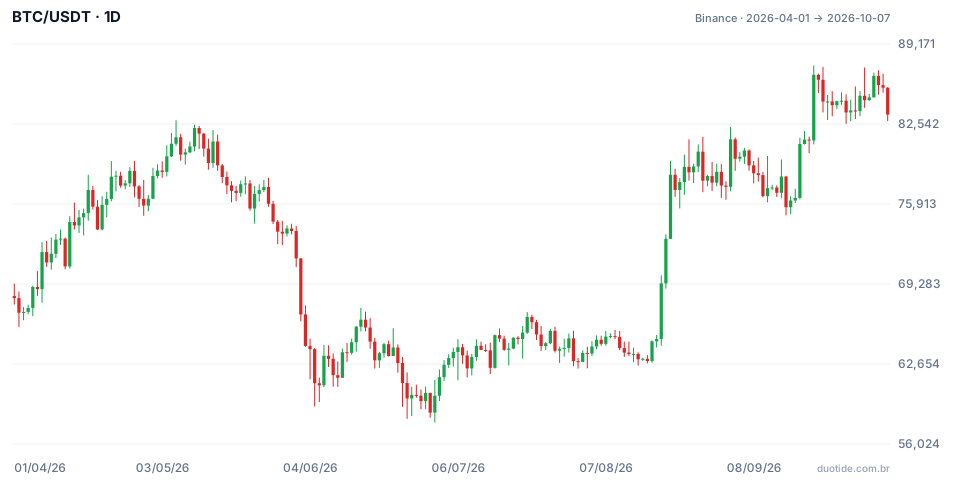
The chart shows bitcoin (BTC/USDT on Binance) from April 1 to October 7, 2026. It started the window at $68,113.92, fell to $57,800.19 on July 1, reached $87,395.67 on September 21, and closed on October 7 at $83,321.81, a 22.33% gain over the period.
Daily Supply in Dollars
With 144 blocks a day at 3.125 BTC, the network issues about 450 new BTC a day. At the October 7, 2026 closing price, that equals 450 × $83,321.81 = $37,494,814.50 a day. Over a year, that's 164,250 BTC, about 0.82% of the estimated supply. After the next halving, expected around 2028, the issuance drops to about 225 BTC a day.
New Supply Compared with Trading Volume
Between April 1 and October 7, 2026, the BTC/USDT pair on Binance traded, on average, 16,195 BTC a day. The 450 BTC issued daily corresponds to 2.78% of that, and that's just one pair on a single exchange. In the short term, the price is decided far more by those buying and selling the bitcoins that already exist than by the ones being created.
The Halving Doesn't Mark the Price
On the day of the last halving, April 20, 2024, bitcoin closed at $64,940.59 on Binance. Our historical high came on October 6, 2025, at $126,199.63. On October 7, 2026, the price was 34% below that high. Programmed scarcity didn't prevent a big decline in the middle of the cycle. These numbers describe what happened, not what will happen at the next halving.

What Happens to Miners at the End
When the reward reaches zero, miners' income will come only from the fees paid on each transaction. Already today, with every halving, the reward shrinks and fees gain relative weight. Whether they'll be enough to keep the network secure in the long run is one of the open debates among experts.
How to Use This Information
As a Trait, Not a Forecast
The supply cap explains why bitcoin's new issuance declines over time. It doesn't say what the price will be: regulation, adoption, interest rates, global liquidity, and sentiment weigh as much or more.
To Calibrate Risk
The chart's window had a swing of about 51% between the low and the high in just over two and a half months. Anyone thinking of trading bitcoin needs to size their position for that kind of swing, not for the long-term thesis.
Limitations
The future dates are estimates: the pace of block production varies with mining capacity. And part of the bitcoins already mined is lost forever in inaccessible wallets, which makes the effective supply smaller than the official one, by an amount nobody can measure precisely.
Common Mistakes About the End of Mining
- Thinking mining ends when the last halving gets close: more than 95% already exists today.
- Treating the halving as a guarantee of a price rally.
- Ignoring that, in the short term, traded volume is dozens of times bigger than new supply.
- Confusing maximum supply with available supply, forgetting the lost coins.
- Trading based on the scarcity thesis without a stop or a defined position size.
If you want to study bitcoin's behavior without risking money, follow the asset in a demo account and log your reads and trades for a few weeks. Also note what the price did around dates like halvings and announcements: your record will show how the market really reacts, beyond the theory.
Practice before you risk. Open your Duotide account and test your ideas on the demo account with US$10,000 in virtual funds.
Create free accountUpdated:
Editorial character of the Duotide newsroom. Articles are written by the team with the help of artificial intelligence; prices and charts come from real market data. Covers cryptocurrencies and tokens: how these markets work and what changes when you trade them at a broker.
Was this article helpful?
Be the first to rate it.
Comments
- No comments yet. Be the first to comment.
Ready to put it into practice?
Open your account and practice on the demo account with US$10,000 in virtual funds, without risking money.
- Secure platformProtected login and identity verification
- Multilingual supportHelp available every day
- Free demo accountUS$10,000 virtual to practice
Trading involves the risk of losing the capital invested.
