

 Português pt
 Español es
 العربية ar
 বাংলা bn
 Deutsch de
 Filipino fil
 Français fr
 हिन्दी hi
 Bahasa Indonesia id
 Italiano it
 Русский ru
 Svenska sv
 ไทย th
 Türkçe tr
 Tiếng Việt vi
 简体中文 zh
Updated:
CryptoLabubu Coin: What It Is and How Meme Coins Work
 Rafael AzevedoEditorial character · Crypto Desk

Quick answer
Labubu Coin is the name given to tokens created on blockchains like Solana that ride the fame of Pop Mart's Labubu figure, with no official tie to the brand. They're meme coins: no product, no revenue, and a price that depends solely on social media attention. Because of that, they rise and fall much faster than established cryptocurrencies, and losing the entire invested amount is a real possibility.
Every so often, a pop culture symbol turns into a cryptocurrency almost overnight. It happened with Dogecoin's shiba inu dog, with internet meme frogs, and, more recently, with Labubu, the sharp-toothed Pop Mart figure that became a craze among collectors. Tokens bearing the character's name showed up on networks like Solana and started circulating among traders before any discussion of fundamentals.
This article explains what's behind this type of asset and uses real Dogecoin prices, the oldest and most liquid meme coin, to show the size of the risk in numbers.
What Labubu Coin is
Labubu Coin is the name given to tokens created on public blockchains that capitalize on the character's popularity. They aren't products of Pop Mart, the brand's owner, and they don't entitle holders to a toy, a discount, or a stake in the company. Since anyone can create a token in minutes, more than one usually exists with the same name, which is already the first risk: buying the wrong contract.

What defines a meme coin
A meme coin is a token with no product, no revenue, and, most of the time, no utility beyond representing a cultural symbol. Unlike a token that pays network fees or grants access to a service, it's created on top of a blockchain that already exists and puts all its effort into distribution and marketing. Its price is held up by social media mentions, the arrival of new buyers, and how fast the community spreads.
Why a collectible character becomes a token
When a character already has an organized fan base, one that lines up for limited editions and creates content on its own, that audience is primed to chase any new release tied to the symbol. The logic is the same as an exclusive sneaker drop: perceived scarcity and emotional attachment outweigh any analysis.
The typical cycle
- Launch: low volume and a price very sensitive to any large purchase.
- Going viral: mentions and listings on new exchanges bring in buyers and the price climbs fast.
- Peak attention: the asset becomes a topic outside the crypto niche and draws in people who've never traded a token like it.
- Distribution and drop: early buyers take profit, attention shifts to the next topic, and the price falls, often as fast as it rose.
Real example: Dogecoin's volatility in 2026
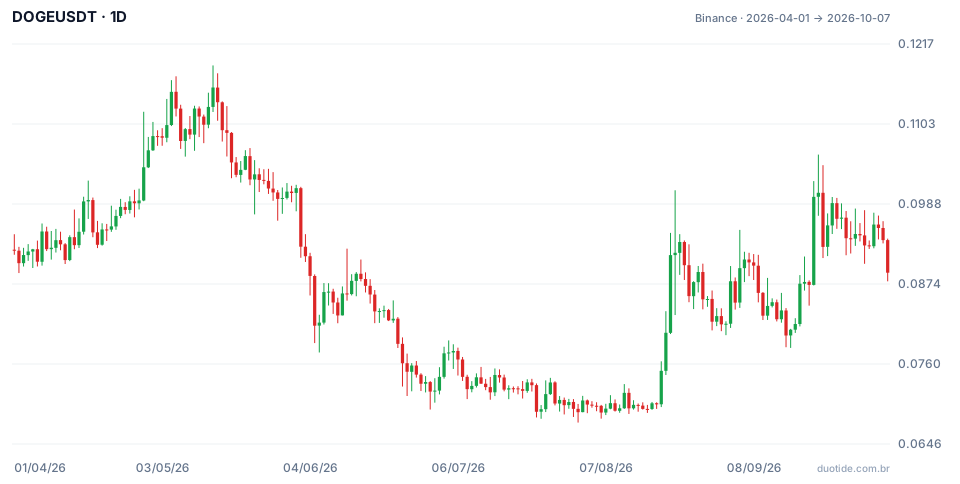
Newly created tokens like the Labubu ones don't have a reliable history to analyze. Dogecoin (DOGE/USDT on Binance), traded since 2019, serves as a benchmark: if the most established meme coin already behaves like this, smaller ones tend to be even more extreme.
A day of euphoria that didn't hold
On September 21, 2026, DOGE rose 14.4% in a single day, from $0.0873 to $0.09986, with volume about 3.5 times higher than the previous day's. It was the coin's biggest daily move between April and October. On October 7, it closed at $0.08904, 10.8% below that rally day's close.
A 43% drop in less than three months
The period's high was $0.11861, on May 14, 2026. On August 1, the low reached $0.06766, a 43% drop from the top. For comparison, bitcoin had its period low on July 1, at $57,800.19, and ended the window up 22.3%; DOGE ended down 3.4%.
Far from the all-time high
DOGE's all-time high in this data series is $0.73995, on May 8, 2021, at the peak of that year's euphoria. The close on October 7, 2026 is 88% below that. Anyone who bought at the peak of attention still hasn't recovered even a fifth of that value, nearly five years later.

How to calculate the risk before entering
An objective way to measure how much an asset moves is the 14-day ATR (average true range). On October 7, 2026, DOGE's ATR was $0.00508, or 5.70% of its price. Bitcoin's, on the same day, was $2,187.23, or 2.63% of its price: the meme coin was moving more than twice as much.
That changes the position size. Suppose a $5,000 account, a maximum risk of 1% per trade ($50), and a stop at 2 ATR from the entry:
- DOGE: stop of 2 × 0.00508 = $0.01015, or 11.4% below $0.08904. Maximum position = 50 ÷ 0.01015 ≈ 4,924 DOGE, about $438.
- BTC: stop of 2 × 2,187.23 = $4,374.46, or 5.25% below $83,321.81. Maximum position = 50 ÷ 4,374.46 ≈ 0.0114 BTC, about $952.
With the same dollar risk, the DOGE position ends up less than half the size. On a newly launched token, with even higher volatility and no history, the math calls for an even smaller position, and the stop might not even hold if liquidity is lacking.
How to evaluate a meme coin without getting caught up in the euphoria
Check the contract and the concentration
Confirm the contract address through reliable sources and check how much of the supply sits in a handful of wallets. High concentration means half a dozen sellers can knock the price down.
Look at real liquidity
A token can rise 40% in a day on thin volume. When it's time to sell, there may not be enough buyers at the price shown on screen. The gap between the displayed price and the executed price, known as slippage, is much bigger on new tokens than on bitcoin or ether.
Set the maximum loss beforehand
With meme coins, losing everything is a real possibility. Treat the position as small speculation, with a size set before you enter.
Limitations
No indicator predicts the end of an attention cycle. The ATR measures how much the price has moved, not where it's going, and Dogecoin's numbers don't apply directly to a token created last week.
Common mistakes with meme coins
- Buying after the token becomes a topic outside the crypto world, when early buyers are already selling.
- Using the same position size you'd use on bitcoin, ignoring the much higher volatility.
- Buying a fake token with the same name by not checking the contract.
- Confusing the character's popularity with the token's value: the toy's success doesn't carry over to the cryptocurrency.
- Treating the numbers above as a forecast: they describe what happened with Dogecoin, not what will happen.
If you want to understand this type of asset, start with a demo account: pick a liquid meme coin, calculate the ATR, size the position as in the example, and note what happens on each trade over a few weeks. The log shows the risk better than any explanation.
Practice before you risk. Open your Duotide account and test your ideas on the demo account with US$10,000 in virtual funds.
Create free accountUpdated:
Editorial character of the Duotide newsroom. Articles are written by the team with the help of artificial intelligence; prices and charts come from real market data. Covers cryptocurrencies and tokens: how these markets work and what changes when you trade them at a broker.
Was this article helpful?
Be the first to rate it.
Comments
- No comments yet. Be the first to comment.
Ready to put it into practice?
Open your account and practice on the demo account with US$10,000 in virtual funds, without risking money.
- Secure platformProtected login and identity verification
- Multilingual supportHelp available every day
- Free demo accountUS$10,000 virtual to practice
Trading involves the risk of losing the capital invested.
