

 Português pt
 Español es
 العربية ar
 বাংলা bn
 Deutsch de
 Filipino fil
 Français fr
 हिन्दी hi
 Bahasa Indonesia id
 Italiano it
 Русский ru
 Svenska sv
 ไทย th
 Türkçe tr
 Tiếng Việt vi
 简体中文 zh
Updated:
ForexCurrency Trading: How the Forex Market Works
 Naomi TanakaEditorial character · Analysis Desk

Quick answer
In currency trading, you buy or sell a pair, like GBP/USD, betting on one currency strengthening against the other. The move is measured in pips (0.0001 on most pairs and 0.01 on yen pairs), and the result is the number of pips multiplied by the pip's value, which depends on the position size. On a standard GBP/USD lot, each pip is worth $10.
The foreign exchange market, also called forex, is the largest financial market in the world by daily volume, with trillions of dollars traded among banks, companies, governments, and individual traders. Despite the scale, the basic concepts are simple, once you understand the logic of currency pairs and the pip measurement.
So the math doesn't stay abstract, we use the pound's real daily quotes against the dollar (GBP/USD) and the dollar against the yen (USD/JPY) between April and October 2026.
What currency trading is
Currency pairs
Currencies are always traded in pairs, because the value of one only makes sense compared to another. On the GBP/USD pair, the quote shows how many dollars buy one pound: on October 7, 2026, the closing quote was 1.3267, meaning one pound was worth about $1.33. On the USD/BRL pair, the quote shows how many reais buy one dollar.
The first currency in the pair is the base currency; the second is the quote currency. Anyone who buys GBP/USD buys pounds and sells dollars, and profits if the pound strengthens. Anyone who sells the pair profits if the pound weakens against the dollar.
A market that almost never closes
Forex runs almost 24 hours on business days, moving through the Asian, European, and US sessions. Liquidity is highest when sessions overlap, especially London and New York, and lowest in the hours between them.

How to calculate pips and the result
A pip is the standardized unit of change in the quote. On most pairs it's the fourth decimal place (0.0001); on yen pairs, the second (0.01).
- Pips = difference between the quotes ÷ pip size.
- Pip value = position size × pip size, in the quote currency.
- Result = pips × pip value, before spread and costs.
On GBP/USD, the quote currency is the dollar. A standard lot (100,000 pounds) is worth 100,000 × 0.0001 = $10 per pip; a mini lot (10,000 pounds), $1 per pip; a micro lot (1,000 pounds), $0.10.
Example with the yen
On USD/JPY, the pip is 0.01 and the quote currency is the yen. A 100,000-dollar lot is worth 1,000 yen per pip. On September 24, 2026, the pair closed at 158.265: 1,000 ÷ 158.265 = about $6.32 per pip. Between September 23's close (157.464) and September 24's, the pair rose about 80 pips, equivalent to about $506 per standard lot.
Real example: the pound against the dollar in 2026
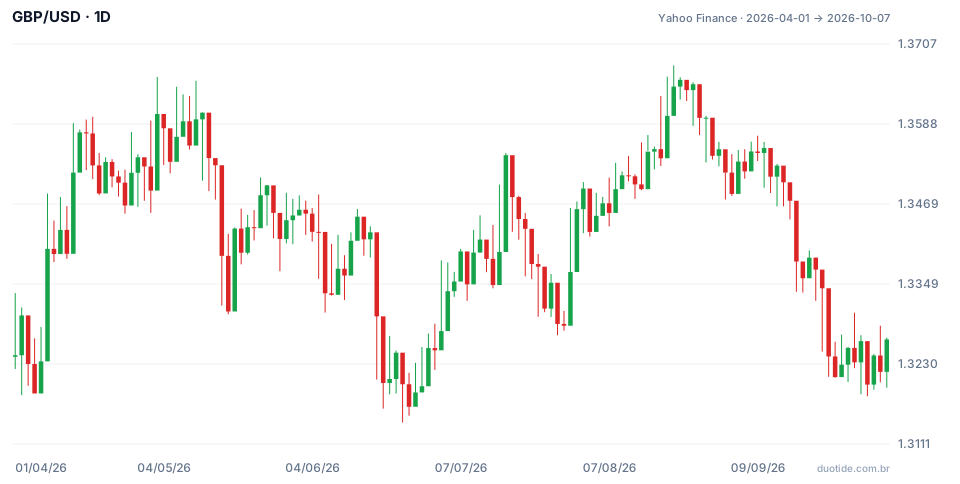
The chart shows GBP/USD's daily candles. The pound started April at 1.3243 and ended October 7 at 1.3267, almost back where it started. Along the way, the high was 1.3675 on August 21 and the low was 1.3143 on June 24: a range of about 532 pips. Three readings:
The size of a normal day
Over the period, the average move from one close to the next was 38.6 pips, and the average range between the day's high and low was 62.6 pips. With a mini lot, that's about $39 of typical daily movement at the close. A 10-pip stop, with that range, would get hit by a single day's normal noise.
The strongest day
The period's biggest daily move was on April 8: the pound closed at 1.3402, about 168 pips above the previous close, more than four times the average. With a standard lot, that would be about $1,676 in a single day, in favor of whoever was long and against whoever was short.
September: a stronger dollar
On September 15 the pound closed at 1.3501; on September 25, at 1.3211, a drop of about 290 pips. On September 24 alone, the day the global bond selloff pushed Treasury yields to multi-year highs, the pound fell about 101 pips. Anyone who sold a mini lot on September 15 and bought it back on September 25 would have gained about $290; anyone who bought it would have lost the same amount. Rising US interest rates tend to strengthen the dollar, but that's a tendency, not a fixed rule.

How to trade currencies with risk control
What moves exchange rates
Central bank interest rate decisions tend to be the strongest factor: higher rates attract capital and tend to strengthen the currency. Inflation, employment, and growth data move rate expectations ahead of any decision. Elections and international tensions can trigger sharp moves, disconnected from any data.
Position size based on the stop
Set the stop based on the pair's volatility and the position size based on the acceptable risk. With a $5,000.00 account and 1% risk ($50.00), a 50-pip stop calls for a $1-per-pip position, a mini lot on GBP/USD. A 100-pip stop calls for half a mini lot.
Spread, trading hours, and leverage
Thinly traded pairs have a bigger spread, and the cost shows up on every entry and exit. Outside the hours of highest liquidity, the spread also widens. And since daily currency moves are small in percentage terms, the leverage offered tends to be high, which amplifies gains and losses in the same proportion.
Limitations
The numbers above come from daily closes. Within the day, the price can move well beyond that, and on major data releases execution can come in far from the price on the screen. The pip calculation also changes depending on your account's currency.
Common mistakes in currency trading
- Forgetting that the yen's pip is 0.01, not 0.0001, and miscalculating the position size.
- Calculating the pip value in dollars when the quote currency is something else.
- Using stops smaller than a day's normal range.
- Trading during low-liquidity hours or right at a data release, with the spread wide open.
- Choosing the leverage before calculating the trade's risk.
- Forgetting that the examples above describe what happened, not what will happen.
To practice without risking money, open a liquid pair, like GBP/USD or EUR/USD, in a demo account, calculate the pip value before each trade, and record the time, the spread, the pips, and the result over a few weeks. That record shows which pairs and hours your method really works in.
Practice before you risk. Open your Duotide account and test your ideas on the demo account with US$10,000 in virtual funds.
Create free accountUpdated:
Editorial character of the Duotide newsroom. Articles are written by the team with the help of artificial intelligence; prices and charts come from real market data. Explains charts, indicators and trading strategies: how they work, where they fail and how to test them first.
Was this article helpful?
Be the first to rate it.
Comments
- No comments yet. Be the first to comment.
Ready to put it into practice?
Open your account and practice on the demo account with US$10,000 in virtual funds, without risking money.
- Secure platformProtected login and identity verification
- Multilingual supportHelp available every day
- Free demo accountUS$10,000 virtual to practice
Trading involves the risk of losing the capital invested.
