

 Português pt
 Español es
 العربية ar
 বাংলা bn
 Deutsch de
 Filipino fil
 Français fr
 हिन्दी hi
 Bahasa Indonesia id
 Italiano it
 Русский ru
 Svenska sv
 ไทย th
 Türkçe tr
 Tiếng Việt vi
 简体中文 zh
Updated:
PsychologyDaily Trading Checklist: Before, During, and After the Session
 Camila NascimentoEditorial character · Risk & Behavior Desk

Quick answer
A daily routine checklist organizes what to do before, during, and after the session: review the previous day, check the economic calendar, set the day's maximum risk, build the watchlist, follow only the plan, and log every trade. It doesn't guarantee profit, but it takes risk decisions out of the heat of the session and lets you judge whether the strategy actually works.
Much of the inconsistency among people starting to trade doesn't come from a lack of technical knowledge, but from a lack of routine. Without a clear structure for before, during, and after the session, important decisions end up being made in the middle of the trading session, when the mind is already tired and more subject to the emotion of the moment.
A checklist turns repetitive decisions into habit. In this guide we build a three-block routine and show, with the Nvidia stock's real ATR (NVDA, from Yahoo Finance), how one of its items, position size, changes from one day to the next even with a fixed risk.
What a trading routine checklist is
It's a short list of checks you run in the same order, every day you trade. It doesn't tell you what to buy or sell. It makes sure the risk decisions were made calmly, before the session, and that your behavior during the session can be reviewed afterward. Without it, it's practically impossible to know whether a bad result came from the strategy or from a rule you skipped.

How to build the checklist in three blocks
Before the session
- Review the previous day: compare what was planned with what happened. It takes a few minutes and keeps you from repeating the same mistake two days in a row.
- Check the economic calendar: rate decisions, jobs data, inflation, and earnings from the companies you follow change the day's volatility.
- Set the day's risk: how much you can lose per trade and for the whole day, and the maximum number of trades.
- Build the watchlist: two to five assets, chosen by criteria set in advance, such as proximity to a support or resistance.
- Update the volatility: check each watchlist asset's ATR to calculate the stop and the position size.
During the session
- Trade only the assets on the list and only under the planned conditions.
- Log the entry, stop, and target before clicking.
- Stop once you hit the day's loss limit or the maximum number of trades.
After the session
- Note every trade: asset, reason, result, and whether the rules were followed.
- Mark which checklist item was skipped, if any.
Practical example: daily risk and position size with Nvidia's ATR
Consider a US$ 5,000 account with 1% risk per trade (US$ 50) and a maximum of three trades a day. The daily loss limit sits at US$ 150, or 3% of the balance. If that amount is reached, the session ends, no matter how convincing the next opportunity looks.
For position size, the rule used here is a stop at 1.5 times the 14-period ATR, the asset's average daily range. The number of shares is the risk per trade divided by the stop distance, rounded down.
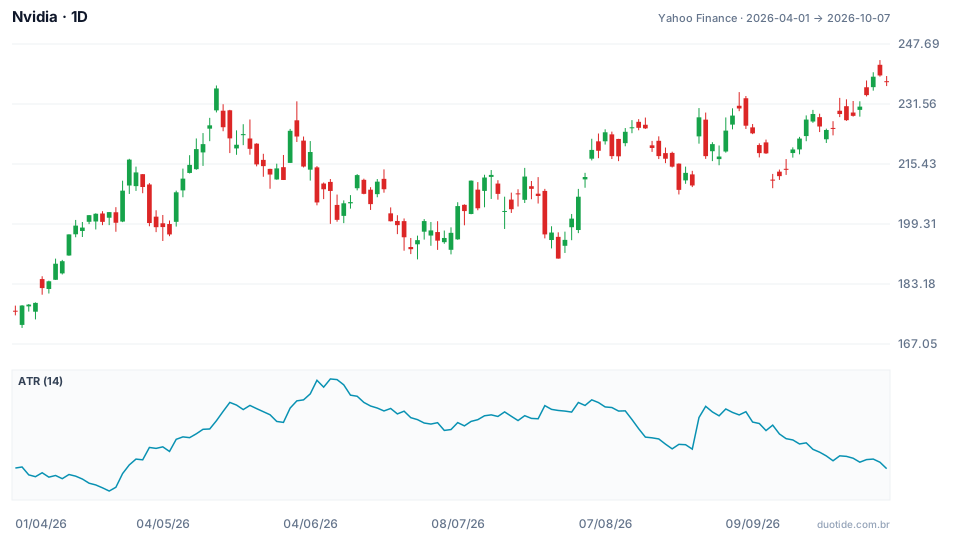
The chart shows Nvidia from April to October 2026 with the 14-period ATR. The stock rose 35.12% over the window, from US$ 175.75 to US$ 237.47, but the daily range varied a lot along the way. Here's the same US$ 50 risk applied on three real days:
April 22, 2026: low ATR
The ATR stood at US$ 4.88, the period's lowest, with the stock at US$ 202.50. Stop = 1.5 × 4.88 = US$ 7.32. Size = 50 ÷ 7.32 = 6.83, or 6 shares. Exposure of US$ 1,215.00 and a real risk of US$ 43.92.
June 9, 2026: high ATR
The ATR reached US$ 8.56, the period's highest, with the stock at US$ 208.19. Stop = 1.5 × 8.56 = US$ 12.84. Size = 50 ÷ 12.84 = 3.89, or 3 shares. Exposure of US$ 624.57 and a real risk of US$ 38.52. With a price close to April's, the position was cut in half because the asset was moving much more.
October 7, 2026: the series' last day
The ATR stood at US$ 5.61, with the stock at US$ 237.47. Stop = 1.5 × 5.61 = US$ 8.42. Size = 50 ÷ 8.415 = 5.94, or 5 shares. Exposure of US$ 1,187.35 and a real risk of US$ 42.08.
Anyone who skips the volatility-update item and reuses April's size in June would be risking 6 × 12.84 = US$ 77.04 per trade, more than 1.5% of the account, without noticing. That's exactly the kind of silent drift the checklist exists to catch.

How to use the checklist day to day
Start small
A 20-item checklist doesn't survive the second week. Start with five or six items and add others only once your record shows a mistake keeps repeating.
Keep risk decisions out of the trading session
Daily limit, number of trades, and position size are decided before the session, calmly. During the session you only execute. Changing these rules mid-day, after a loss, is exactly what the checklist is meant to prevent.
Judge the process, not just the result
A day with no profit where every rule was followed is a good process day. A day with profit where the risk limit was ignored is a warning sign. Over weeks, the record usually shows the biggest losses happened on the days when some item was skipped.
Limitations
A routine doesn't guarantee profit: no process eliminates the risk of loss. The ATR describes past volatility and can change suddenly with news. And the stop can be filled at a worse price than planned in markets with price jumps.
Common mistakes in a trading routine
- Building the plan after opening the chart, instead of before.
- Using the same position size every day, without looking at the current volatility.
- Raising the risk after a loss to try to recover it the same day.
- Trading assets outside the list because they looked like an unmissable opportunity.
- Not logging trades and relying on memory to judge your own performance.
To get started, use a demo account for a few weeks following the checklist to the letter: calculate each position's size with the day's ATR, respect the daily limit, and log whether every rule was followed. The record will show which items make a difference for you.
Practice before you risk. Open your Duotide account and test your ideas on the demo account with US$10,000 in virtual funds.
Create free accountUpdated:
Editorial character of the Duotide newsroom. Articles are written by the team with the help of artificial intelligence; prices and charts come from real market data. Writes about risk management, position sizing and the psychology behind traders' decisions.
Was this article helpful?
Be the first to rate it.
Comments
- No comments yet. Be the first to comment.
Ready to put it into practice?
Open your account and practice on the demo account with US$10,000 in virtual funds, without risking money.
- Secure platformProtected login and identity verification
- Multilingual supportHelp available every day
- Free demo accountUS$10,000 virtual to practice
Trading involves the risk of losing the capital invested.
