

 Português pt
 Español es
 العربية ar
 বাংলা bn
 Deutsch de
 Filipino fil
 Français fr
 हिन्दी hi
 Bahasa Indonesia id
 Italiano it
 Русский ru
 Svenska sv
 ไทย th
 Türkçe tr
 Tiếng Việt vi
 简体中文 zh
Updated:
PsychologyDemo vs. Real Account: 3 Psychological Differences
 Camila NascimentoEditorial character · Risk & Behavior Desk

Quick answer
On a real account, fear of losing changes behavior in the face of the same signal, the lack of risk on demo inflates confidence, and the pain of a realized loss weighs more than the pleasure of an equal gain. That's why a lot of people who follow the plan on demo move the stop, exit early, or trade on impulse with real money. The shock eases when demo is treated like a real account and the move over starts with small positions.
The chart is the same, the candles are the same, the indicator gives the same signal. Even so, anyone who has moved from a demo account to a real one knows something changes inside. It's not the market that becomes different, it's the person in front of the screen.
To make this concrete, we use the Ibovespa between April and October 2026, a period with a long decline and a fast recovery. It's the kind of path that looks calm on a finished chart and is quite different to live through with your own money.
Real example: the Ibovespa seen through real money
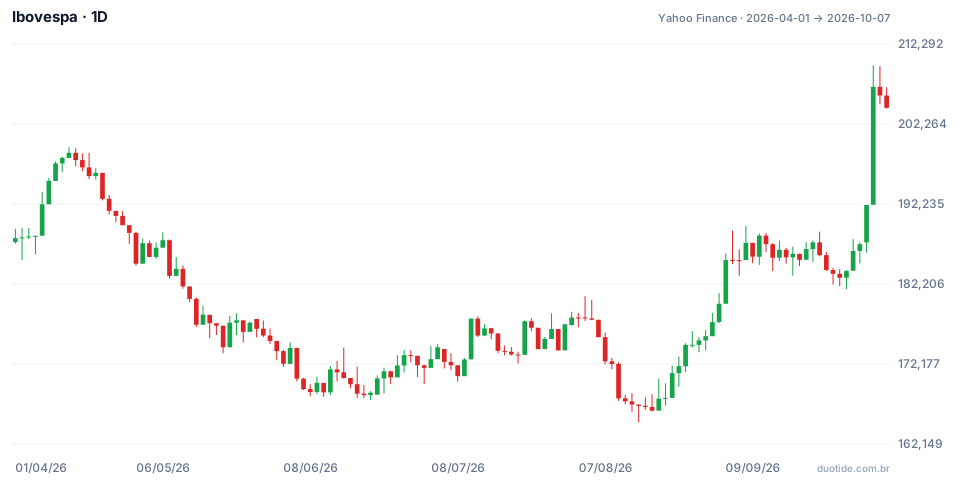
The index closed April 1, 2026 at 187,953 points and October 7, 2026 at 204,302, up 8.7% over the period. Looking only at those two points, it looks like a calm half-year. The path between them wasn't.
The four-month decline
The highest close before the decline was 198,657 points, on April 14. The lowest came on August 18: 166,335 points, a drop of 16.27%. A R$10,000 position tracking the index from the top would have fallen to about R$8,373, an on-paper loss of R$1,627.
Eleven straight declining sessions
Between August 4 and August 18, the Ibovespa closed down for 11 straight sessions, going from 178,000 points (August 3) to 166,335, a decline of 6.55%. The worst day was August 11, down 2.50%. On demo, eleven red days are a curiosity. On a real account, they're eleven days opening the app and watching the balance shrink.
The recovery that waited for no one
On October 5 the index rose 7.70% in a single session, from 192,115 to 206,912 points, above the April top. The same R$10,000 position would have been worth about R$10,416 on that day. Anyone who sold at the bottom out of fear locked in the loss and missed the bounce back. These numbers describe what happened; they don't indicate what the index will do.

The 3 psychological differences between demo and real accounts
1. Fear of losing changes behavior in the face of the same signal
On demo, losing R$300 on a trade doesn't hurt: it's a number that climbs back up on the next entry. That's why traders usually follow the plan to the letter. On a real account, with the same plan, reactions show up that weren't there before: exiting too early at the first sign of a turn, or pushing the stop farther away hoping the price comes back, turning a small, planned loss into a bigger one. In August's decline, those two reactions are the most likely ones, and neither comes from any new technical reading.
2. The absence of risk inflates confidence
Since being wrong on demo costs nothing, it's natural to open five trades at once or double the position after three wins. Carried over to a real account, that behavior gets expensive. Compare two rules on a R$2,000 account, with three losses in a row:
- Risking 2% of the starting capital per trade (R$40): a loss of R$120, or 6% of the account. Getting back to the starting balance only takes a 6.4% gain.
- Risking 10% per trade (R$200): a loss of R$600, or 30% of the account. Getting back requires a 42.9% gain on what's left.
The loss takes three trades to happen; the recovery can take months.
3. A realized loss weighs more than the equivalent gain
Behavioral finance studies describe loss aversion: losing an amount tends to be felt more intensely than gaining the same amount. On demo, this asymmetry barely shows up. On a real account, a R$150 loss can trigger a disproportionate reaction: becoming overly cautious on the next trade, or trying to recover quickly with an entry outside the plan, the classic impulse trade. In the Ibovespa example, it's that pain that pushes the sell at August's bottom.
How to reduce the shock in practice
Treat demo as if it were real
Use the balance you'll actually have and define the position size as a percentage of capital. Stick to that percentage even knowing the money is fictional.
Start small on the real account
When you move over, use an amount you'd accept losing without disrupting your financial routine, even if that means small positions for a while. The goal at the start is to train your head, not to make money.
Log what you felt, not just the result
Write down, before, during, and after every entry, what went through your head. Patterns like moving the stop after two losses become visible on paper long before they become visible in memory.
Reduce the size when discipline slips
If you notice you're pushing stops away or increasing the position outside the plan, that's a sign the money is weighing more than the method. Cut the size back until discipline returns.
Limitations
No technique eliminates the difference between virtual and real money. Loss aversion is human and doesn't disappear with experience; what changes is your ability to recognize it and have rules ready for when it shows up.
Common mistakes in the transition from demo to a real account
- Moving over with the same position size used on demo.
- Increasing the risk after a winning streak.
- Pushing the stop farther away because the loss got uncomfortable.
- Trying to recover a loss with an entry outside the plan.
- Concluding the method stopped working when the problem was the execution.
Before moving over, run an honest test on a demo account: pick a hard period, like the Ibovespa's decline between April and August, and write down what you would do each week with a position the size you plan to use on the real account. Then log your first real trades with the same care and compare: the gap between the two logs is what you need to train.
Practice before you risk. Open your Duotide account and test your ideas on the demo account with US$10,000 in virtual funds.
Create free accountUpdated:
Editorial character of the Duotide newsroom. Articles are written by the team with the help of artificial intelligence; prices and charts come from real market data. Writes about risk management, position sizing and the psychology behind traders' decisions.
Was this article helpful?
Be the first to rate it.
Comments
- No comments yet. Be the first to comment.
Ready to put it into practice?
Open your account and practice on the demo account with US$10,000 in virtual funds, without risking money.
- Secure platformProtected login and identity verification
- Multilingual supportHelp available every day
- Free demo accountUS$10,000 virtual to practice
Trading involves the risk of losing the capital invested.
