
 Português pt
 Español es
 العربية ar
 বাংলা bn
 Deutsch de
 Filipino fil
 Français fr
 हिन्दी hi
 Bahasa Indonesia id
 Italiano it
 Русский ru
 Svenska sv
 ไทย th
 Türkçe tr
 Tiếng Việt vi
 简体中文 zh
Updated:
ETFs & indicesETFs: What They Are and Why They're the Most Diversified Instrument
 Rafael AzevedoEditorial character · Markets Desk
Quick answer
An ETF is an index fund traded on an exchange that, in a single share, gives exposure to an entire basket of assets, such as the roughly 500 companies in the S&P 500. That's why one company's sharp drop barely affects the result. Diversification reduces single-company risk, but not market risk: if the index falls, the ETF falls with it.
Building a diversified portfolio stock by stock takes time, capital, and constant monitoring of every company. ETFs were created to solve that problem: in a single purchase, you get an entire basket of assets, without picking and watching each one.
In this guide we use real daily quotes for SPY, the ETF that tracks the S&P 500 index, and for some stocks that are part of that index, between April and October 2026, to show with numbers what diversification does and what it doesn't do.
What an ETF is
An ETF (exchange traded fund) is an index fund traded on an exchange. It tracks the makeup of an index or a basket of assets: stocks from a country, a sector, a commodity, fixed-income bonds, or a combination of markets. Shares are bought and sold like stocks, with the price moving throughout the session, unlike a traditional fund, whose value is calculated once a day.
In Brazil, there are ETFs that track the Ibovespa, international indices, gold, and fixed income. In the United States, SPY is one of the most traded funds in the world.

How to calculate the effect of diversification
The math is simple: the impact of one company's drop on the ETF is its drop multiplied by its weight in the basket. In an ETF of 50 stocks with an equal 2% weight, a stock that falls 30% in a day takes 30% × 2% = 0.6 percentage point off the fund, if the others stay still. In a portfolio made up of only that stock, the loss would be the full 30%.
Example with a real drop
On July 14, 2026, IBM fell 25.2% in a single session, from $290.23 to $217.07. That same day, SPY, which holds IBM among the index's roughly 500 companies, rose 0.36%. With a hypothetical weight of 0.4% in the index, IBM's drop would have taken about 0.1 percentage point off the fund, and the rest of the basket more than made up for it.
Real example: SPY against individual stocks in 2026
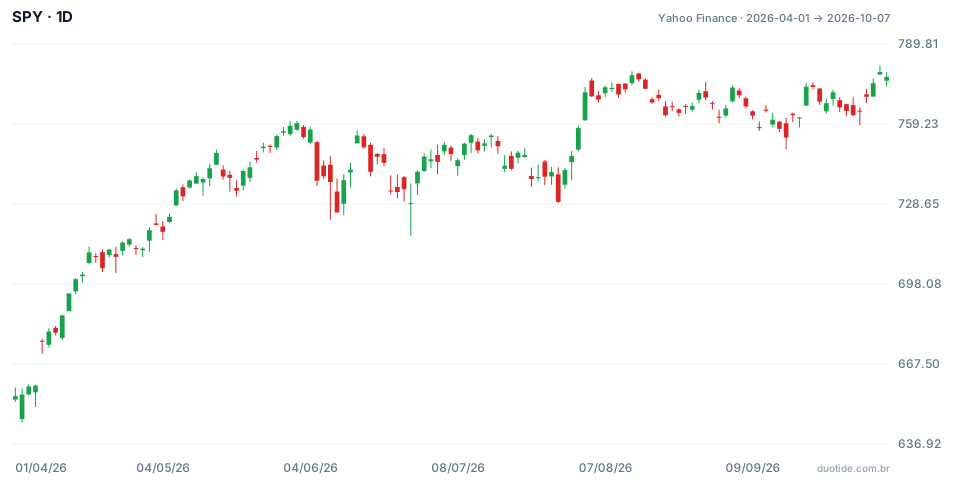
The chart shows SPY from April 1, 2026 ($655.24) to October 7, 2026 ($777.22), a 18.6% gain. The low was $645.11 on April 2, and the high, $781.62 on October 6. Three comparisons show what the basket did differently.
The worst day
SPY's biggest daily drop in the period was 2.58%, on June 5. Over the same stretch, stocks in the index had much worse days: Tesla fell 14.5% on July 23, and Apple fell 7.35% on July 31, a day when SPY rose 0.72%.
The biggest drawdown from a peak
SPY's biggest pullback from a peak close was 4.5%, through June 10. Oracle went on to accumulate a 53.7% drop from its peak in the period, IBM 37.5%, and Tesla 33.0%.
The other side of the coin
Diversification also caps the upside extremes. Between April 1 and October 7, Micron rose 195.8% and AMD 207.2%, while Nike fell 23.0%. Anyone holding only SPY stayed far from both extremes, with the basket's 18.6%. That's the price of diversification: less risk of picking the worst stock, less chance of picking the best one.

How to use ETFs
Broad market exposure
A broad index ETF is the most direct way to get an entire country's market in a single order, without depending on one company's results.
Sector and commodity ETFs
Sector ETFs concentrate exposure (technology, energy) and are less diversified. Gold or oil ETFs give access to the commodity without dealing with futures contracts directly.
Short-term trading
Since they trade all day, ETFs accept limit orders, stops, and technical analysis like any stock. Many traders use the ETF as a substitute for the index.
Costs
Every ETF charges an annual management fee, deducted from the fund's assets. SPY's is 0.0945% a year; actively managed funds usually charge much more. Compare the fee between ETFs that track the same index, and also look at the gap between the bid and ask price.
How to choose between similar ETFs
Before choosing, look at four things: the index the fund tracks and how many assets it holds; the management fee; the average daily traded volume, which sets the spread paid going in and out; and the tracking record, meaning how much the fund's return has drifted from the index's return over recent years. Two ETFs on the same index can have very different costs and liquidity, and that difference adds up every year the position stays open.
Limitations
Diversification reduces single-company risk, not market risk: if the whole index falls, the ETF falls with it. There's also tracking error, when the fund drifts a bit from the index because of costs, and liquidity risk in thinly traded ETFs.
Common mistakes when trading ETFs
- Thinking an ETF can't fall: it falls along with the index it tracks.
- Buying a sector ETF and thinking it's as diversified as a broad index.
- Ignoring the management fee and the spread on low-volume ETFs.
- Buying several ETFs that track similar indices and thinking you've diversified more.
- Forgetting that the examples above describe what happened in 2026, not what will happen.
To practice without risking money, track an index ETF and two or three stocks that are part of it on a demo account for a few weeks. Log the worst day, the best day, and the biggest drawdown for each: the difference between the basket and the individual stocks becomes clear in your own numbers.
Practice before you risk. Open your Duotide account and test your ideas on the demo account with US$10,000 in virtual funds.
Create free accountUpdated:
Editorial character of the Duotide newsroom. Articles are written by the team with the help of artificial intelligence; prices and charts come from real market data. Follows the news that moves prices — rates, stock markets, companies and commodities — explained without jargon.
Was this article helpful?
Be the first to rate it.
Comments
- No comments yet. Be the first to comment.
Ready to put it into practice?
Open your account and practice on the demo account with US$10,000 in virtual funds, without risking money.
- Secure platformProtected login and identity verification
- Multilingual supportHelp available every day
- Free demo accountUS$10,000 virtual to practice
Trading involves the risk of losing the capital invested.
