

 Português pt
 Español es
 العربية ar
 বাংলা bn
 Deutsch de
 Filipino fil
 Français fr
 हिन्दी hi
 Bahasa Indonesia id
 Italiano it
 Русский ru
 Svenska sv
 ไทย th
 Türkçe tr
 Tiếng Việt vi
 简体中文 zh
Updated:
StrategiesHow Scalping Works: What It Is, Costs, and a Real Example
 Naomi TanakaEditorial character · Analysis Desk
Quick answer
Scalping is a trading style that opens and closes many positions within the same day, each lasting seconds or minutes, aiming for small gains on each one. Since the profit per trade is small, cost (spread and commission) weighs heavily: with a 5-pip target and stop and a 1-pip spread, you need to win 60% of the time just to break even. The method requires liquid assets, written rules, and strict discipline.
Scalping is the style of traders who open and close many trades within the same day, each lasting from a few seconds to a few minutes, chasing small, repeated gains. The scalper isn't trying to catch the month's trend or the whole day's move: they want only a short slice of the price's back-and-forth, and they want it dozens of times.
It sounds simple, but it's the style where the cost of each trade and discipline weigh most heavily on the result. In this guide we use real daily EUR/USD quotes (Yahoo Finance) from April to October 2026 to show how much movement is available in a day and how much of it cost eats up.
What scalping is
In scalping, a position stays open for a short time and the target is measured in a few points or pips (in forex, 1 pip is the fourth decimal place: from 1.1250 to 1.1251). The scalper usually trades on the 1-minute or 5-minute chart, picks highly liquid assets, such as major currency pairs, indices, and high-volume futures contracts, and concentrates trades during the busiest trading hours.
Three features define the method:
- Short targets and stops: the distance to profit and to loss is small, often similar.
- Many trades: the result comes from adding up dozens of trades, not just one.
- No overnight positions: the scalper closes everything out before the session ends.

How to calculate the cost of a scalping trade
Cost is the point that most sets scalping apart from other styles. Someone holding a position for weeks pays the spread once to chase a move of hundreds of pips. The scalper pays the same spread to chase 5 or 10 pips, and pays it again on every trade.
Here's a simple calculation, with example values (spread and target vary by broker and by time of day):
- Gross target: 5 pips. Gross stop: 5 pips. Spread: 1 pip.
- Net gain on a win: 5 − 1 = 4 pips.
- Net loss on a miss: 5 + 1 = 6 pips.
- Win rate needed to break even: 6 ÷ (4 + 6) = 60%.
With no cost at all, and equal target and stop, 50% winners would be enough to break even. A single pip of spread pushed that mark to 60%. On a standard EUR/USD lot (100,000 euros), each pip is worth US$ 10: that's US$ 10 of cost per trade and US$ 200 in a day with 20 trades, before any profit.
Real example: the daily EUR/USD move in 2026
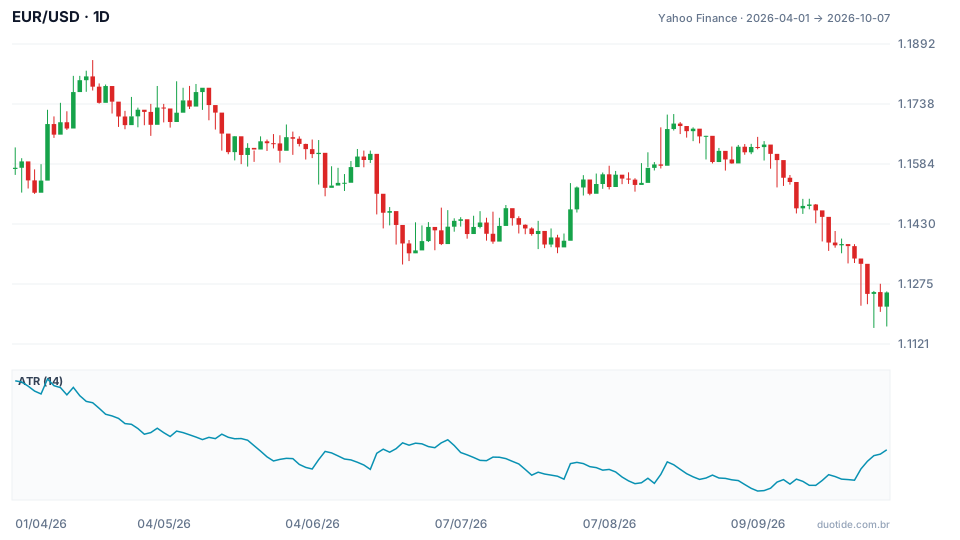
The chart shows daily EUR/USD candles and, in the lower panel, the 14-period ATR, which measures the average range of the last 14 days. It helps gauge what a 5-pip target represents within the day.
April: more room to move
On April 8, 2026, the ATR stood at 96.5 pips, the highest value in the window, with the pair at 1.16866. On April 17, EUR/USD hit the period's high, 1.18511. With that much range, a 5-pip target is about 5% of the day's average move.
September: the market shrank
On September 9, 2026, the ATR fell to 47.3 pips, practically half of April's value. The narrowest day of the period was August 11, with just 20.7 pips between the high and the low. On days like that, the same 1-pip spread weighs much more heavily on a move that barely exists, and false entries become more frequent.
October: range returns, price falls
At the start of October the pair started moving again: on October 1, the distance between the high and the low was 119.7 pips, the largest in the window, and on October 5, EUR/USD touched 1.11623, the period's low. In the most recent data, October 7, it closed at 1.12535, with an ATR of 65.4 pips. Between April 1 and October 7 the pair fell 2.77%. Across all 136 days, the average daily high-low range was 49 pips.
The lesson from these numbers: the available room changes a lot from one month to the next. A scalping plan that worked with April's wide-ranging market may stop working with September's narrow one, without the trader having changed anything.

How to use scalping with method
Choose an asset and time of day with a low spread
Since cost is the main enemy, the scalper sticks to the most liquid assets and the highest-volume hours. On EUR/USD, the overlap between the London and New York sessions tends to concentrate liquidity. Outside those hours the spread tends to widen and the price becomes more prone to jumps.
Adjust target and stop to volatility
Instead of always using 5 pips, many scalpers set target and stop as a fraction of the ATR on the chart they trade. If volatility drops by half, as it did from April to September, a fixed target becomes relatively large and takes longer to reach.
Set limits before opening the platform
The maximum number of trades, the maximum daily loss, and the time to stop should all be written down before the first order. In scalping, decisions happen too fast to be made on impulse: the rule has to be set in advance.
Log everything
With dozens of trades a day, only a log shows whether your real win rate is above the rate that breaks even on cost. Record the entry, exit, spread paid, and reason for every trade.
Limitations
Scalping demands continuous attention to the screen, fast execution, and a stable connection. Execution delays (so-called slippage) add to the spread and can turn a system that breaks even on paper into one that loses. Economic news, such as employment data and interest rate decisions, widens the spread and triggers jumps that blow past the stop. And fatigue counts: deciding hundreds of times a day wears a trader down, and mistakes tend to show up by the end of the session.
Common mistakes in scalping
- Ignoring cost: calculating the result in gross pips instead of the net amount after spread and commission.
- Using a target smaller than the stop without a proven win rate that offsets that asymmetry.
- Trading during low-liquidity hours or right as news breaks, when the spread widens.
- Increasing position size after a loss to recover quickly.
- Keeping the same fixed target when volatility changes by half, as happened with EUR/USD between April and September 2026.
- Treating the numbers in this article as a forecast: they describe what happened, not what will happen.
Before risking money, test scalping on a demo account for a few weeks. Record the real spread on every trade, calculate the win rate that breaks even on your cost, and compare it with the rate you actually achieve. If yours doesn't clear the break-even rate with room to spare, the method isn't ready yet.
Practice before you risk. Open your Duotide account and test your ideas on the demo account with US$10,000 in virtual funds.
Create free accountUpdated:
Editorial character of the Duotide newsroom. Articles are written by the team with the help of artificial intelligence; prices and charts come from real market data. Explains charts, indicators and trading strategies: how they work, where they fail and how to test them first.
Was this article helpful?
Be the first to rate it.
Comments
- No comments yet. Be the first to comment.
Ready to put it into practice?
Open your account and practice on the demo account with US$10,000 in virtual funds, without risking money.
- Secure platformProtected login and identity verification
- Multilingual supportHelp available every day
- Free demo accountUS$10,000 virtual to practice
Trading involves the risk of losing the capital invested.
