

 Português pt
 Español es
 العربية ar
 বাংলা bn
 Deutsch de
 Filipino fil
 Français fr
 हिन्दी hi
 Bahasa Indonesia id
 Italiano it
 Русский ru
 Svenska sv
 ไทย th
 Türkçe tr
 Tiếng Việt vi
 简体中文 zh
Updated:
ForexHow to Calculate Pip Value in Forex, Step by Step
 Naomi TanakaEditorial character · Analysis Desk

Quick answer
Pip value is the position size multiplied by the pip size (0.0001 on most pairs and 0.01 on yen pairs), converted to the account currency. On EUR/USD, 0.10 lot is worth US$ 1 per pip, about R$ 4.98 at the October 7, 2026 dollar rate. On USD/JPY, 1 lot is worth ¥ 1,000 per pip, about US$ 6.32, not US$ 10.
Every forex trader has heard the phrase “I made 40 pips today.” It sounds precise, but it says almost nothing on its own. Forty pips on a small position are worth a few reais; the same forty pips on a larger position can be worth hundreds. The pip distance shows the price move; the pip value shows the impact on the account.
Knowing how to calculate pip value is what turns “my stop is 25 pips away” into “my stop represents R$ 124.54 of risk.” In this guide, every example uses the real closing quotes from October 7, 2026 (Yahoo Finance): EUR/USD at 1.1254, USD/JPY at 158.30, and the dollar at R$ 4.9814.
What a pip is
A pip is the standard unit of price change in currency pairs. In most pairs, like EUR/USD and GBP/USD, a pip is 0.0001, the fourth decimal place. In pairs with the yen, like USD/JPY, a pip is 0.01, the second decimal place. Many platforms show one extra digit, the pipette, worth a tenth of a pip.
If EUR/USD goes from 1.1254 to 1.1279, it moved 25 pips. If USD/JPY goes from 158.30 to 158.55, it also moved 25 pips.

How to calculate pip value
- Pip value in the quote currency = position size × pip size
- Convert to the account currency, if different, using the exchange rate between the two
The quote currency is the second one in the pair: the dollar in EUR/USD, the yen in USD/JPY. A standard lot has 100,000 units of the first currency; 0.10 lot, 10,000; 0.01 lot, 1,000.
Reference table for EUR/USD
In EUR/USD, the quote currency is already the dollar, so pip value doesn't depend on the pair's rate. Converting to reais at the October 7, 2026 dollar rate:
- 1 lot (100,000) → 100,000 × 0.0001 = US$ 10 per pip = R$ 49.81
- 0.10 lot (10,000) → US$ 1 per pip = R$ 4.98
- 0.01 lot (1,000) → US$ 0.10 per pip = R$ 0.50
Worked example: EUR/USD
A trader opens 0.10 lot of EUR/USD with a 25-pip stop. The pip is worth US$ 1, so the risk is 25 × US$ 1 = US$ 25. In reais: 25 × 4.9814 = R$ 124.54.
Worked example: USD/JPY
Pairs with the yen are where manual calculations fail most. On 1 lot of USD/JPY, the pip is worth 100,000 × 0.01 = ¥ 1,000. To convert to dollars, divide by the rate: 1,000 ÷ 158.30 = US$ 6.32 per pip, not US$ 10.
With 0.10 lot, the pip is worth ¥ 100, or US$ 0.63. A 25-pip stop costs 25 × 0.63 = US$ 15.79, or R$ 78.67. The same position and the same stop from the EUR/USD example cost 37% less here. Anyone who assumes “0.10 lot always equals US$ 1 per pip” gets the math wrong, and the size of the error changes every time the yen's rate changes.
Real example: EUR/USD in pips in 2026
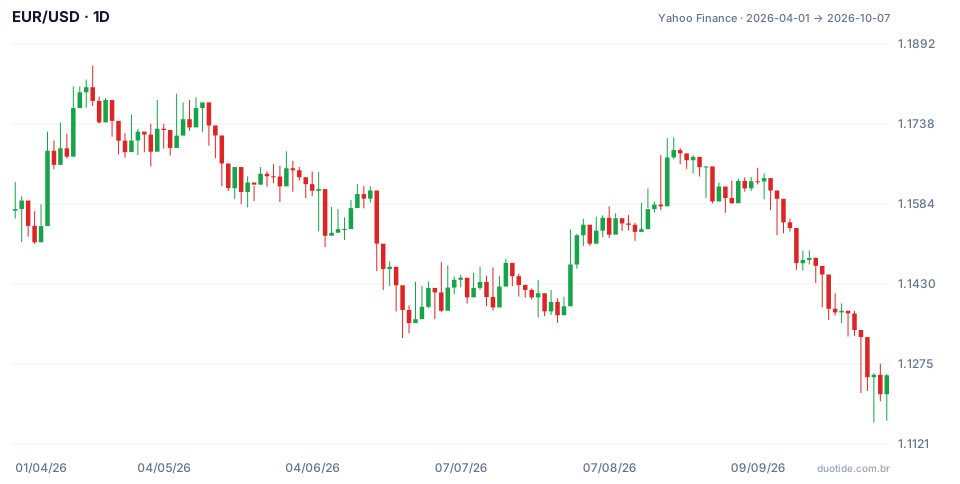
The chart shows daily EUR/USD from April 1 to October 7, 2026. Measured in pips, the period looks like this:
- From the 1.1574 close on April 1 to the 1.1254 close on October 7, the pair fell 321 pips. On 0.10 lot, that's US$ 321, or R$ 1,599.03.
- From the 1.1851 high on April 17 to the 1.1162 low in early October, that's 689 pips.
- The average daily range, from high to low, was 49.1 pips over the chart's 136 sessions and 54.7 pips over the 20 sessions through October 7.
The last number is the most useful for anyone setting stops. A 25-pip stop on EUR/USD was less than half the range of an ordinary day at that point: it can get hit by a normal swing without the trade idea being wrong.

How to use pip value
Size the position by the risk
The flow is always the same: decide where the stop invalidates the idea, measure the distance in pips, decide how much you're willing to lose, and only then calculate the size. With a R$ 5,000 account and 1% risk (R$ 50), a 25-pip stop on EUR/USD allows up to 50 ÷ (25 × 4.9814) = 0.40 of the 0.10 lot value, or about 0.04 lot.
Compare trades on different pairs
Convert everything to the account currency before comparing. 25 pips on EUR/USD and 25 pips on USD/JPY don't cost the same.
Check the platform
If the platform shows a value very different from the table above for EUR/USD, check the pair, lot size, and account currency before sending the order.
Limitations
Pip value in reais changes every day with the exchange rate, and on pairs where the quote currency isn't the account's, it also changes with the pair itself. Spread and commissions don't enter the pip calculation, but they do affect the result.
Common mistakes when calculating pip value
- Using 0.0001 as the pip on yen pairs, where the pip is 0.01.
- Assuming US$ 10 per lot on any pair.
- Forgetting to convert to the account currency.
- Confusing the pip with the pipette in the fifth decimal place.
- Rounding the stop to fit the risk, instead of reducing the position.
To practice without risking money, do the pip math before every order on a demo account and note the risk in reais next to it. Within a few weeks, “25 pips” will mean a concrete amount to you, and that amount is what protects the account. The market numbers above describe what happened, not what will happen.
Practice before you risk. Open your Duotide account and test your ideas on the demo account with US$10,000 in virtual funds.
Create free accountUpdated:
Editorial character of the Duotide newsroom. Articles are written by the team with the help of artificial intelligence; prices and charts come from real market data. Explains charts, indicators and trading strategies: how they work, where they fail and how to test them first.
Was this article helpful?
Be the first to rate it.
Comments
- No comments yet. Be the first to comment.
Ready to put it into practice?
Open your account and practice on the demo account with US$10,000 in virtual funds, without risking money.
- Secure platformProtected login and identity verification
- Multilingual supportHelp available every day
- Free demo accountUS$10,000 virtual to practice
Trading involves the risk of losing the capital invested.
