

 Português pt
 Español es
 العربية ar
 বাংলা bn
 Deutsch de
 Filipino fil
 Français fr
 हिन्दी hi
 Bahasa Indonesia id
 Italiano it
 Русский ru
 Svenska sv
 ไทย th
 Türkçe tr
 Tiếng Việt vi
 简体中文 zh
Updated:
BeginnersHow to Trade: Basic Concepts for Beginners
 Marina CostaEditorial character · Beginner's Guide

Quick answer
To start trading, understand that a trade's result is the difference between the exit price and the entry price multiplied by the quantity. Before entering, define how much you accept losing (something like 1% of capital), where the stop is, and where the target is. The quantity comes from the math money risk ÷ distance to the stop, not from how much money you have available.
Before opening your first position, it's worth understanding what happens behind the click on buy or sell. Trading isn't about guessing whether a price will rise or fall: it's deciding, with numbers in hand, how much you accept risking to try to capture a move and how you'll exit the trade, whether winning or losing.
Anyone who skips this step tends to repeat the same pattern: entering without knowing how much they can lose, increasing the size after a loss to recover quickly, and giving up within a few weeks. In this guide, the concepts come with calculations made from real daily ether quotes (ETH/USDT on Binance) between April and October 2026.
What trading means, in practice
When you buy an asset, you make money if the price rises relative to the entry; when you sell, you make money if it falls. In either case, the result is the difference between the exit price and the entry price, multiplied by the quantity traded. That simple math should be behind every decision, not the feeling that the asset is about to take off.
Three prices define a planned trade, all chosen before the entry:
- Entry: where your analysis indicates it's worth opening the position.
- Stop: the point that invalidates the idea and limits the loss.
- Target: where the profit is taken, ideally at a distance of at least twice the stop.

How to calculate the position size
The first number to calculate isn't the desired profit, but how much you accept losing on that trade. A common reference is to risk 1% to 2% of capital. With that, the formula is:
- Quantity = money risk ÷ distance to the stop
The distance to the stop needs to respect the asset's normal swing. An objective way to measure that swing is the 14-day ATR (average true range), which shows how much the price typically moves between a day's high and low. A stop of 2 times the ATR stays outside the normal back-and-forth.
Example with ether, on a US$8,000 account
The account risks 1% per trade, that is, US$80.
- April 14, 2026: ETH at US$2,322.44, ATR of US$112.51. Stop = 2 × 112.51 = US$225.02 below, at US$2,097.42. Quantity = 80 ÷ 225.02 = 0.3555 ETH, a position of US$825.68.
- August 18, 2026: ETH at US$1,917.85, ATR of US$46.24. Stop = 2 × 46.24 = US$92.48 below, at US$1,825.37. Quantity = 80 ÷ 92.48 = 0.8651 ETH, a position of US$1,659.04.
The risk is the same, US$80, on both dates. What changes is the size: when the asset is more turbulent, the position gets smaller; when it's calm, it can be larger. That's quite different from always using the same dollar amount.
Real example: the two trades on the ether chart
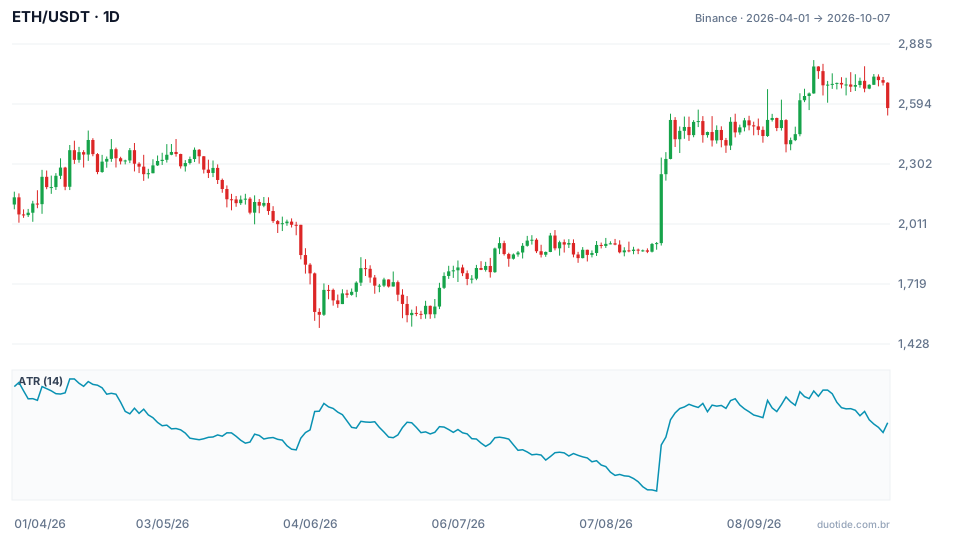
The bottom panel shows ether's 14-day ATR. It went from US$112.51 on April 14, the period's highest value, to US$46.24 on August 18, the lowest. See what happened with the two trades above, with a target at twice the stop distance:
April: the trade that got stopped out
The first trade's target sat at US$2,772.48. The price never got there: on May 17 the low was US$2,091.48 and the stop at US$2,097.42 was triggered. A loss of 0.3555 × 225.02 = US$80, exactly as planned. In the following weeks ether kept falling and hit the period's low on June 6, at US$1,505.68.
August: the trade that hit its target
The second trade's target sat at US$1,917.85 + 2 × 92.48 = US$2,102.81. Right the next day, August 19, ether jumped 17.5% and closed at US$2,252.80, blowing past the target. A gain of 0.8651 × 184.96 = US$160, twice the risk. These results are in the past and say nothing about the next trades.

How to apply these concepts
Risk-reward ratio and win rate
With a 2-to-1 target, you break even by winning one trade out of every three, because 1 ÷ (1 + 2) = 33.3%. On 10 trades with 4 wins, the balance would be 4 × US$160 − 6 × US$80 = +US$160. This only works if the losses are actually the planned size and the target isn't abandoned halfway there.
Trading journal
Write down the date, asset, reason for the entry, stop, target, quantity, and result. After 20 or 30 entries, you can answer a concrete question: did the losses come from the price going against the plan, or from you abandoning the plan early? The answer changes what needs fixing, the method or the discipline.
Total account risk
Five open positions with 1% risk each put 5% of the account on the line at the same time. If the assets move together, as often happens with cryptocurrencies, those losses can all land on the same day.
Limitations
A stop limits the loss in most cases, but not on price gaps: if the market opens well below the stop, the order fills at the first available price. The ATR also changes over time and needs to be recalculated for every trade.
Common mistakes beginners make
- Entering without knowing, before the click, how much you're willing to lose.
- Always using the same dollar amount, without looking at the asset's volatility.
- Moving the stop farther away after the price has already gone against the position.
- Increasing the next entry size to try to recover a loss.
- Trading several assets at once without adding up the total risk.
- Mistaking a winning streak for proof that the method works.
To practice without risking money, use a demo account to repeat this approach: calculate the ATR, set the stop, target, and quantity, and log every trade in a journal. Only increase the size when the process, not a single result, shows that it's working.
Practice before you risk. Open your Duotide account and test your ideas on the demo account with US$10,000 in virtual funds.
Create free accountUpdated:
Editorial character of the Duotide newsroom. Articles are written by the team with the help of artificial intelligence; prices and charts come from real market data. Answers the first questions of those just starting out: account, platform, basic concepts and common mistakes.
Was this article helpful?
Be the first to rate it.
Comments
- No comments yet. Be the first to comment.
Ready to put it into practice?
Open your account and practice on the demo account with US$10,000 in virtual funds, without risking money.
- Secure platformProtected login and identity verification
- Multilingual supportHelp available every day
- Free demo accountUS$10,000 virtual to practice
Trading involves the risk of losing the capital invested.
