

 Português pt
 Español es
 العربية ar
 বাংলা bn
 Deutsch de
 Filipino fil
 Français fr
 हिन्दी hi
 Bahasa Indonesia id
 Italiano it
 Русский ru
 Svenska sv
 ไทย th
 Türkçe tr
 Tiếng Việt vi
 简体中文 zh
Updated:
Risk managementHow to Trade Binary Options Step by Step, With Risk Management
 Camila NascimentoEditorial character · Risk & Behavior Desk

Quick answer
To trade binary options in an organized way, pick an asset you follow, match the expiry to your analysis, apply a fixed and small fraction of capital per entry, and set a loss limit per session. Above all, calculate the minimum win rate: with an 85% return, you need to win more than 54% of entries just to break even. Log every trade to find out whether the method pays off.
Knowing what a binary option is isn't the same as knowing how to trade it in an organized way. A lot of people understand the all-or-nothing mechanics and still lose money fast, because they enter without a plan: deciding the asset, the expiry, and the amount on impulse, with no criteria that can be repeated and evaluated.
This guide focuses on the practical side. Before the steps, though, comes a calculation that changes how you look at the product, made with real daily EUR/USD quotes between April and October 2026.
What a binary option is
It's a contract where you choose whether an asset's price will be above or below a level at a set expiry. If you're right, you get a fixed return on the amount invested, say 85%. If you're wrong, you lose the entire entry amount. The result doesn't depend on the size of the move, only on the direction at the moment of expiry.

How to calculate the minimum win rate
Since the gain is smaller than the loss, getting it right half the time isn't enough. The break-even win rate is:
- Minimum rate = 1 ÷ (1 + return)
- With an 85% return: 1 ÷ 1.85 = 54.1%
- With a 75% return: 1 ÷ 1.75 = 57.1%
Below that rate, the balance tends to be negative over the long run, even with more wins than losses.
Real example: EUR/USD's daily direction in 2026
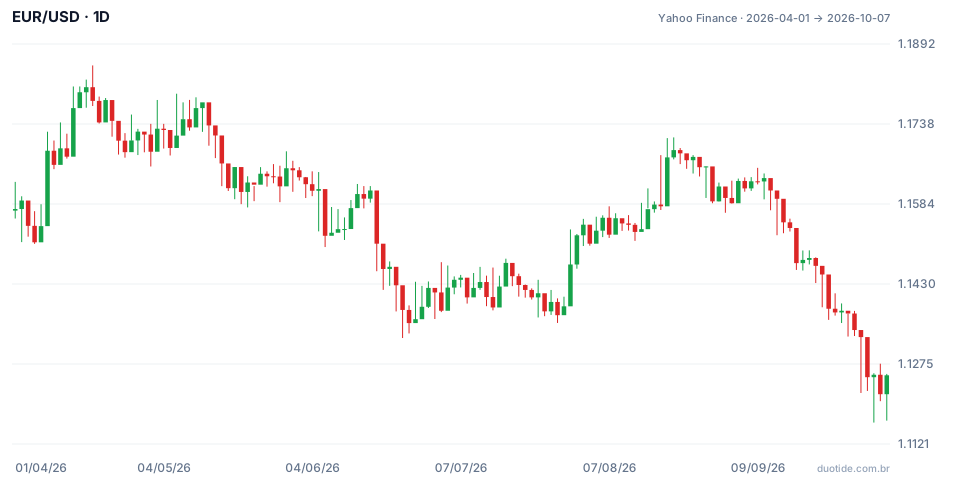
Between April 1 and October 7, 2026, EUR/USD had 136 trading days. It closed up on 63 of them (46.3%) and down on 73 (53.7%). Over the period, the pair fell from 1.15742 to 1.12535, with a high of 1.18511 on April 17 and a low of 1.11623 on October 5.
Betting on a rise every day
Anyone placing a R$100 entry betting on a rise every day, with an 85% return, would have won 63 × R$85 = R$5,355 and lost 73 × R$100 = R$7,300. Balance: −R$1,945.
Betting on a fall every day, in a market that fell
Even always betting on a fall, in a period when the pair actually fell, the result would be 73 × R$85 = R$6,205 against 63 × R$100 = R$6,300. Balance: −R$95. The 53.7% win rate fell short of the 54.1% needed. Getting the half-year's trend right didn't guarantee a gain on the daily entries.
Losing streaks
The longest streak of consecutive declines was five sessions, from September 11 to September 17, when the pair went from 1.16339 to 1.14699; there was also a five-session winning streak that ended on June 15. For anyone betting on the opposite direction, that would mean five straight losses. These numbers describe what happened, not what will happen.

How to trade binary options step by step
Step 1: pick an asset you follow
Always trading the same currency pair, index, or stock lets you recognize the times of heaviest movement and the asset's typical behavior. Switching assets with every entry, chasing whatever jumped hard in the last hour, leads to decisions in a context you don't know.
Step 2: match the expiry to your analysis
Expiries of just a few minutes depend on random noise. If your analysis is based on a move that plays out over hours, a very short expiry can make you lose even when you get the direction right, because the price swings the wrong way right before it closes.
Step 3: set the entry as a fixed fraction of capital
A reasonable reference is not exceeding 1% to 2% of capital per entry. With R$2,000 set aside, 2% is R$40. Five losses in a row, like the September streak, would cost R$200, or 10% of capital: it hurts, but you can keep going. Someone doubling the entry after every loss, starting at R$40, would lose 40 + 80 + 160 + 320 + 640 = R$1,240, 62% of capital, on that same five-loss streak.
Step 4: set a loss limit per session
Before opening the platform, decide the maximum number of entries and the loss that ends the session. For example: at most 10 entries of R$30, stopping if the loss reaches R$150. Without that limit, it's common to fall into a streak of trying to win back a loss that only makes it bigger.
Step 5: pick the time by liquidity
Currency pairs tend to have more volume when the London and New York sessions overlap; stocks, in the first and last hour of the trading day. Outside these windows, moves tend to be more erratic.
Step 6: log every trade
Write down the asset, time, expiry, amount, reason for the entry, and result. After 50 to 100 entries, calculate your win rate and compare it with the minimum rate for the return offered. It's that comparison, not the memory of your last few trades, that tells you whether the method pays off.
Limitations
Binary options are a high-risk product, with total loss of the entry on every wrong call. The return offered varies by asset and time, and the minimum rate changes along with it. Also check whether the platform is authorized to operate in your country.
Common mistakes when trading binary options
- Thinking that winning more than half the time is enough, without calculating the minimum rate.
- Doubling the entry after every loss to recover faster.
- Trading with no entry criteria, just reacting to the chart in real time.
- Ignoring the session's loss limit because the next one is going to win.
- Choosing expiries too short for the analysis you're doing.
- Judging the method by a handful of entries, with no log.
To practice without risking money, follow this approach on a demo account for a few weeks and log every entry. At the end, compare your win rate with the minimum rate for the return offered: the result shows, with your own data, whether it's worth continuing.
Practice before you risk. Open your Duotide account and test your ideas on the demo account with US$10,000 in virtual funds.
Create free accountUpdated:
Editorial character of the Duotide newsroom. Articles are written by the team with the help of artificial intelligence; prices and charts come from real market data. Writes about risk management, position sizing and the psychology behind traders' decisions.
Was this article helpful?
Be the first to rate it.
Comments
- No comments yet. Be the first to comment.
Ready to put it into practice?
Open your account and practice on the demo account with US$10,000 in virtual funds, without risking money.
- Secure platformProtected login and identity verification
- Multilingual supportHelp available every day
- Free demo accountUS$10,000 virtual to practice
Trading involves the risk of losing the capital invested.
