

 Português pt
 Español es
 العربية ar
 বাংলা bn
 Deutsch de
 Filipino fil
 Français fr
 हिन्दी hi
 Bahasa Indonesia id
 Italiano it
 Русский ru
 Svenska sv
 ไทย th
 Türkçe tr
 Tiếng Việt vi
 简体中文 zh
Updated:
Risk managementHow to Use Stop Loss and Take Profit in Forex
 Camila NascimentoEditorial character · Risk & Behavior Desk

Quick answer
In forex, first set how much you can lose in money (for example, 1% of the account), then the stop distance in pips, ideally based on the chart's structure or a multiple of the ATR, and only then the position size. The take profit usually sits at a multiple of the stop, such as twice it, or at the next support or resistance. Both orders should be set before entry.
In forex, where prices move in fractions of a cent all the time, deciding where to exit a trade is just as important as deciding where to enter. The two basic tools for that are the stop loss, which limits the loss, and the take profit, which locks in the planned gain. Used before entry, they take the exit out of the realm of emotion.
In this guide, instead of made-up numbers, we use EUR/USD's real daily quotes between April and October 2026 to calculate the stop, target, and position size.
What stop loss and take profit are
The stop loss is an order that automatically closes the trade when the price reaches a defined level against you. The take profit does the same in the opposite direction, when the price reaches the profit target. Both solve the same problem: without them, the exit is left to the mood of the moment, exactly when most people make their worst decisions.
How to calculate stop loss and take profit in pips
On EUR/USD, a pip is the fourth decimal place: 0.0001. On a standard lot of 100,000 euros, each pip is worth $10; on 10,000 units, $1. The math always follows this order:
- 1. Dollar risk: capital × risk percentage per trade.
- 2. Stop distance in pips: from the chart's structure or from volatility (for example, 1.5 × ATR).
- 3. Pip value: dollar risk ÷ stop distance.
- 4. Take profit: a multiple of the stop distance or the next support or resistance.
Example with real EUR/USD data
On September 16, 2026, EUR/USD closed at 1.15376, with a 14-day ATR of 50.3 pips. Imagine a short entered at that close, in a $5,000 account with 1% risk.
- Dollar risk: 5,000 × 1% = $50.
- Stop at 1.5 × ATR: 1.5 × 50.3 = 75.45, rounded to 75 pips → stop at 1.16126.
- Pip value: 50 ÷ 75 = $0.67; the closest size is 6,600 units ($0.66 per pip), with a risk of 75 × 0.66 = $49.50.
- Take profit at a 1-to-2 ratio: 150 pips → target at 1.13876, a gain of 150 × 0.66 = $99.00.
What happened: the highest high after the entry was 1.14978, on September 17, far from the stop. On September 23 the day's low reached 1.13847 and the target was filled. This is a case that worked out; the same calculation applies to the ones that don't, and in those the loss stays at the planned $49.50.
Real example: EUR/USD's volatility in 2026
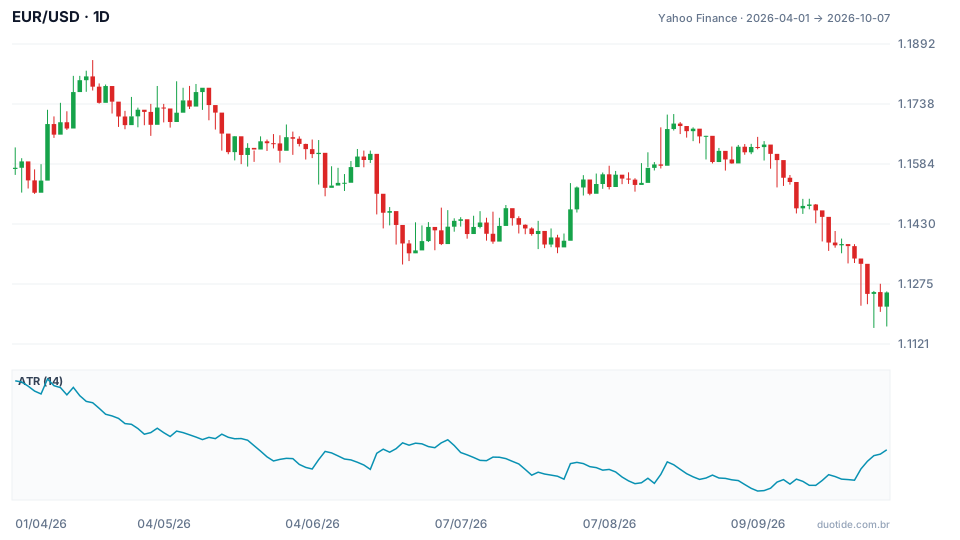
The chart shows EUR/USD's 14-day ATR. It changed quite a bit over the period, and that changes the right stop distance.
April: ATR near 96 pips
On April 8 the ATR reached 96.5 pips, the highest value of the period, with the pair at 1.16866. A fixed 50-pip stop, at that point, sat about half a typical day's swing away.
September: ATR below 50 pips
On September 9 the ATR fell to 47.3 pips, the lowest value of the period, with the pair at 1.16274. The same 50-pip stop became more than a full day's typical swing. April's volatility was about double September's.
October: a 120-pip day
On October 1 the pair swung between 1.13392 and 1.12194, a range of 119.8 pips, more than double the previous day's ATR (52.0 pips). Stops that were too tight got hit on that single session. On October 7 the ATR was at 65.4 pips, and the pair closed at 1.12535, 2.77% below the start of April. These numbers describe what happened, not what will happen.

How to use stop loss and take profit in forex
Place the stop where the idea becomes wrong
The stop should sit at a point that, if reached, invalidates the trade: a bit below a support on a long, a bit above a resistance on a short. The ATR helps check whether that distance isn't inside the day's normal noise.
Calculate the size after the stop
First the dollar risk, then the distance, and the size last. Doing it backwards, picking the lot size and only then seeing where the stop fits, is the most common way to end up risking more than intended.
Risk-reward ratio
With a target at twice the risk, the win rate that breaks even is 33%: one winning trade pays for two losing ones. At a 1-to-3 ratio, it drops to 25%. Spread and swap costs raise that rate and need to be included in the math.
Adjust, but don't move the stop farther away
Moving the stop closer to protect a gain is management. Moving it farther away to give the trade one more chance turns a small, planned loss into a big, unplanned one.
Limitations
The stop doesn't guarantee the price: on big news or at the Monday open, the market can jump past the level and the order gets filled worse. And the ATR is calculated from the past, so it doesn't anticipate a 120-pip day like October 1's.
Common mistakes with stop loss and take profit in forex
- Always using the same number of pips, no matter the pair's volatility.
- Choosing the lot size before knowing where the stop will sit.
- Setting the target so close that the gain doesn't pay for the losses.
- Moving the stop farther away when the price gets close to it.
- Forgetting spread and swap when calculating the real risk.
To practice without risking money, open EUR/USD in a demo account, add the 14-period ATR, and calculate the stop, target, and size before each trade, following the order above. Record the result of each one over a few weeks: your journal will quickly show whether your stop is too tight for the pair.
Practice before you risk. Open your Duotide account and test your ideas on the demo account with US$10,000 in virtual funds.
Create free accountUpdated:
Editorial character of the Duotide newsroom. Articles are written by the team with the help of artificial intelligence; prices and charts come from real market data. Writes about risk management, position sizing and the psychology behind traders' decisions.
Was this article helpful?
Be the first to rate it.
Comments
- No comments yet. Be the first to comment.
Ready to put it into practice?
Open your account and practice on the demo account with US$10,000 in virtual funds, without risking money.
- Secure platformProtected login and identity verification
- Multilingual supportHelp available every day
- Free demo accountUS$10,000 virtual to practice
Trading involves the risk of losing the capital invested.
