

 Português pt
 Español es
 العربية ar
 বাংলা bn
 Deutsch de
 Filipino fil
 Français fr
 हिन्दी hi
 Bahasa Indonesia id
 Italiano it
 Русский ru
 Svenska sv
 ไทย th
 Türkçe tr
 Tiếng Việt vi
 简体中文 zh
Updated:
Risk managementMartingale Strategy in Trading: How It Works and Why It's So Risky
 Camila NascimentoEditorial character · Risk & Behavior Desk

Quick answer
Martingale is the strategy of doubling the size of the next trade after every loss, so the first win recovers everything. In practice it requires capital that grows in a geometric progression: starting with R$ 100, seven losses in a row already add up to R$ 12,700. Sequences like this happen in real markets, which is why martingale sharply raises the risk of wiping out the account.
Few strategies spark as much debate as martingale. The idea is easy to grasp, and that simplicity is probably what makes it so appealing to beginners: double the size of the next trade after every loss, expecting that the first win will recover everything lost and still leave a small profit.
In this guide we run the martingale numbers with real figures, including a real sequence of seven losing days in a row for bitcoin in 2026, and show why most risk managers recommend avoiding the strategy.
What martingale is
Martingale was born as a betting system in the 18th century, applied to games with roughly 50% odds, like coin flips. The rule has three lines: bet a starting amount; if you lose, double the next bet; if you win, go back to the starting amount. Since each win theoretically covers all previous losses plus the first bet's profit, the strategy looks like it guarantees a positive result, as long as there's money to keep doubling.
In trading, the logic is the same: after a losing trade, the size of the next position is doubled (or increased a lot) to recover the loss as soon as a win comes.

How to calculate martingale
With 1-to-1 payout, the bet on round n is the starting amount × 2 raised to (n − 1), and the total lost after n losses is the starting amount × (2 raised to n − 1). Starting with R$ 100:
- Rounds 1 to 4: R$ 100, R$ 200, R$ 400, and R$ 800 → accumulated loss of R$ 1,500
- Rounds 5 to 7: R$ 1,600, R$ 3,200, and R$ 6,400 → accumulated loss of R$ 12,700
- The eighth bet needs to be R$ 12,800 to return a R$ 100 profit if it works out
When the payout is below 100%
In fixed-payout trades, the gain is a percentage of the amount, for example 85%, and the loss is the full amount. There, doubling isn't enough: the next entry needs to be (accumulated losses + desired profit) ÷ 0.85. Starting with R$ 100 to win R$ 85, the second entry is already R$ 217.65; the fifth, R$ 2,243.94; and after seven losses in a row the accumulated loss is R$ 19,579.76, with the eighth entry at R$ 23,135.01 to recover everything and win the same R$ 85.
Real example: seven straight down days for bitcoin in 2026
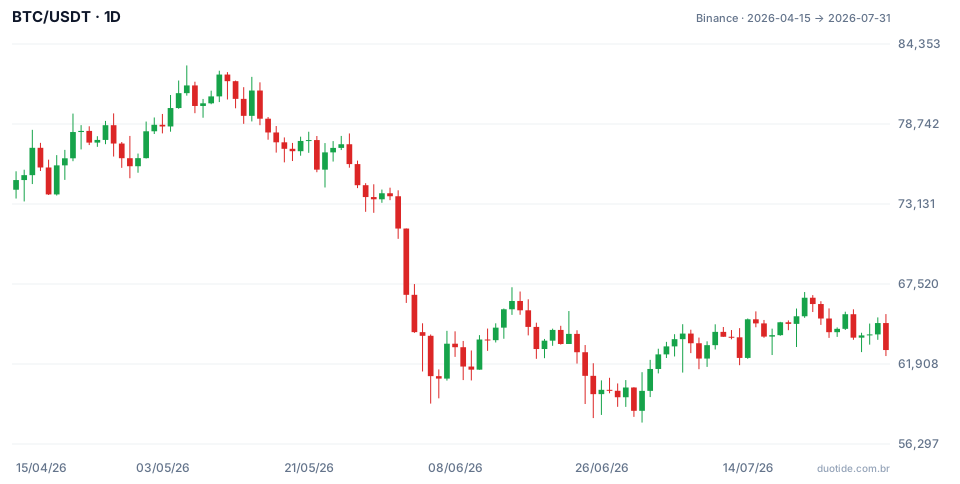
The chart shows BTC/USDT from April 15, 2026 ($74,809.99) to July 31, 2026 ($62,887.88). In early June it shows exactly the kind of sequence that destroys a martingale.
The sequence
Bitcoin closed May 30 at $73,884.38. From there, it closed lower seven days in a row, from May 31 to June 6, ending at $60,884.62: 17.6% lower. Only on June 7 did it close higher again, at $63,332.01.
What would have happened with a martingale
Imagine someone betting every day on the next day's rise, with a R$ 100 starting bet, 1-to-1 payout, and a R$ 10,000 account. After six losses (May 31 to June 5), they would already have lost R$ 6,300 and would need to put R$ 6,400 on the seventh, but only R$ 3,700 would be left. The account can't sustain the sequence, and the recovery on June 7 would come too late. With an 85% payout, the breaking point would come even sooner: after five losses the accumulated loss would already be R$ 4,066.29, and the sixth entry, R$ 4,883.87.
This isn't rare
In bitcoin's daily data on Binance from July 2018 to October 2026, there were six sequences of seven or more down closes in a row, two of them with eight. On EUR/USD, between July 1, 2022, and July 15, 2022, there were ten down closes in a row. And even in a game with exactly 50% odds, the math is clear: in 500 trades, the chance of seeing at least one sequence of seven losses is about 86%; of eight losses, about 63%.

Why martingale fails in practice
Limited capital
The system only works with infinite money. Since the loss grows in a geometric progression, the account runs out much sooner than intuition suggests.
Position and margin limits
Platforms and exchanges impose maximum position sizes and require growing margin, which can stop the sequence partway through, with the loss already locked in.
Small gain, huge loss
Martingale trades many small gains for one rare, gigantic loss. The equity curve looks great for weeks and then collapses all at once. That scenario, running out of capital in the middle of a bad streak, is the risk of ruin, and it's far greater in martingale than in any fixed-risk approach.
Limits of the alternatives
Risking a fixed percentage of the account, such as 1% per trade, doesn't turn a bad strategy into a good one: it just guarantees that a losing streak costs little. With 1%, seven losses in a row cost about 6.8% of the account, not the whole account.
Common mistakes with martingale
- Thinking a long losing streak is too unlikely to happen to you.
- Forgetting that, with a payout below 100%, doubling doesn't recover the loss.
- Increasing exposure right when your read on the market is getting worse.
- Confusing martingale with averaging down on an asset you've studied: both increase the position against you and require a hard limit.
- Judging the strategy after a few weeks of small gains, before the bad streak shows up.
- Forgetting that the examples above describe what happened, not what will happen.
To see this without risking money, run the simulation on a demo account or in a spreadsheet: log the result of each trade with a fixed size and, next to it, what would have happened with martingale. Within a few weeks the record shows the difference between a curve that swings and one that can wipe out all at once.
Practice before you risk. Open your Duotide account and test your ideas on the demo account with US$10,000 in virtual funds.
Create free accountUpdated:
Editorial character of the Duotide newsroom. Articles are written by the team with the help of artificial intelligence; prices and charts come from real market data. Writes about risk management, position sizing and the psychology behind traders' decisions.
Was this article helpful?
Be the first to rate it.
Comments
- No comments yet. Be the first to comment.
Ready to put it into practice?
Open your account and practice on the demo account with US$10,000 in virtual funds, without risking money.
- Secure platformProtected login and identity verification
- Multilingual supportHelp available every day
- Free demo accountUS$10,000 virtual to practice
Trading involves the risk of losing the capital invested.
