

 Português pt
 Español es
 العربية ar
 বাংলা bn
 Deutsch de
 Filipino fil
 Français fr
 हिन्दी hi
 Bahasa Indonesia id
 Italiano it
 Русский ru
 Svenska sv
 ไทย th
 Türkçe tr
 Tiếng Việt vi
 简体中文 zh
Updated:
Risk managementWhen to Close a Trade: 5 Exit Signals
 Camila NascimentoEditorial character · Risk & Behavior Desk

Quick answer
Close a trade when the exit rule set before the entry is reached: the stop loss, if the market goes against you; the target, a trailing stop, or a technical signal, if it goes your way; or a maximum time limit, if nothing happens. The right exit depends on the type of move, and what matters most for the result is deciding the rule in advance and sticking to it.
A lot gets said about how to enter a trade: which indicator to use, which candle to wait for, which news to watch. Much less gets said about how to exit, and that's where a good part of the result gets decided. A good entry with a bad exit can turn into a loss; a planned exit keeps a small loss from growing.
To compare the methods with real numbers, we applied all five to the same hypothetical purchase of Apple (AAPL) shares, using real daily quotes from April to October 2026.
The Reference Trade
On April 7, 2026, Apple closed at $253.50, below the 20-day exponential moving average (EMA 20), which stood at $254.72. On April 8 it moved back above it, closing at $258.90. Let's assume a buy at that close. What changes from one method to another is just the exit rule.

Real Example: Five Exits for the Same Purchase
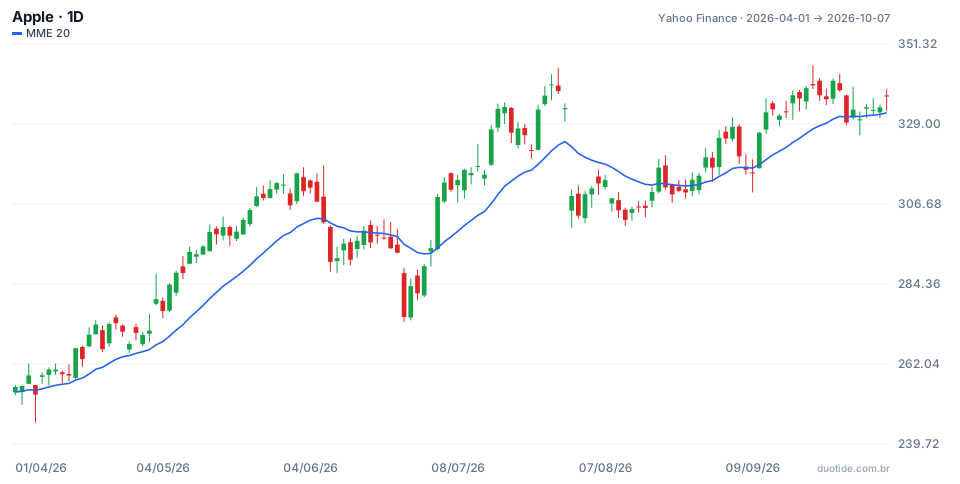
The chart shows Apple with the EMA 20. Over the period, the stock went from $255.63 (April 1) to $336.67 (October 7), a 31.7% gain, with a low of $245.70 on April 7 and a high of $345.34 on September 22.
1. Stop Loss: The Loss Limit
This is the most important exit: a price set before the entry that closes the trade if the market goes against you. Here, a logical point is below the April 7 low ($245.70), say at $245.00. A risk of $13.90 per share, or 5.4%. In this case the stop was never hit: the lowest low through June 9 was $256.07. It existed for the scenario that didn't happen, and that's exactly what it's for.
2. Take Profit: Fixed Target
With a target of 5% above the entry ($271.85), the trade would have closed on April 17, when the high reached $272.30. A gain of $12.95 per share. It's the most predictable exit, but it left out all the rest of the rally.
3. Time Exit
If the rule were to exit after 10 trading days, the trade would end on April 22 at $273.17, a gain of $14.27, or 5.5%. The time exit serves to avoid leaving capital tied up in an idea that lost steam; here, it cut short a trade that was working out well.
4. 5% Trailing Stop
The trailing stop follows the price when it moves favorably. With the rule of exiting on the first close that's 5% below the highest close since entry, the stop rose along with it up to the record close of $315.20 on June 2, settling at $299.44. On June 9 the stock closed at $290.55, below that level, and the exit happened there. A gain of $31.65 per share, or 12.2%.
5. Technical Signal Exit: Close Below the EMA 20
Exiting on the first close below the average, the trade would end on June 8, at $301.54, with the EMA 20 at $302.55. A gain of $42.64 per share, or 16.5%. In this trade it was the best result, but the same rule had a different outcome in July: buying on the move back above the average, on July 1 at $294.38, the exit came on July 31 at $308.91, a 4.9% gain, after the stock had closed at $340.08 on July 28.
What the Comparison Shows
- Fixed target and time exit: gains of 5.0% and 5.5%, fast, but short in a strong trend.
- 5% trailing stop: 12.2%, giving back part of the move.
- Moving average: 16.5% in April and June, but only 4.9% in July.
No method was the best in every situation. The numbers describe what happened with this stock in this period, not what's going to happen.
How to Use Each Exit
Stop Loss Always, Together with Another Rule
The stop loss protects; the other exits lock in the gain. Combine the stop from the entry with a fixed target, a trailing stop, or a technical exit. Deciding the exit after already being in the trade tends to turn into an emotional decision.
A Strong Trend Calls for an Exit That Follows
In long moves, a trailing stop and a moving-average exit usually capture more than a fixed target, at the cost of giving back part of the gain when the price turns.
A Sideways Market Calls for a Fixed Target
When the price moves within a range, targets calculated from the recent range tend to be more predictable than waiting for a technical signal that arrives late.
Limitations: The Stop Isn't a Price Guarantee
On July 31, Apple opened at $304.81, 8.6% below the previous close ($333.43). A trailing stop sitting at $323.08 that day would have been executed near the open, about $18 below the planned level. Price gaps between one trading day and the next, like the ones that happen after earnings, make the actual exit worse than the planned one. The bigger the position, the bigger the effect.

Common Mistakes When Exiting
- Entering without a stop loss and deciding the exit only once the price is already against you.
- Moving the stop farther away as the price approaches it, to give hope more room.
- Taking profit too early out of fear, and holding a loss too long hoping it comes back.
- Switching the exit method in the middle of the trade.
- Thinking the stop guarantees the exit price, forgetting the gaps between one trading day and the next.
- Choosing the method by the best result from a single example, without testing it over many trades.
To find out which exit fits your style, do what we did here: in a demo account, apply two or three exit rules to the same entry and note each one's result over several weeks. The record, not the impression of one good trade, is what shows which rule works for you.
Practice before you risk. Open your Duotide account and test your ideas on the demo account with US$10,000 in virtual funds.
Create free accountUpdated:
Editorial character of the Duotide newsroom. Articles are written by the team with the help of artificial intelligence; prices and charts come from real market data. Writes about risk management, position sizing and the psychology behind traders' decisions.
Was this article helpful?
Be the first to rate it.
Comments
- No comments yet. Be the first to comment.
Ready to put it into practice?
Open your account and practice on the demo account with US$10,000 in virtual funds, without risking money.
- Secure platformProtected login and identity verification
- Multilingual supportHelp available every day
- Free demo accountUS$10,000 virtual to practice
Trading involves the risk of losing the capital invested.
