

 Português pt
 Español es
 العربية ar
 বাংলা bn
 Deutsch de
 Filipino fil
 Français fr
 हिन्दी hi
 Bahasa Indonesia id
 Italiano it
 Русский ru
 Svenska sv
 ไทย th
 Türkçe tr
 Tiếng Việt vi
 简体中文 zh
Updated:
MarketsHow to Trade CFDs in Practice: Margin, Stop, and Result
 Rafael AzevedoEditorial character · Markets Desk
Quick answer
To trade CFDs in practice, first decide how much you accept losing, set the stop at a distance that matches the asset's volatility, and only then calculate the position size. The margin is just a fraction of the exposure: gains and losses are calculated on the full value, which is why leverage amplifies both sides. Include the spread and the overnight financing fee in the math.
CFD stands for contract for difference: instead of buying the asset, you trade a contract whose result is the difference between the entry price and the exit price. That lets you trade the rise and fall of stocks, indices, currencies, and commodities without actually owning the asset, but it also brings leverage, holding costs, and the risk of losing faster than you'd expect.
This guide is practical. Instead of made-up numbers, we use real daily quotes for Apple stock (AAPL) between April and October 2026 to build three complete trades, from the margin calculation to the exit.
What a CFD is, in practical terms
When you open a CFD, you don't deposit the position's full value, just a margin, a percentage of it. With a 20% margin, for example, US$586 controls an exposure of about US$2,930. The rest works as leverage built into the contract: gains and losses are calculated on the full exposure, not on the margin.
Three numbers define any trade: the position size (how many units), the distance to the stop, and the cost of keeping the position open overnight, the so-called overnight financing fee. That cost varies by instrument and appears in the contract specification on the platform.

How to calculate a CFD trade
The approach below starts from the risk, not the desired profit. We'll use a US$10,000 account that accepts losing 1% (US$100) per trade and a stop of 1.5 times the 14-day ATR, the indicator that measures the average daily price range.
Step by step with Apple on April 15, 2026
- Entry: buy at the April 15 close, at US$266.43. The 14-day ATR was at US$5.90.
- Stop: 1.5 × 5.90 = US$8.85 below the entry, that is, US$257.58.
- Size: US$100 ÷ 8.85 = 11.3 units, rounded down: 11 units.
- Exposure: 11 × 266.43 = US$2,930.73. 20% margin: US$586.15.
- Target: twice the stop distance, 2 × 8.85 = 17.70, that is, US$284.13.
The target was hit on May 1, when the day's high reached US$287.22. Result: 11 × 17.70 = US$194.70. The stock moved 6.6%, but against the deposited margin the gain was 33.2%. That's the effect of leverage, and it works exactly the same way in reverse.
Real example: Apple's volatility in 2026
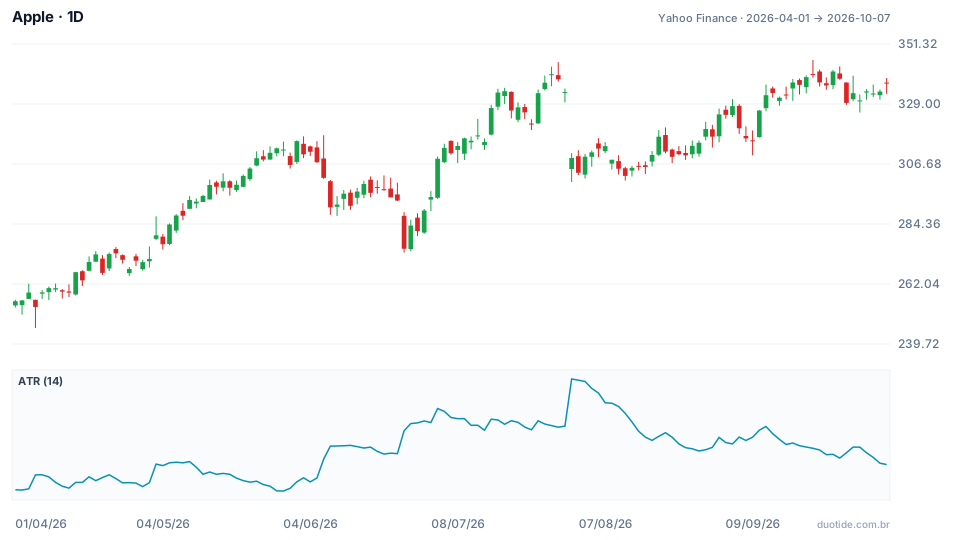
The bottom panel shows the 14-day ATR. It ranged between US$5.57 (May 29) and US$9.87 (July 31), and ended the period at US$6.58. The higher the ATR, the wider the stop needs to be and the smaller the position for the same risk. The other two trades show what can go wrong even with everything calculated:
September: stop hit before the rally
Buy on September 1 at US$325.13, with the ATR at US$7.63. Stop of 1.5 × 7.63 = US$11.45, at US$313.68; a position of 8 units (100 ÷ 11.45 = 8.7). On September 9 the day's low was US$309.90, and the stop was triggered: a loss of 8 × 11.45 = US$91.60. In the following days the stock rose and closed September 22 at US$339.75. The stop did what it was supposed to: it limited the loss to the planned amount. There's no stop that only triggers when the price is going to keep falling.
June: the opening gap
Buy on June 3 at US$310.26, with the ATR at US$6.07. Stop of 1.5 × 6.07 = US$9.11, at US$301.15; a position of 10 units, with a planned loss of US$91.10. On June 8 the low stopped at US$301.17, two cents above the stop. The next day the stock opened at US$300.75, already below it, and the order was filled at the open: a loss of 10 × (310.26 − 300.75) = US$95.10. Here the gap was small; on big news it can be much larger. On June 25 Apple closed at US$275.15.

How to trade CFDs day to day
Pick a few assets and know the contract
Before trading, read the CFD specification: minimum size, required margin, trading hours, typical spread, and overnight fee. The same stock can have different margins during periods of higher volatility.
Calculate the result before you click
Entry, stop, size, and target must be defined before the order. If the calculated size falls below the contract's minimum, the trade doesn't fit your account with that stop: reduce the risk or skip it.
Count the cost of holding the position
A trade that lasts two weeks pays financing every single night, including weekends. On long trades, this cost can eat up a meaningful part of the gain. Add it to the risk-and-return math.
Limitations
A stop doesn't guarantee the price: on opening gaps, the order fills at the first available price. Leverage amplifies gains and losses in the same proportion, and many platforms close positions automatically when free margin runs out.
Common mistakes when trading CFDs
- Choosing the size by the available margin, instead of by the stop distance.
- Using the entire account margin on a single position, with no room for normal swings.
- Moving the stop farther away when the price gets close to it.
- Ignoring the financing fee on trades that last several days.
- Assuming a stop eliminates the risk of a price gap between one session and the next.
- Drawing conclusions from a single trade: the examples above show what happened, not what will happen.
To practice without risking money, repeat this approach on a demo account with the asset you follow: write down the entry, ATR, stop, size, margin, and result of every trade. After 20 or 30 logs, you'll have a real sense of how much leverage weighs on your result.
Practice before you risk. Open your Duotide account and test your ideas on the demo account with US$10,000 in virtual funds.
Create free accountUpdated:
Editorial character of the Duotide newsroom. Articles are written by the team with the help of artificial intelligence; prices and charts come from real market data. Follows the news that moves prices — rates, stock markets, companies and commodities — explained without jargon.
Was this article helpful?
Be the first to rate it.
Comments
- No comments yet. Be the first to comment.
Ready to put it into practice?
Open your account and practice on the demo account with US$10,000 in virtual funds, without risking money.
- Secure platformProtected login and identity verification
- Multilingual supportHelp available every day
- Free demo accountUS$10,000 virtual to practice
Trading involves the risk of losing the capital invested.
