

 Português pt
 Español es
 العربية ar
 বাংলা bn
 Deutsch de
 Filipino fil
 Français fr
 हिन्दी hi
 Bahasa Indonesia id
 Italiano it
 Русский ru
 Svenska sv
 ไทย th
 Türkçe tr
 Tiếng Việt vi
 简体中文 zh
Updated:
StocksIonQ (IONQ) stock in 2026: quantum computing, volatility, and risk
 Rafael AzevedoEditorial character · Markets Desk

Quick answer
IonQ (IONQ) is a trapped-ion quantum computing company whose revenue grew about 200% in 2026, though it still had no operating profit. The stock rose 171% between the March low and the May high, then fell 50.7% through July, closing on October 7 down 7.9% for the year. With an average daily swing above 6% of the price, position sizing matters as much as the company analysis.
IonQ is one of the most frequently mentioned companies when it comes to quantum computing. In 2026 revenue grew at a pace rare for a hardware company, the company announced a billion-dollar acquisition, and expanded contracts with governments. At the same time, it remained without operating profit and carried a valuation that already priced in much of that growth.
The result of that shows up in the chart: IonQ stock (ticker IONQ, in the United States) saw extreme swings throughout the year. This article gathers the numbers the company released through mid-2026 and uses the actual daily chart to show the size of those swings and how to account for them. Nothing here is a recommendation to buy or sell.
What IonQ does
IonQ builds quantum computers based on trapped ions: electrically charged atoms, held in place by electromagnetic fields, act as qubits, the quantum processing units. It is a different approach from the superconducting circuits used by other companies in the sector.
The company designs and operates the hardware, provides the software tools to program it, and sells cloud access, through the major platforms, to governments, researchers, and businesses. It also invests in quantum networks and announced the purchase of a semiconductor company for about $1.8 billion, to bring part of chip manufacturing in-house.

The numbers released in 2026
- First-quarter 2026 revenue of $64.7 million, almost seven times the same quarter a year earlier, about 30% above the company's own guidance.
- Annual revenue guidance raised to $260 million to $270 million. In July, trailing-12-month revenue totaled $130.0 million, up 201.9%.
- Remaining performance obligations (RPO) backlog of about $470 million, roughly five times higher than a year earlier, with customers in more than 30 countries.
- Technical roadmap targeting a 256-qubit system by the end of 2026 and, long term, fault-tolerant machines with more than 10,000 qubits.
The math shows the size of the bet: the midpoint of the guidance, $265 million, is a little more than double the $130 million from the prior 12 months. The stock now depends on that pace holding up quarter after quarter.
Real example: IONQ stock and the ATR in 2026
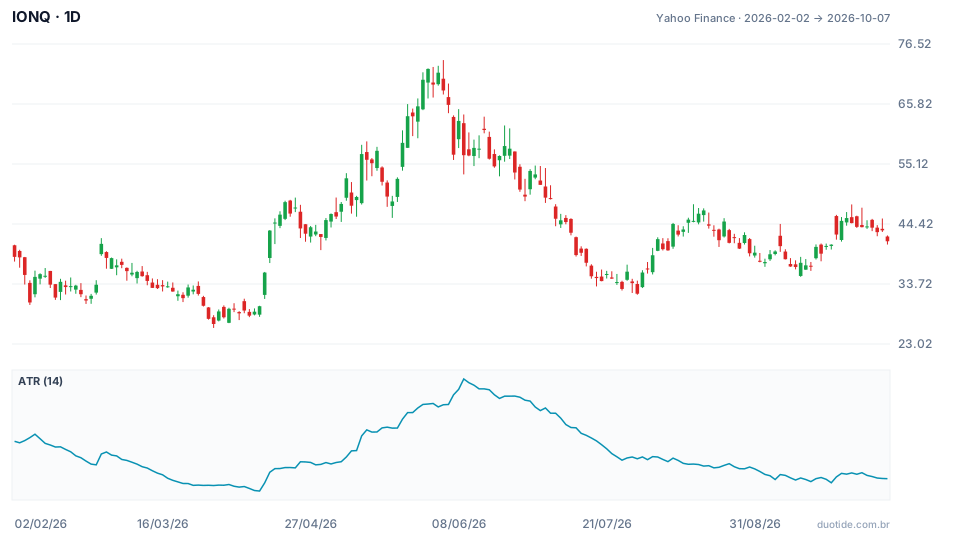
The chart shows IONQ's daily candles (Yahoo Finance) and, in the panel below, the 14-day ATR, which measures the average daily price range in dollars. The stock closed 2025 at $44.87 and, on October 7, 2026, stood at $41.34, down 7.9% for the year. The annual result hides an extreme path.
March to May: from $26 to $72
On March 30 the stock made its lowest close of the year, $26.59. On April 14 and 15 it rose 20.2% and 21.0% on consecutive days, from $29.76 to $43.25, a 45.3% gain over two sessions. On May 29 it closed at $72.07, the year's closing high, 171% above the March low.
June and July: volatility explodes and the price is cut in half
On June 5 the stock fell 13.5% in a single day. The ATR reached the period's highest value on June 9: $6.05, or 10.7% of the closing price ($56.69). On July 21, IONQ closed at $35.51, 50.7% below the May high.
August to October: lower volatility, still high
On October 7 the ATR stood at $2.62, or 6.3% of the price. That is less than in June, but it still means an ordinary day moves the stock more than 6%, something that for many large-cap companies only happens on earnings day.

How to analyze and trade such a volatile stock
Calculate position size using the ATR
Suppose a $10,000 account willing to risk 1% per trade ($100), with a stop of 2 times the ATR:
- On June 9: stop = 2 × 6.05 = $12.10 per share. Position = 100 ÷ 12.10 = 8 shares, about $453.52 at $56.69.
- On October 7: stop = 2 × 2.62 = $5.24 per share. Position = 100 ÷ 5.24 = 19 shares, about $785.46 at $41.34.
The dollar risk is the same in both cases; what changes is the number of shares. When the ATR is high, the position has to be smaller.
Track the data that supports the price
Every quarter, compare revenue with the annual guidance, watch how the RPO backlog evolves, and track the cash-burn rate. Progress on the in-house manufacturing acquisition and execution of the technical roadmap toward larger systems also matter.
Competition and market maturity
Large technology companies are also investing heavily in quantum computing, and it is still unclear when the commercial market will mature enough to sustain the expected growth.
Limitations
The ATR measures how much the price has moved, not the direction. A stop based on it does not protect against gap openings, which are common in small-cap stocks after news. The business numbers cited are from the first half of 2026 and change quickly for a company at this stage.
Common mistakes when analyzing IonQ stock
- Confusing revenue growth with profit: the company still was not generating operating profit.
- Using the same position size as for a stable stock on one that had already swung more than 10% in a day several times that year.
- Buying after two days of 20% gains, assuming the move will keep going at the same pace.
- Ignoring the execution risk of the billion-dollar acquisition and the technical roadmap.
- Treating the quantum sector as a single block, without comparing technologies and competitors.
- Reading the 2026 chart as a forecast: it describes what happened, not what will happen.
To study the stock without risking money, open IONQ's daily chart on a demo account, add the 14-period ATR, calculate the position size before each simulation, and record the result. In stocks this volatile, the habit of measuring risk before entry matters more than getting the direction right.
Practice before you risk. Open your Duotide account and test your ideas on the demo account with US$10,000 in virtual funds.
Create free accountUpdated:
Editorial character of the Duotide newsroom. Articles are written by the team with the help of artificial intelligence; prices and charts come from real market data. Follows the news that moves prices — rates, stock markets, companies and commodities — explained without jargon.
Was this article helpful?
Be the first to rate it.
Comments
- No comments yet. Be the first to comment.
Ready to put it into practice?
Open your account and practice on the demo account with US$10,000 in virtual funds, without risking money.
- Secure platformProtected login and identity verification
- Multilingual supportHelp available every day
- Free demo accountUS$10,000 virtual to practice
Trading involves the risk of losing the capital invested.
