

 Português pt
 Español es
 العربية ar
 বাংলা bn
 Deutsch de
 Filipino fil
 Français fr
 हिन्दी hi
 Bahasa Indonesia id
 Italiano it
 Русский ru
 Svenska sv
 ไทย th
 Türkçe tr
 Tiếng Việt vi
 简体中文 zh
Updated:
Risk managementMargin Trading: How It Works and What a Margin Call Is
 Camila NascimentoEditorial character · Risk & Behavior Desk

Quick answer
Margin trading means opening a position bigger than the money you deposit, using the margin as collateral. With 10:1 leverage, $1,000.00 controls $10,000.00, and a 10% drop in the asset wipes out the entire margin. When losses push the balance below the required minimum, a margin call comes: without a new deposit, the position can be closed automatically.
Trading with margin means opening a position bigger than the money you deposit as collateral, using capital borrowed from the broker or the mechanics of the instrument itself, such as futures contracts and CFDs. It's a tool that amplifies gains and losses in the same proportion, and it's that second part that beginners tend to underestimate.
To show the effect with real numbers, we use Nvidia's (NVDA, on the Nasdaq) real daily quotes between April and October 2026. The stock rose 35.1% over the period, from $175.75 to $237.47, but the path had drops that, with leverage, would have closed positions along the way.
What margin is and what leverage is
Margin is the amount deposited as collateral to open the position. Leverage is the ratio between the position size and that margin. With 5:1 leverage, $2,000.00 of margin controls a $10,000.00 position; with 10:1, $1,000.00 is enough. Profit and loss, however, are calculated on the position's full value, not on the margin.
Maintenance margin and margin call
Beyond the initial margin, the broker requires a minimum balance to keep the position open, the maintenance margin. When losses push the balance below that minimum, a margin call comes: a request for an additional deposit. Without the deposit, the position can be closed automatically, at whatever price the market offers. Each broker and instrument has its own rules; in the examples below we use a hypothetical rule, closing when the loss eats up 50% of the deposited margin.

How to calculate the effect of margin
- Position size = margin × leverage.
- Dollar result = position size × the asset's change.
- Result on the margin = the asset's change × leverage.
- Drop that wipes out the margin = 1 ÷ leverage: 20% at 5:1 and 10% at 10:1.
Real example: margin on Nvidia in 2026
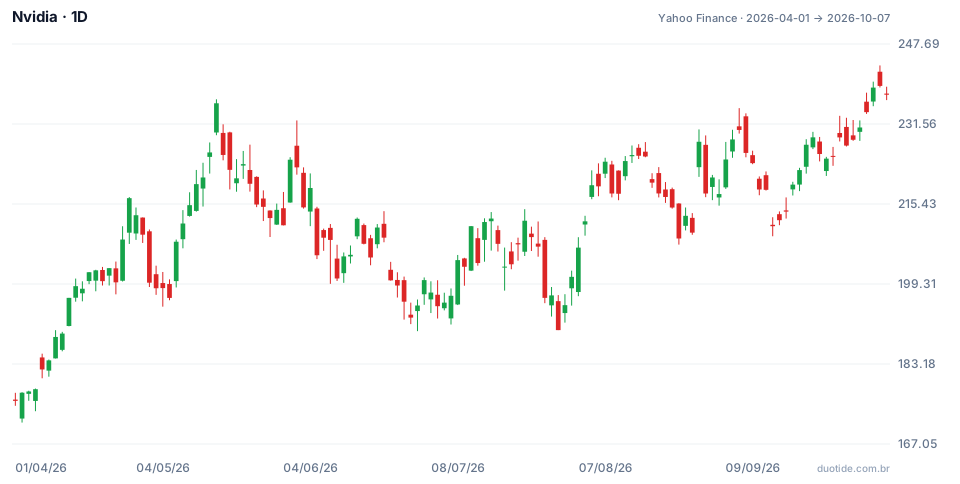
The chart shows NVDA's daily candles. Three real situations, with a $10,000.00 position:
May: the upside
Between May 5 ($196.50) and May 14 ($235.74), the stock rose 20.0%. A $10,000.00 position would gain about $1,997.00. With 5:1 leverage, on a $2,000.00 margin, that's almost 100% in seven sessions. It's this kind of number that draws people to margin.
June with 5:1 leverage
On June 1, NVDA closed at $224.36. With a $10,000.00 position, that would be about 44.57 shares. On June 10 the stock closed at $200.42, down 10.7%. The loss would be $1,067.04, or 53.4% of the $2,000.00 margin. Under the hypothetical 50% rule, the position would have already been closed earlier: June 9's low ($199.34) represented a 11.2% drop from June 1. Without leverage, the same $2,000.00 invested directly in shares would lose about $213.41, and anyone who held on would see the stock close on October 7 at $237.47, 5.8% above the June 1 price.
June with 10:1 leverage
With a $1,000.00 margin for the same $10,000.00 position, the 50% rule would close the position at a $500.00 loss, that is, a 5% drop in the stock: $213.14. On June 3 the low was $214.51, close to the limit. On June 4 the low reached $210.97, a 6.0% drop from June 1: the position would be closed that day, with the stock closing at $218.66 hours later. The high leverage turned a normal pullback in the stock into a realized loss.

How to use margin with risk control
Calculate the risk on the account, not on the margin
The practical rule is to limit the risk per trade to a fraction of the account's total capital, such as 1%. On a $10,000.00 account, that's a maximum loss of $100.00, whether the position is $5,000.00 or $50,000.00. The stop is placed where the trade's idea stops being valid, and the position size is adjusted so the loss down to the stop is $100.00. That adjustment controls the risk far more than the leverage the platform offers.
Set the stop before the liquidation point
The stop needs to sit well before the point where the broker closes the position. If liquidation comes before the stop, the margin rule decides the exit, not you.
Account for the cost of carrying the position
Leveraged positions held for several days usually pay interest on the borrowed amount, or daily funding fees. These costs reduce the result even on winning trades.
Limitations
The stop doesn't guarantee the exit price: with an opening gap, the order gets filled at the first available price, and the loss can go past what was planned, sometimes beyond the deposited margin, depending on the instrument and the broker's rules.
Common mistakes when trading with margin
- Choosing the position size based on the maximum leverage offered, instead of the acceptable risk.
- Calculating the result on the margin and forgetting the loss is on the entire position.
- Not knowing the point at which the broker closes the position.
- Placing the stop past the liquidation point, or not placing one at all.
- Ignoring interest and fees for holding the position several days.
- Forgetting that the examples above describe what happened, not what will happen.
To practice without risking money, open the same trade in a demo account with different leverage levels and note, for each one, the drop that would get the position closed. Record over a few weeks how many times the price passed through those points before moving in the direction you expected. That record shows the real size of margin risk.
Practice before you risk. Open your Duotide account and test your ideas on the demo account with US$10,000 in virtual funds.
Create free accountUpdated:
Editorial character of the Duotide newsroom. Articles are written by the team with the help of artificial intelligence; prices and charts come from real market data. Writes about risk management, position sizing and the psychology behind traders' decisions.
Was this article helpful?
Be the first to rate it.
Comments
- No comments yet. Be the first to comment.
Ready to put it into practice?
Open your account and practice on the demo account with US$10,000 in virtual funds, without risking money.
- Secure platformProtected login and identity verification
- Multilingual supportHelp available every day
- Free demo accountUS$10,000 virtual to practice
Trading involves the risk of losing the capital invested.
