

 Português pt
 Español es
 العربية ar
 বাংলা bn
 Deutsch de
 Filipino fil
 Français fr
 हिन्दी hi
 Bahasa Indonesia id
 Italiano it
 Русский ru
 Svenska sv
 ไทย th
 Türkçe tr
 Tiếng Việt vi
 简体中文 zh
Updated:
Risk managementMargin Trading Risks: Margin Call, Stop Out, and Liquidation
 Camila NascimentoEditorial character · Risk & Behavior Desk

Quick answer
In margin trading, a margin call warns that collateral has fallen below the minimum required, stop out is the point where the platform starts closing positions on its own, and liquidation is the forced close with loss of the margin. The higher the leverage, the smaller the drop needed: at 10x, about a 9.5% move against the position is already enough.
Every margin trade carries a risk beyond the direction of the price: the risk of the trade's own structure, which can close a position before the market shows who was right. Margin call, stop out, and liquidation explain why two accounts with the same capital can have completely different fates on the same move.
In this guide, we use Ether's real daily quotes (ETH/USDT on Binance) between April and October 2026 to calculate where leveraged positions would be liquidated and what happened to them. Ether rose 20.3% over the period, and even so a good number of those positions would never make it to the end.
What margin trading is
Trading with margin means opening a position bigger than the money deposited, using collateral (the margin) and an implicit loan from the platform. Leverage is the ratio between the position size and the collateral: with $1,000 of margin and a $5,000 position, the leverage is 5 times.
Three terms show up on almost every platform:
- Margin call: a warning that the collateral has fallen below the required minimum. You can deposit more, cut the position, or wait.
- Stop out: the level at which the platform starts closing positions on its own, because the collateral has dropped too much.
- Liquidation: the forced closing of the position, usually with the loss of all or nearly all of that trade's margin.

How to calculate the liquidation price
In an isolated-margin position, liquidation happens when the loss eats up the margin, minus a small maintenance margin. In simplified form:
- Long: liquidation price ≈ entry × (1 − 1/leverage + maintenance margin).
- Short: liquidation price ≈ entry × (1 + 1/leverage − maintenance margin).
With a 0.5% maintenance margin, a 10x long is liquidated with a drop of about 9.5%; at 5x, with a drop of 19.5%; at 20x, with a drop of 4.5%. Every platform has its own rules, fees, and tiers, so treat these numbers as approximations.
Example with Ether
On April 1, 2026, ETH/USDT closed at $2,140.35. A 5x long entered there would have a liquidation price of 2,140.35 × (1 − 0.2 + 0.005) = 2,140.35 × 0.805 = $1,722.98.
Real example: Ether in 2026
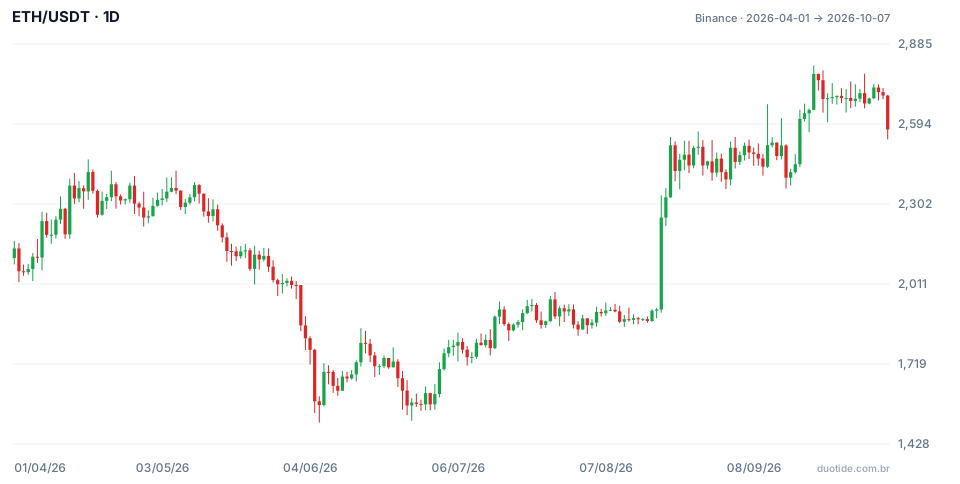
The chart shows ETH/USDT's daily candles from April to October 2026. The price ended the period at $2,574.14, but went through a low of $1,505.68 on June 6, 29.7% below the April 1 close. Three situations show the effect of leverage:
The right direction, liquidated along the way
For long positions opened on April 1 at $2,140.35, with a 0.5% maintenance margin:
- 20x: liquidation at $2,044.03, already reached on April 2, when the low was $2,017.04.
- 10x: liquidation at $1,937.02, reached on June 2.
- 5x: liquidation at $1,722.98, reached on June 4, with a low of $1,717.28.
- 3x: liquidation at $1,437.60, which was never reached. This position would have made it to October 7 with Ether 20.3% above the entry.
All of them bet on the direction that was confirmed by the end of the period. Only the one with the lowest leverage survived to see it.
June 5: a 13% drop in one day
Ether closed on June 4 at $1,770.77 and, on June 5, reached $1,540.19, a 13.0% drop within the day. A 10x long opened at the June 4 close would have a liquidation price of $1,602.55 and would have been closed the same day. On days like this, the price moves fast, and execution can come in worse than the calculated level.
August 19: the same risk for shorts
On August 18, Ether closed at $1,917.85. The next day it reached $2,333.65, up 21.7% at the high, and closed at $2,252.80 (+17.5%). A 5x short opened on August 18 would have a liquidation price of about $2,291.83 and would have been liquidated; at 10x, at $2,100.05. Leveraged short positions suffer the same way in sharp rallies.

How to trade with margin with more control
Calculate your effective leverage, not the one offered
The platform may offer 1:100 or 1:500, but what matters is the total size of your positions divided by your equity. With a $2,000 account and a $10,000 position, the effective leverage is 5 times. If the asset drops 13%, like Ether did on June 5, the loss is $1,300, or 65% of the account.
Know where your stop out sits
On the same account, if the margin required for the $10,000 position is $500 (1:20) and the stop out happens at a 50% margin level, the platform closes the position when equity falls to $250, which is after a loss of $1,750 (a 17.5% drop in the asset). Know your platform's exact rule before trading.
Use your own stop before liquidation
A stop you set yourself, well ahead of the liquidation price, turns a total loss of the margin into a planned loss. Calculate the position size so that stop represents 1% to 2% of the account.
Avoid holding leveraged positions through events
Interest rate decisions, inflation reports, or news specific to the asset produce the 13% to 20% jumps seen above. Cutting leverage ahead of these moments limits the damage.
Limitations
The formulas above ignore funding fees, interest on the loan, and differences between platforms, which change the exact liquidation price. Daily candles also don't show the order of prices within the day. And no leverage is safe on its own: at 3x, a 33% drop would still liquidate the position.
Common mistakes in margin trading
- Using the maximum leverage offered just because it's available.
- Trusting the trade's direction and ignoring the path the price takes to get there.
- Trading without a stop and letting liquidation play that role.
- Depositing more margin at every call to save a losing position.
- Stacking several small positions and forgetting that, together, they add up to a lot of leverage.
- Not reading the platform's margin call and stop out rules.
To practice without risking money, open a small leveraged position in a demo account, write down the calculated liquidation price, and compare it with what the platform shows. Record how the result changes at 2x, 5x, and 10x on the same asset. The examples above describe what happened with Ether in 2026, not what will happen.
Practice before you risk. Open your Duotide account and test your ideas on the demo account with US$10,000 in virtual funds.
Create free accountUpdated:
Editorial character of the Duotide newsroom. Articles are written by the team with the help of artificial intelligence; prices and charts come from real market data. Writes about risk management, position sizing and the psychology behind traders' decisions.
Was this article helpful?
Be the first to rate it.
Comments
- No comments yet. Be the first to comment.
Ready to put it into practice?
Open your account and practice on the demo account with US$10,000 in virtual funds, without risking money.
- Secure platformProtected login and identity verification
- Multilingual supportHelp available every day
- Free demo accountUS$10,000 virtual to practice
Trading involves the risk of losing the capital invested.
