

 Português pt
 Español es
 العربية ar
 বাংলা bn
 Deutsch de
 Filipino fil
 Français fr
 हिन्दी hi
 Bahasa Indonesia id
 Italiano it
 Русский ru
 Svenska sv
 ไทย th
 Türkçe tr
 Tiếng Việt vi
 简体中文 zh
Updated:
StocksMeme Stocks in 2026: What They Are and How to Assess the Risk
 Rafael AzevedoEditorial character · Markets Desk
Quick answer
Meme stocks are stocks whose price starts moving more on social media and forum attention than on the company's results. They can rise tens of percent in a day and give it all back in a few sessions, as GameStop did in May 2024. The risk is controlled with a small position, sized from volatility (the ATR), and a stop defined before entering.
The term meme stock gained traction in January 2021, when retail investors gathered on forums like WallStreetBets bought up shares of GameStop en masse, a stock funds were betting would fall. Since then, the phenomenon has stopped being an isolated episode and become a recurring behavior: every so often, a forgotten stock comes back to the center of the conversation on social media, and the price starts moving for reasons that have little to do with the company's earnings.
In this guide you'll see what defines a meme stock, what actually happened with GameStop during the May and June 2024 frenzy, with real daily prices, and how to measure and limit the risk before trading this type of asset.
What a meme stock is
A meme stock is a stock whose price starts being driven more by attention on social media and online communities than by the company's results. The sector doesn't matter: what defines a meme stock is the price behavior, not the business.
A few ingredients show up frequently:
- Sudden attention: the ticker starts getting mentioned en masse on forums and social media.
- Abnormal volume: the number of shares traded jumps to dozens of times the average.
- High short interest: when many investors are betting on a decline, a sharp rally forces some of them to buy back shares, which pushes the price up even further (the so-called short squeeze).
- Call options: heavy buying of out-of-the-money call options can force market makers to buy shares to hedge themselves, an effect known as a gamma squeeze.

Real example: GameStop in May and June 2024
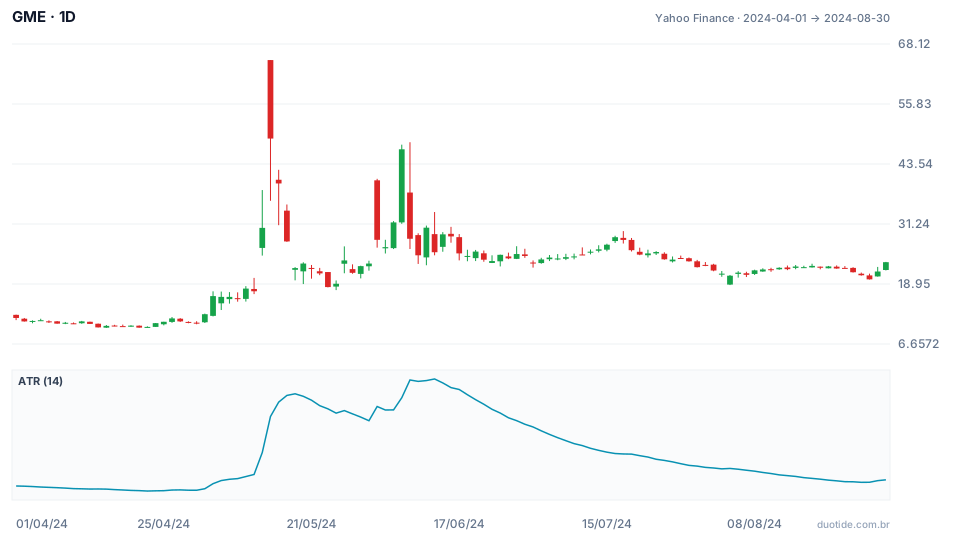
The chart shows GameStop (GME) on the daily, from April 1 to August 30, 2024, with the 14-day ATR, which measures each session's average swing. The stock started the period at $11.99, marked a low of $9.95 on April 16, and ended at $23.42. The path between those points is what matters here.
May's spike
On May 10, 2024, the stock closed at $17.46. On May 13, after the investor known as Roaring Kitty, one of the figures from the 2021 episode, started posting on social media again, it rose 74.4% and closed at $30.45, with 187.2 million shares traded. On April 23, just a few weeks earlier, it had been only 2.5 million. On May 14, the stock opened at $64.83, the entire period's high, and closed at $48.75.
The drop right after
Three sessions later, on May 17, GME closed at $22.21: down 54.4% from the May 14 close and down 65.7% from that same day's high. Anyone who bought at the May 14 open, drawn in by the previous day's rally, lost two-thirds of their value in three days.
June's second frenzy
On June 6, the stock rose 47.45%, to $46.55. The next day, with 279.1 million shares traded, it swung between $48.00 and $26.12 and closed at $28.22, down 39.38%. The 14-day ATR reached $7.57 on June 12, nearly 30% of the $25.46 closing price. On April 23 it had been $0.60.
And in 2026?
In 2026, GameStop is far from that behavior. Through October 7, the stock ranged between $17.79 (August 20) and $26.88 (May 1) and closed at $24.58, with an ATR of $0.84, about 3.4% of the price. That shows another feature of meme stocks: the frenzy is temporary, and the same stock can go from volatile to calm, and back again, with no warning.
How to assess the risk of a meme stock
Measure volatility before entering
The ATR turns volatility into a number. With a $10,000 account and a maximum risk of 1% per trade ($100), a 1.5 ATR stop on June 12, 2024 would come to 1.5 × 7.57 = $11.36 per share. The maximum position would be 100 ÷ 11.36 = 8.8, or 8 shares, about $204. With the October 7, 2026 ATR, the stop would come to 1.5 × 0.84 = $1.26, and the same rule would allow 79 shares. Volatility changes the position size by almost tenfold.
Set the stop before entering
With meme stocks, the price can open far from the previous close, as on May 14, 2024, when the stock opened at $64.83 after closing at $30.45. A stop doesn't guarantee the exit price in a gap like that, but setting the exit before entering avoids making the decision under pressure.
Watch the volume and the short interest
Volume dozens of times above average and heavy short interest indicate a sharp move could happen, in either direction. They don't indicate the direction or when the top will come.
Tell speculation apart from investing
By fundamental analysis, meme stocks often trade at prices hard to justify by earnings. Anyone trading these stocks with eyes open treats the position as short-term speculation, with a small size and a planned exit, rather than as an investment to hold while waiting for another spike.
Limitations
No indicator anticipates when attention on social media will start or end. The ATR measures the volatility that already happened: on May 10, 2024, it stood at $1.63, and in the very next session the stock swung $13.43 between the day's low and high and rose 74%.

Common mistakes when trading meme stocks
- Buying after a very strong one-day rally, like the May 14, 2024 open, when much of the move had already happened.
- Using the same position size as for an ordinary stock, without adjusting for the ATR.
- Waiting for an official announcement to sell: in frenzies like this, the price usually reverses before that.
- Treating high volume as a guarantee the rally will continue.
- Confusing enthusiasm on social media with the company's value.
- Forgetting that the examples above describe what happened, not what will happen.
To understand how these stocks behave without risking money, follow a meme stock on a demo account, calculate the ATR before each simulated entry, set the stop and the position size, and record the result. A few weeks of logging show better than any text how far these stocks can move in a single session.
Practice before you risk. Open your Duotide account and test your ideas on the demo account with US$10,000 in virtual funds.
Create free accountUpdated:
Editorial character of the Duotide newsroom. Articles are written by the team with the help of artificial intelligence; prices and charts come from real market data. Follows the news that moves prices — rates, stock markets, companies and commodities — explained without jargon.
Was this article helpful?
Be the first to rate it.
Comments
- No comments yet. Be the first to comment.
Ready to put it into practice?
Open your account and practice on the demo account with US$10,000 in virtual funds, without risking money.
- Secure platformProtected login and identity verification
- Multilingual supportHelp available every day
- Free demo accountUS$10,000 virtual to practice
Trading involves the risk of losing the capital invested.
