

 Português pt
 Español es
 العربية ar
 বাংলা bn
 Deutsch de
 Filipino fil
 Français fr
 हिन्दी hi
 Bahasa Indonesia id
 Italiano it
 Русский ru
 Svenska sv
 ไทย th
 Türkçe tr
 Tiếng Việt vi
 简体中文 zh
Updated:
PsychologyThe Most Common Psychological Mistakes Beginner Traders Make
 Camila NascimentoEditorial character · Risk & Behavior Desk

Quick answer
The most common psychological mistakes beginners make are revenge trading (trying to recover a loss right away), FOMO (entering out of fear of missing out), moving the stop farther away, overconfidence after wins, and confirmation bias. All of them make a trader abandon the plan at the worst possible moment. Rules written before trading, a daily loss limit, and a trading journal reduce their impact.
Most trading courses talk about charts, indicators, and strategies. Anyone who has traded for a while knows that much of the bad results don't come from a badly designed strategy, but from decisions made under pressure, in the heat of the moment, against the plan itself.
In this guide, each mistake comes with the mechanism behind it, an example with real numbers, and a practical rule to limit the damage. For the market example, we use the real daily quotes for ether (ETH/USDT on Binance) between July and October 2026.
Why your head gets in the way more than your strategy
Losing money hurts more than gaining the same amount feels good. This imbalance, studied by behavioral economics as loss aversion, pushes traders toward two opposite and equally costly behaviors: holding a loss for too long, hoping it will recover, and taking a profit too early, afraid of giving it back. On top of that comes the rush to recover what was lost and the fear of missing out on a move everyone else seems to be riding.

Real example: FOMO in ether in August 2026
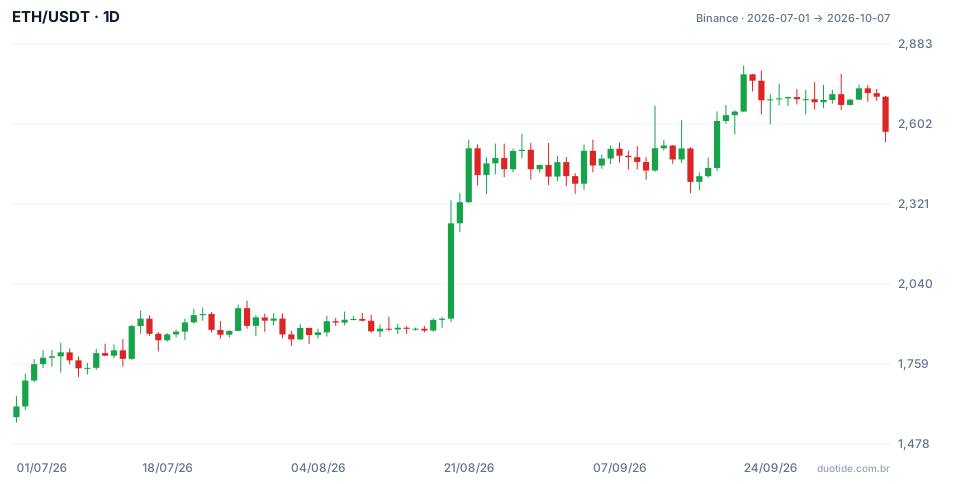
The chart shows ETH/USDT from July 1, 2026 (US$1,609.58) to October 7, 2026 (US$2,574.14). The August stretch is a textbook case of the fear of missing out, FOMO.
Three days of euphoria
On August 18 ether closed at US$1,917.85. The next day it rose 17.5%, then another 3.3%, and on August 21 it closed at US$2,516.30: a 31.2% gain in three sessions. It's the kind of move that floods social media and makes anyone on the sidelines feel they need to get in no matter what.
What happened to those who bought at the top of the euphoria
Anyone who bought at the August 21 close saw the price fall to US$2,355.71 on August 23, 6.4% below their entry. Ether spent the next three weeks below that price and didn't close above US$2,516.30 again until September 11. It wasn't a disaster, but it was three weeks underwater for an entry made with no plan, driven only by the recent rally. On October 7 ether closed at US$2,574.14, just 2.3% above that purchase.
The moved stop that "worked"
Imagine that same person had placed their stop at US$2,400, 4.6% below the entry. It would have been hit as early as August 22, when the low was US$2,385. If they had pushed the stop lower, they would have survived and, weeks later, gotten back into profit. That's the danger: the market sometimes rewards the mistake, and the person learns the wrong lesson. Next time they move a stop, the price might simply keep falling. Judging a decision by the outcome of a single case, rather than by the process, is called outcome bias.
The most common mistakes, one by one
Revenge trading
After a loss comes the urge to get even with the market right away. The math shows the problem: in an account of R$5,000 with 1% risk per trade (R$50), a loss is just R$50. If the person doubles the next trade to R$100 to recover quickly and loses again, that's already R$150, three times the planned risk, in two trades made in the worst possible emotional state.
Overconfidence after gains
The opposite is just as costly. After a few winning trades in a row, it's easy to increase position size and skip steps in the analysis. Winning streaks are part of the normal statistics of any strategy and don't mean the risk has disappeared. Keeping the same position size in good and bad stretches is the simplest way to avoid giving it all back in a single trade.
FOMO
Entering because the price is rising fast, as in the ether example, tends to lead to late entries, near the end of the move. One question filters out much of this impulse: if this asset weren't rising right now, would I enter for the same technical reasons?
Moving the stop
Pushing a losing trade's stop farther away turns a small, planned loss into an unlimited one. The stop should be decided before the entry, based on the analysis and the maximum amount you accept losing, not adjusted after the market has already shown the opposite of what was expected.
Confirmation bias
After deciding an asset is going to rise, a person starts to notice only the news and signals that confirm that idea. Before entering, write down at least one scenario that would invalidate the analysis. If it happens, the trade is closed, regardless of the initial expectation.
Ignoring your own plan
Many people write a reasonable plan and abandon it exactly when it would be most useful: after two losses or three wins in a row. A plan that only holds up on calm days isn't a plan.

How to reduce the impact of these patterns
Daily loss limit
Set a number, for example 3% of the account, and stop trading for the day once it's hit. This cuts revenge trading off at the root.
Mandatory pause
After two or three losses in a row, step away from the screen for a set amount of time. The next trade won't recover the previous ones; it's a new trade.
Trading journal
Record the reason for the entry, the stop, the target, the result, and how you felt. Within a few weeks, patterns that memory hides will show up, like always entering after days of a strong rally.
Limitations
None of these habits eliminate the risk of loss, which is part of trading. They simply bring decisions closer to the original plan and shrink the size of the mistakes you're going to make anyway.
Common mistakes when trying to control emotions
- Thinking discipline is willpower, instead of rules written before the session.
- Judging a decision only by its outcome, like the moved stop that "worked."
- Increasing position size to recover a loss.
- Trading tired, angry, or after a bad streak just to avoid ending the day in the red.
- Forgetting that the ether example describes what happened, not what will happen during the next strong rally.
To practice without risking money, use a demo account to live through exactly the scenarios that cause the most anxiety, like a losing streak or a rally you missed. Log every trade and how you felt before it: that record shows your triggers more clearly than any ready-made list.
Practice before you risk. Open your Duotide account and test your ideas on the demo account with US$10,000 in virtual funds.
Create free accountUpdated:
Editorial character of the Duotide newsroom. Articles are written by the team with the help of artificial intelligence; prices and charts come from real market data. Writes about risk management, position sizing and the psychology behind traders' decisions.
Was this article helpful?
Be the first to rate it.
Comments
- No comments yet. Be the first to comment.
Ready to put it into practice?
Open your account and practice on the demo account with US$10,000 in virtual funds, without risking money.
- Secure platformProtected login and identity verification
- Multilingual supportHelp available every day
- Free demo accountUS$10,000 virtual to practice
Trading involves the risk of losing the capital invested.
