

 Português pt
 Español es
 العربية ar
 বাংলা bn
 Deutsch de
 Filipino fil
 Français fr
 हिन्दी hi
 Bahasa Indonesia id
 Italiano it
 Русский ru
 Svenska sv
 ไทย th
 Türkçe tr
 Tiếng Việt vi
 简体中文 zh
Updated:
StrategiesSocial Trading: Benefits, Risks, and How to Copy Safely
 Naomi TanakaEditorial character · Analysis Desk

Quick answer
Social trading means following, discussing, or copying other traders' trades in a community or platform. It helps you learn from different ways of thinking, but the risk stays yours: the main precaution is copying the risk, not the quantity, by sizing the position from your own capital and the stop distance.
Learning by watching someone with more experience is one of the oldest ways to pick up a skill, and in the financial market it got its own name: social trading. The idea is to follow, discuss, or replicate other traders' decisions within a community.
The problem is that copying an entry is easy; copying the right risk isn't. In this guide we show what social trading has going for it, where it usually goes wrong, and how to calculate the size of a copied position using Ether's real volatility (ETH/USDT on Binance) in 2026.
What social trading is
Social trading covers any way of sharing analysis, strategies, or trades among traders publicly or semi-publicly. There are three main formats:
- Discussion communities: forums and groups where people comment on analysis and explain their entries.
- Profiles with an open track record: platforms that show each trader's results, trades, and statistics.
- Automatic copying (copy trading): a trader's trades are replicated in their followers' accounts, at a set proportion.

Real benefits
- Different ways of thinking: seeing how someone else reads the same chart helps you find blind spots in your own analysis.
- A shorter learning curve: commented trades, with the reasoning behind each decision, teach faster than trial and error on your own.
- Shared discipline: communities that demand records and justifications build the habit of documenting.
- Comparing methods: you can watch different approaches to the same market before choosing your own.
How to calculate the size of a copied position
The most expensive mistake in social trading is copying the other person's quantity instead of copying the risk. The correct math has three steps:
- Dollar risk = capital × risk percentage per trade.
- Stop distance = entry − stop (for example, 2 × ATR).
- Position size = dollar risk ÷ stop distance.
Example with real Ether data
On October 7, 2026, ETH closed at $2,574.14, with a 14-day ATR of $86.64. Imagine a followed trader with $100,000 in capital who buys 5 ETH there, with a stop at 2 ATR ($173.28), that is, at $2,400.86.
- Their risk: 5 × 173.28 = $866.40, or 0.87% of capital.
- A follower with $10,000 who copies the same 5 ETH: a $12,870.70 position, bigger than their entire account (only possible with leverage), and a risk of $866.40, or 8.66% of capital.
- A follower who copies the 1% risk instead: $100 ÷ 173.28 = 0.5771 ETH, a $1,485.54 position.
The same trade, the same entry, and the same stop: in one case the risk is ten times bigger. Three losses in a row would cost the first follower about a quarter of their account; the second, about 3%.

Real example: Ether's volatility changes the math
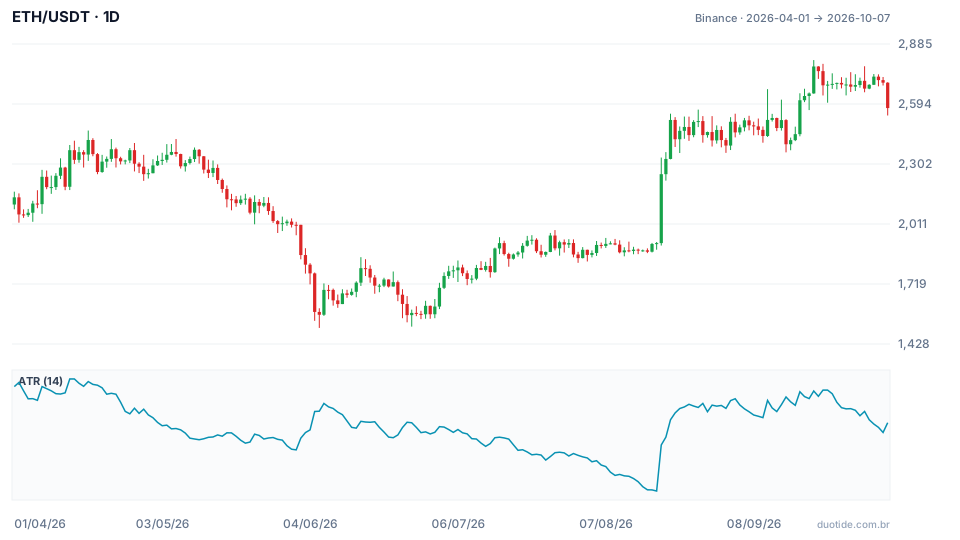
The chart shows ETH's 14-day ATR between April and October 2026. It didn't stay still, and that affects any stop copied as a fixed amount.
April: the ATR at its highest
On April 14 the ATR reached $112.51, with the price at $2,322.44. A $100 stop copied from someone, at that point, sat less than one typical day's swing away from the entry.
August: the ATR at its lowest
On August 18 the ATR fell to $46.24, with ETH at $1,917.85. The same $100 stop was equivalent to more than two typical days. April's volatility was 2.43 times August's: anyone copying a fixed stop is, without realizing it, changing the risk from one phase to another.
October: a day bigger than the stop
On October 7 ETH opened at $2,697.49, reached $2,699.80 at the high, and $2,538.06 at the low, a range of $161.74 in a single session, almost double the ATR. Anyone who had bought at the open with a 1 ATR stop would have been stopped out the same day. Over the full period, ETH rose 20.27%, from $2,140.35 on April 1 to $2,574.14, after marking a low of $1,505.68 on June 6 and a high of $2,807.34 on September 21. These numbers describe what happened, not what will happen.
How to use social trading responsibly
Treat every trade as an idea
Someone else's entry is a hypothesis to study, not an order. Ask why it was made, where the stop is, and what the exit plan is.
Evaluate the track record across different scenarios
A few months of good results can be luck, or a single big bet that worked out. Favor long track records that have gone through rallies, drops, and sideways markets, and look at the account's maximum drawdown, not just the total gain.
Copy the risk, not the quantity
With automatic copying, set the proportion based on your own capital and check the resulting risk per trade. If the platform allows it, cap the maximum loss on the copied account.
Use the community as a second filter
The real value is in the exchange of reasoning. If another trader's idea passes your own entry criteria, it can reinforce the decision; if it doesn't, it's worth ignoring, even if it comes from a famous profile.
Limitations
Published results may not include costs, execution delays, and price differences between the followed trader's account and yours. And responsibility for the risk still falls on whoever is copying.
Common mistakes in social trading
- Copying someone else's quantity instead of calculating the size from your own capital.
- Choosing who to follow based only on the last few months' gains.
- Keeping a fixed dollar stop when the asset's volatility has changed.
- Stopping justifying your own entries just because someone else did the same.
- Forgetting that past performance doesn't guarantee future results.
To practice without risking money, pick one or two traders to watch in a demo account, redo each of their trades with the size calculated from your own risk, and record the result over a few weeks. Comparing your version with the original shows how much of the result comes from the entry and how much comes from position size.
Practice before you risk. Open your Duotide account and test your ideas on the demo account with US$10,000 in virtual funds.
Create free accountUpdated:
Editorial character of the Duotide newsroom. Articles are written by the team with the help of artificial intelligence; prices and charts come from real market data. Explains charts, indicators and trading strategies: how they work, where they fail and how to test them first.
Was this article helpful?
Be the first to rate it.
Comments
- No comments yet. Be the first to comment.
Ready to put it into practice?
Open your account and practice on the demo account with US$10,000 in virtual funds, without risking money.
- Secure platformProtected login and identity verification
- Multilingual supportHelp available every day
- Free demo accountUS$10,000 virtual to practice
Trading involves the risk of losing the capital invested.
