

 Português pt
 Español es
 العربية ar
 বাংলা bn
 Deutsch de
 Filipino fil
 Français fr
 हिन्दी hi
 Bahasa Indonesia id
 Italiano it
 Русский ru
 Svenska sv
 ไทย th
 Türkçe tr
 Tiếng Việt vi
 简体中文 zh
Updated:
PsychologyWhat Is Overtrading and How to Avoid It
 Camila NascimentoEditorial character · Risk & Behavior Desk

Quick answer
Overtrading is trading more often or with larger positions than your plan allows, almost always driven by emotion rather than a real opportunity. The clearest signs are entering with no criteria, increasing position size after losses, and forcing trades on quiet days. It costs you twice: in the bad trades themselves and in the fees and spreads that pile up with every extra entry.
Many traders with a reasonable strategy lose money not because the method is bad, but because they can't sit still when it gives no signal. Overtrading is one of the behaviors most often cited by people with years in the market as a cause of poor results.
In this guide we explain what characterizes the problem, why it happens, and how much it costs, with a cost example and ether's real volatility (ETH/USDT on Binance) between April and October 2026.
What Overtrading Is
Overtrading isn't defined by a fixed number of trades per day, since that depends on the strategy: a scalper makes dozens, a swing trader makes a few per month. What characterizes the problem is opening positions outside the criteria set beforehand, whether by entering with no clear setup, increasing size with no justification, or trading at times the strategy itself doesn't recommend.
A simple test: after the trade, can you explain why you entered? If the answer is something like "it looked like it was going to go up," with no concrete criterion, the trade probably came from impulse.
The Most Common Causes
- Recovering losses: after a losing trade, the urge to zero out the damage leads to rushed entries. This is the so-called revenge trading, which usually makes the loss bigger.
- Boredom: on days with little movement, some traders force trades just to feel like they're doing something.
- Overconfidence: a streak of wins creates the feeling that any entry will work out.
- Fear of missing out: watching the price move without you and entering late, far from the planned point.
How to Calculate the Cost of Overtrading
Even without counting the trades' results, every extra entry has a cost. An illustrative example, with a hypothetical cost of 0.1% per round-trip trade (entry and exit, combining fee and spread):
- A $1,000 position: a cost of $1 per trade.
- A plan of 2 trades a day, but the person makes 8: that's 6 extra trades.
- Over 20 trading days: 6 × 20 = 120 extras × $1 = $120.
- That's 12% of the position's value spent on cost alone, before any losses.
The math gets worse when the extra trade is a bad one, which is common, because it's born precisely outside the criteria.
Real Example: Ether's Quiet Days
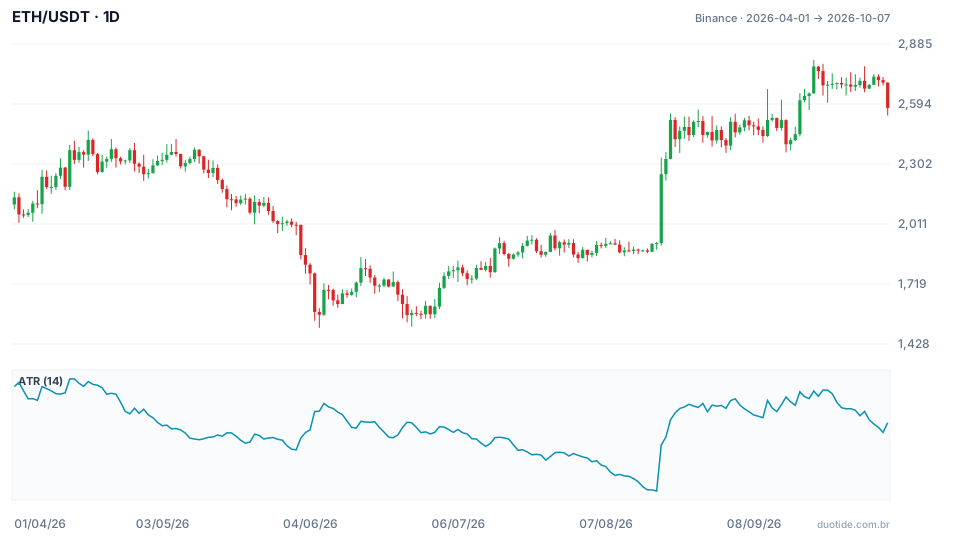
The chart shows ether between 04/01 ($2,140.35) and 10/07/2026 ($2,574.14), with the 14-day ATR in the panel below. The ATR measures the price's average daily range and helps show when the market was active and when it was quiet, which is when boredom tends to push traders into overtrading.
April: an Active Market
On 04/14 the ATR reached $112.51, the period's highest, with the price at $2,322.44. That equals an average daily range of 4.8%: enough room for many strategies to find signals.
August: a Quiet Market
On 08/18 the ATR dropped to $46.24, the period's lowest, with the price at $1,917.85: a 2.4% daily range, half of April's. With so little movement, a forced trade needs a bigger slice of the daily range just to cover costs, and signals from most strategies become scarce. This is the kind of phase where anyone who can't accept sitting out ends up entering with no criteria.
The Whole Period
Of the window's 190 days, on 83 ether closed within 1% of the previous day, and on only 10 did the move exceed 5%. On 10/07 the ATR stood at $86.64, about 3.4% of the price. These numbers describe what happened, not what will happen, but they show that quiet days are the rule, not the exception.

How to Avoid Overtrading
Write Down Your Criteria Before Trading
Entry, exit, and position size, written down. The rule is simple: if the trade doesn't fit the criteria, it doesn't happen.
A Trade Limit and a Daily Loss Limit
Set a maximum number of trades per day and a daily loss that, once hit, ends the day. Stick to both even when it feels like the next entry is going to make up for everything.
A Mandatory Pause at the Triggers
If overtrading shows up right after a loss or on boring days, build in a break away from the platform before deciding whether a real opportunity exists.
Review the Week
At the end of each week, count how many trades you made and how many followed the criteria. If a significant share didn't, the pattern is already showing up.
Limitations
The ATR shows how much the market moved, not whether there was a good opportunity. A quiet market can have great trades for range strategies, and an active one can be dangerous. The reference is still your plan, not the indicator.
Common Mistakes Linked to Overtrading
- Measuring discipline by the number of trades, instead of by how closely you stuck to the plan.
- Increasing position size after a loss to recover quickly.
- Forcing entries on days with little movement.
- Ignoring fees and spreads, which pile up with every extra trade.
- Keeping the platform open all day with no technical reason to watch the market.
- Forgetting that the examples above describe what happened, not what will happen.
To practice without risking money, use a demo account for a few weeks with a fixed daily trade limit and log, for each one, whether it followed the criteria. Compare the results of trades inside and outside the plan: your own record will show the real cost of overtrading.
Practice before you risk. Open your Duotide account and test your ideas on the demo account with US$10,000 in virtual funds.
Create free accountUpdated:
Editorial character of the Duotide newsroom. Articles are written by the team with the help of artificial intelligence; prices and charts come from real market data. Writes about risk management, position sizing and the psychology behind traders' decisions.
Was this article helpful?
Be the first to rate it.
Comments
- No comments yet. Be the first to comment.
Ready to put it into practice?
Open your account and practice on the demo account with US$10,000 in virtual funds, without risking money.
- Secure platformProtected login and identity verification
- Multilingual supportHelp available every day
- Free demo accountUS$10,000 virtual to practice
Trading involves the risk of losing the capital invested.
