

 Português pt
 Español es
 العربية ar
 বাংলা bn
 Deutsch de
 Filipino fil
 Français fr
 हिन्दी hi
 Bahasa Indonesia id
 Italiano it
 Русский ru
 Svenska sv
 ไทย th
 Türkçe tr
 Tiếng Việt vi
 简体中文 zh
Updated:
ForexHow to Calculate the Forex Spread, Step by Step
 Naomi TanakaEditorial character · Analysis Desk

Quick answer
To calculate the forex spread, subtract the sell price from the buy price (ask − bid) and divide by the pip size, which is 0.0001 on most pairs. Then multiply by the pip value: US$ 10 per standard lot when the dollar is the pair's second currency. A 1.4-pip spread costs US$ 14 per lot.
The spread is the cost you pay on every forex trade, win or lose, and it's already baked into the price the moment you enter. That's why a freshly opened position always shows up a little in the red.
The math is simple. What changes a trader's life is comparing that cost with the size of the target and with how often they trade. In this guide we run the numbers and use GBP/USD's real ATR (pound against dollar, from Yahoo Finance, April through October 2026) to show when the spread is a detail and when it decides the result.
What the spread is in forex
Every quote has two prices. The bid is the price you sell at; the ask, the price you buy at. The ask is always higher, and the difference between the two is the spread. A buyer enters at the ask and, to exit, sells at the bid: the price needs to move at least the size of the spread just to break even.
The spread is measured in pips. On most pairs, a pip is the fourth decimal place (0.0001). On pairs with the Japanese yen, it's the second decimal place (0.01). Many platforms show a fifth digit, the pipette, worth a tenth of a pip.

How to calculate the spread
- Spread in price: ask − bid.
- Spread in pips: (ask − bid) ÷ pip size.
- Pip value when the dollar is the pair's second currency: position size × 0.0001. A standard lot (100,000 units) gives US$ 10 per pip; a mini lot (0.1), US$ 1.
- Spread cost: spread in pips × pip value × number of lots.
Example with the real GBP/USD quote
The last close of GBP/USD in the series was 1.32668. Suppose the platform shows a bid of 1.32662 and an ask of 1.32676; the spread here is hypothetical, because every platform sets its own and it changes throughout the day.
- Spread in price: 1.32676 − 1.32662 = 0.00014.
- Spread in pips: 0.00014 ÷ 0.0001 = 1.4 pips.
- Cost on 1 standard lot: 1.4 × US$ 10 = US$ 14.
- Cost on 0.1 lot: 1.4 × US$ 1 = US$ 1.40.
- In reais, with the dollar at R$ 4.9814 (the same series' last USD/BRL close): US$ 14 ≈ R$ 69.74 per lot.
When the dollar is the pair's first currency, as in USD/JPY, the pip value in dollars is the position size × pip size ÷ rate. That's why pip value on these pairs moves along with the price.
Real example: the spread compared with GBP/USD's move
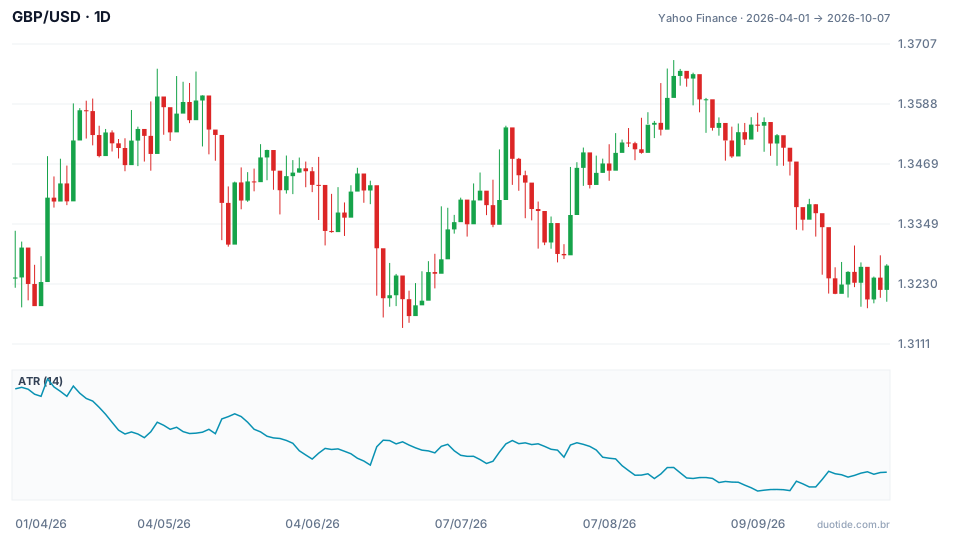
The chart shows GBP/USD with the 14-period ATR, the average daily range. It's the ruler for telling whether 1.4 pips is a lot or a little.
For anyone targeting the day's move, the spread is small
At the end of the series, the ATR stood at 0.00721, or 72.1 pips. A 1.4-pip spread equals 1.9% of that average move. With targets the size of the ATR, the entry cost barely changes the math.
In a calm market, the same spread weighs more
The period's lowest ATR was 0.00616 (61.6 pips), on September 9, and the highest, 0.01241 (124.1 pips), on April 8. On the busiest day, 1.4 pips was 1.1% of the average range; on the calmest, 2.3%. The difference looks small, but it shows the logic: the less the pair moves, the bigger the slice the spread takes.
For anyone targeting a few pips, the spread decides
With a 5-pip target, a 1.4-pip spread eats up 28% of the planned gain. If the spread widens to 4 pips during news or thin liquidity, it eats up 80%. Add frequency: ten trades a day on 1 lot with a 1.4-pip spread cost US$ 140 a day, or US$ 2,800 over 20 sessions, before any result.
How to use the spread calculation
Compare the spread with the target, not with the price
A 1.4-pip spread is irrelevant for anyone targeting 70 pips and heavy for anyone targeting 5. Before choosing a strategy, calculate what percentage of the average target goes to cost.
Avoid the hours with a wide spread
The spread tends to widen at the trading day's rollover, when liquidity is lower, and around major releases. Note when that happens on the pairs you trade.
Include the spread in the stop
A buy order closes at the bid. If the stop sits right at a support, a wider spread can trigger it without the price actually having reached that level.
Limitations
The real spread is variable and the math above uses a fixed value. Commissions and swap are separate costs and need to be added on. And the ATR describes past volatility, which can change quickly.
Common mistakes when calculating the spread
- Confusing the pip with the pipette and getting the math wrong by a factor of ten.
- Using US$ 10 per pip on pairs where the dollar isn't the second currency.
- Ignoring the spread in short-target, high-frequency strategies.
- Trading during low-liquidity hours without checking the moment's spread.
- Placing the stop without considering that a buy exits at the bid.
To practice, note the spread of the pairs you follow at different times over a week on a demo account and calculate, for your average target, how much it represents. That record says more about your strategy's real cost than any table.
Practice before you risk. Open your Duotide account and test your ideas on the demo account with US$10,000 in virtual funds.
Create free accountUpdated:
Editorial character of the Duotide newsroom. Articles are written by the team with the help of artificial intelligence; prices and charts come from real market data. Explains charts, indicators and trading strategies: how they work, where they fail and how to test them first.
Was this article helpful?
Be the first to rate it.
Comments
- No comments yet. Be the first to comment.
Ready to put it into practice?
Open your account and practice on the demo account with US$10,000 in virtual funds, without risking money.
- Secure platformProtected login and identity verification
- Multilingual supportHelp available every day
- Free demo accountUS$10,000 virtual to practice
Trading involves the risk of losing the capital invested.
