

 Português pt
 Español es
 العربية ar
 বাংলা bn
 Deutsch de
 Filipino fil
 Français fr
 हिन्दी hi
 Bahasa Indonesia id
 Italiano it
 Русский ru
 Svenska sv
 ไทย th
 Türkçe tr
 Tiếng Việt vi
 简体中文 zh
Updated:
StocksNike (NKE) stock in 2026: real recovery or value trap
 Rafael AzevedoEditorial character · Markets Desk

Quick answer
Nike (NKE) stock fell 46.1% in 2026 through October 7, pressured by falling sales, a roughly 20% contraction in China, tariffs, and excess inventory. Even with the price much lower, the P/E stayed above 20, because earnings fell too. The recovery depends on margin, inventory, and China; until then, the risk of a value trap stays on the radar.
Few brands are as well known as Nike, but in 2026 the company's stock went through a very difficult year: a sharp price decline, contracting sales, and a recovery plan still underway. The question dividing analysts was direct: was Nike facing a real recovery, or a value trap, where the price looks low but the problems have not been solved yet?
This article gathers the numbers released about Nike (ticker NKE, on the New York Stock Exchange) in mid-2026 and uses the stock's actual daily chart, with the MACD, to show what happened from February to October. The business data reflects that moment. Nothing here is a recommendation to buy or sell.
What Nike does
Nike designs and sells footwear, apparel, and sports equipment under the Nike, Jordan, and Converse brands. The core of the business is footwear, where performance sneakers also function as everyday fashion items.
The company sells through two channels: its own stores, apps, and websites, where it controls price and brand experience, and a network of wholesale retail partners, which secures shelf space and global reach. In recent years Nike had concentrated sales in the direct channel, and in 2026 it began reversing part of that strategy.

The numbers released in 2026
- Annual revenue of $46.3 billion, down 9.8% year over year.
- Company guidance for a revenue decline of 2% to 4%, with a contraction of about 20% in Greater China.
- Trade tariffs adding about $1.5 billion in extra costs in 2026 and compressing gross margin by about 130 basis points.
- Excess inventory estimated at $7.7 billion, a target of the restructuring plan called "Win Now," with a goal of returning to a gross margin above 42%.
- Free cash flow of $3.3 billion and earnings per share (EPS) of $1.52 for the 12 months through June.
Why a low price doesn't mean a cheap stock
NKE closed 2025 at $63.71 and, on October 7, 2026, stood at $34.36, down 46.1%. Even so, the P/E did not come down, because earnings fell too. With the EPS of $1.52 cited in June:
- Close on June 30, 2026: $41.05 ÷ 1.52 = P/E of 27.0.
- Close on October 7, 2026: $34.36 ÷ 1.52 = P/E of 22.6.
A P/E above 20 after a drop of nearly half the stock's value shows that the market was still paying for a recovery that had not yet shown up in the numbers. That is exactly the argument of those who call it a value trap.
Real example: Nike's MACD in 2026
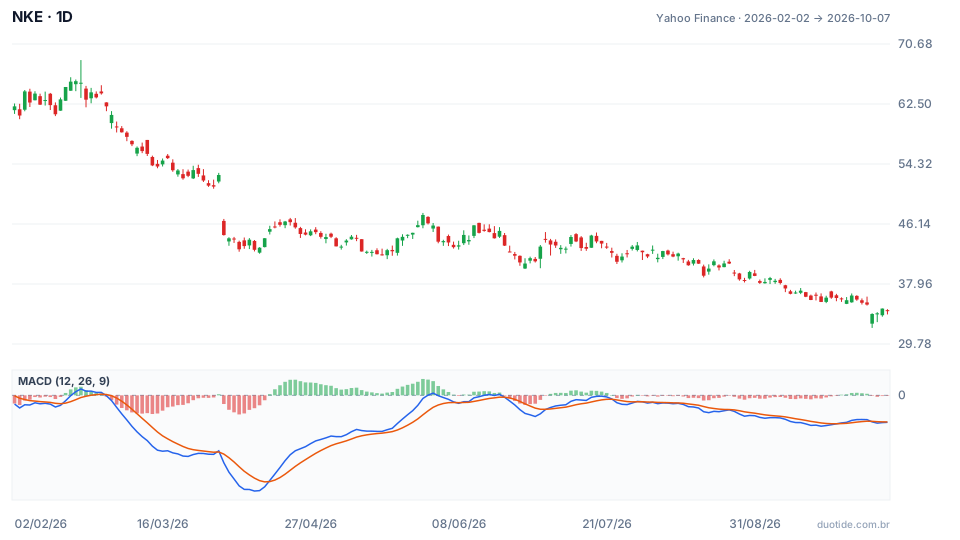
The chart shows NKE's daily candles (Yahoo Finance) and the MACD (12, 26, 9), with the MACD line, the signal line, and the histogram. Between February and October there were 14 crossovers between the two lines. What happened after them teaches a lot about indicators in a downtrend.
February: the bearish signal that worked
On February 27 the MACD crossed below the signal line, with the stock at $62.18. Ten trading sessions later it stood at $53.98, down 13.2%. The signal tracked the stock's main direction.
March and April: the bullish signal on the eve of the biggest drop
On March 31 the MACD crossed above the signal line, with the stock at $52.82. The next day, April 1, NKE fell 15.5%, to $44.63, the year's biggest single-day drop. The MACD reached the period's lowest point, −4.08, on April 10, with the stock at $42.62.
June to October: a series of bullish signals, without a rally
Of the period's seven bullish crossovers, six ended with the stock lower ten trading sessions later: among them, June 9 (−6.3%), July 29 (−6.3%), and September 24 (−4.5%). On October 2 the stock made the period's low, $31.97 intraday, and closed at $33.87, the year's lowest close.

How to analyze Nike stock
Greater China and inventory
The recovery depends on sales in Greater China stopping their decline and on excess inventory shrinking without burning margin through discounts. Both numbers show up in every quarterly report.
Gross margin and tariffs
The target of a gross margin above 42% is the thermometer of the "Win Now" plan. Trade tariffs work against that target, and changes in U.S. trade policy directly affect profit.
Wholesale and the sports calendar
The return of strength in the wholesale channel and the major sporting events of 2026, including the World Cup, were cited as opportunities to recover volume, especially in soccer and running.
Limitations
The MACD is calculated from moving averages and lags. In a long downtrend, bullish crossovers appear on every small bounce and fail in sequence, as in 2026. The P/E above uses June's earnings, which change every quarter.
Common mistakes when analyzing Nike stock
- Assuming a stock is cheap just because it fell a lot, without looking at the P/E and the earnings trajectory.
- Trusting the strength of the brand while ignoring inventory, tariffs, and the decline in China.
- Buying every bullish MACD crossover in a clear downtrend.
- Ignoring the MACD's position relative to zero: below it, the medium-term bias stays bearish.
- Expecting sporting events alone to solve margin and inventory problems.
- Reading the 2026 chart as a forecast: it shows what happened, not what will happen.
To study the stock without risking money, open NKE's daily chart on a demo account, add the MACD, record every crossover and what the price did over the following ten sessions, and recalculate the P/E with every quarterly report. That record shows whether the recovery is showing up in the numbers or only in the talk.
Practice before you risk. Open your Duotide account and test your ideas on the demo account with US$10,000 in virtual funds.
Create free accountUpdated:
Editorial character of the Duotide newsroom. Articles are written by the team with the help of artificial intelligence; prices and charts come from real market data. Follows the news that moves prices — rates, stock markets, companies and commodities — explained without jargon.
Was this article helpful?
Be the first to rate it.
Comments
- No comments yet. Be the first to comment.
Ready to put it into practice?
Open your account and practice on the demo account with US$10,000 in virtual funds, without risking money.
- Secure platformProtected login and identity verification
- Multilingual supportHelp available every day
- Free demo accountUS$10,000 virtual to practice
Trading involves the risk of losing the capital invested.
