

 Português pt
 Español es
 العربية ar
 বাংলা bn
 Deutsch de
 Filipino fil
 Français fr
 हिन्दी hi
 Bahasa Indonesia id
 Italiano it
 Русский ru
 Svenska sv
 ไทย th
 Türkçe tr
 Tiếng Việt vi
 简体中文 zh
Updated:
ForexCPI, NFP, or FOMC: Which News Moves Forex the Most
 Naomi TanakaEditorial character · Analysis Desk

Quick answer
Of the three, the FOMC decision usually has the biggest potential to move forex, because it directly affects dollar rate expectations; CPI and NFP matter because they feed into that decision. But what moves the price at each release is the surprise relative to what was expected, not the name of the data. On GBP/USD in 2026, the sessions following FOMC decisions had an average range of 113.7 pips, versus 62.6 pips on an ordinary day.
Three acronyms dominate the economic calendar for anyone trading dollar-linked currencies: CPI, NFP, and FOMC. All three come out of the United States, but they affect the whole world, because the dollar sits on one side of most of the most heavily traded pairs, like EUR/USD, GBP/USD, and USD/JPY. Every forex trader has asked the same question: which one moves the price the most?
To move past theory, we measured GBP/USD's daily range (high minus low) between April and October 2026 and compared FOMC decision days and the month's first Fridays, when payroll usually comes out, against an ordinary day.
What each acronym stands for
CPI
It's the consumer price index, the main measure of US inflation, released every month. It comes in two versions: the headline index and the core, which excludes food and energy for being more volatile. When both surprise in the same direction, the market's read tends to be more straightforward. When one comes in hot and the other soft, the first reaction is often partly reversed.
NFP
That's payroll, nonfarm job creation, part of the monthly employment report. The report also brings the unemployment rate, revisions to previous months, and wage growth. The market tends to react first to the jobs number and, minutes later, adjust the reaction once it notices the rest of the report tells a different story. That's why NFP is known for back-and-forth moves.
FOMC
That's the US central bank committee that sets the benchmark interest rate, at eight scheduled meetings a year. The decision and the statement come out at one time, and about 30 minutes later the central bank chair's press conference begins. That's two separate reaction windows, which can point in opposite directions. At four meetings a year, the committee members' rate projections also come out, which can change the market's read even when the decision itself surprises no one.
Why the surprise matters more than the number
A released number doesn't move the market because it's high or low, but because of how it differs from what was expected. If the consensus already called for weak inflation, a CPI that's only slightly weak generates little reaction, because the price was already adjusted. In practice, CPI and NFP move the dollar to the extent that they change the bet on what the FOMC will do. The FOMC, in turn, is the decision itself, which is why it tends to have the biggest potential for movement.
Real example: GBP/USD on news days
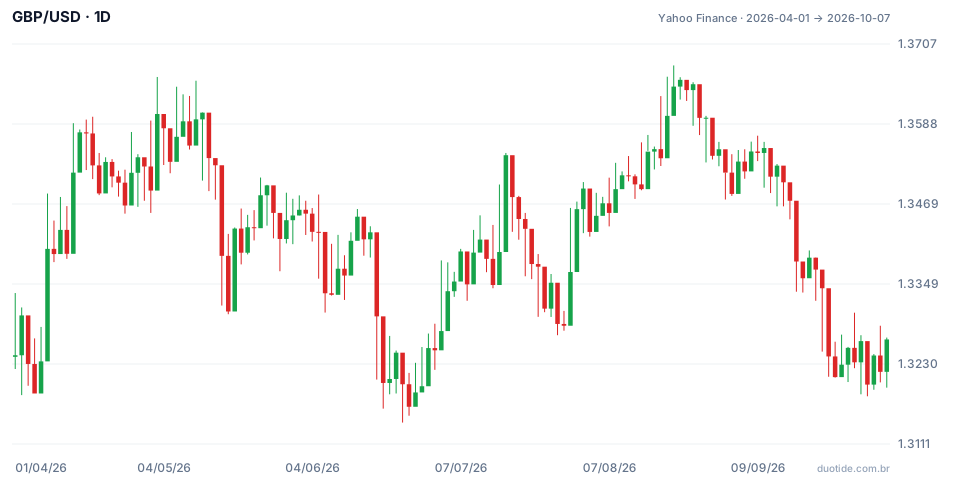
Over the chart's period, GBP/USD went from 1.3243 on April 1, 2026, to 1.3267 on October 7, 2026, practically in the same spot, but it swung between 1.3143 (June 24) and 1.3675 (August 21). The average session range was 62.6 pips. Here's what happened on news days.
FOMC decisions: the widest sessions of the period
Since the decision comes out at the end of the European trading day, we looked at the decision day and the following session. In the period's four meetings, the following session had a range well above average:
- April 28-29 meeting: 54.7 pips on April 29 and 137.5 pips on April 30, the widest range of the six months (high of 1.3593 and low of 1.3455).
- June 16-17 meeting: 46.6 pips on June 17 and 119.2 pips on June 18.
- July 28-29 meeting: 29.5 pips on July 29 and 129.4 pips on July 30.
- September 15-16 meeting: 49.5 pips on September 16 and 68.7 pips on September 17.
The average of those four following sessions was (137.5 + 119.2 + 129.4 + 68.7) ÷ 4 = 113.7 pips, nearly double an ordinary day. Three of them rank among the six widest ranges of the period. Notice too that the decision day itself tends to be calm: the market waits.
First Fridays: payroll is inconsistent
On the period's seven first Fridays, the range was 47.2 pips (April 3), 69.0 (May 1), 125.3 (June 5), 46.6 (July 3), 72.6 (August 7), 59.4 (September 4), and 73.6 (October 2). Average: 493.7 ÷ 7 = 70.5 pips, only slightly above an ordinary day. Only June 5 had a big move. The payroll calendar has holiday exceptions, and in July, for example, Friday July 3 was a US holiday, which helps explain the calm day. The picture matches NFP's reputation: sometimes it moves a lot, often almost nothing.
What this means in money
On a mini lot (£10,000), each GBP/USD pip is worth US$1. The 137.5 pips on April 30 amount to a US$137.50 distance between the day's high and low, more than double the US$62.60 of an average day. Anyone using the same stop as an ordinary day on an FOMC session has a much higher chance of being stopped out by noise. These numbers describe what happened in this period, not what will happen at the next meeting.

How to use the news calendar
Know the time and the consensus beforehand
Every economic calendar shows the release time, the previous result, and the market's expectation. Without knowing the consensus, there's no way to tell whether the number was a surprise.
Adjust the size, not just the stop
If the session tends to have double the range, a stop twice the size with half the position keeps the same money risk. Widening the stop without reducing the position doubles the risk.
Wait for the dust to settle
On NFP and the FOMC press conference, the first move often gets reversed. Many traders prefer to wait 15 to 30 minutes and trade the direction that holds, instead of trying to nail the first second.
Limitations
The sample here is small: four meetings and seven Fridays. The daily range mixes the news effect with everything else that happened that day, including UK news. And at the moment of release the spread tends to widen, and execution can come in worse than the price on the screen.
Common mistakes when trading CPI, NFP, and FOMC
- Trading the headline without knowing what the market's consensus was.
- Entering in the first second of the release, when the spread is wider and the move more erratic.
- Forgetting that the FOMC has two windows: the statement and the press conference.
- Keeping the same position size on a news day and an ordinary day.
- Assuming a given number always moves the market the same way: the reaction depends on the surprise and the moment.
To practice, mark the next CPI, NFP, and FOMC releases on your calendar and follow the pair you trade on a demo account. Log each news session's range and compare it with the average of ordinary days. After a few months, your log will show which events really move your pair.
Practice before you risk. Open your Duotide account and test your ideas on the demo account with US$10,000 in virtual funds.
Create free accountUpdated:
Editorial character of the Duotide newsroom. Articles are written by the team with the help of artificial intelligence; prices and charts come from real market data. Explains charts, indicators and trading strategies: how they work, where they fail and how to test them first.
Was this article helpful?
Be the first to rate it.
Comments
- No comments yet. Be the first to comment.
Ready to put it into practice?
Open your account and practice on the demo account with US$10,000 in virtual funds, without risking money.
- Secure platformProtected login and identity verification
- Multilingual supportHelp available every day
- Free demo accountUS$10,000 virtual to practice
Trading involves the risk of losing the capital invested.
