

 Português pt
 Español es
 العربية ar
 বাংলা bn
 Deutsch de
 Filipino fil
 Français fr
 हिन्दी hi
 Bahasa Indonesia id
 Italiano it
 Русский ru
 Svenska sv
 ไทย th
 Türkçe tr
 Tiếng Việt vi
 简体中文 zh
Updated:
Risk managementCross Margin vs. Isolated Margin: The Difference and Which to Choose
 Camila NascimentoEditorial character · Risk & Behavior Desk

Quick answer
With isolated margin, each position has a separate margin amount, and if it gets liquidated, only that amount is lost. With cross margin, the entire account balance backs the positions: liquidation becomes more distant, but one bad trade can eat through the whole account. For beginners, isolated margin tends to be more predictable, because the maximum loss on each trade is set before you enter.
Anyone trading with leverage, in derivatives or in crypto, has to make a decision that many beginners just leave on the platform's default: cross margin or isolated margin. The choice doesn't change the entry or the target, but it changes how much of the account is exposed on each trade and at what price the position gets force-closed.
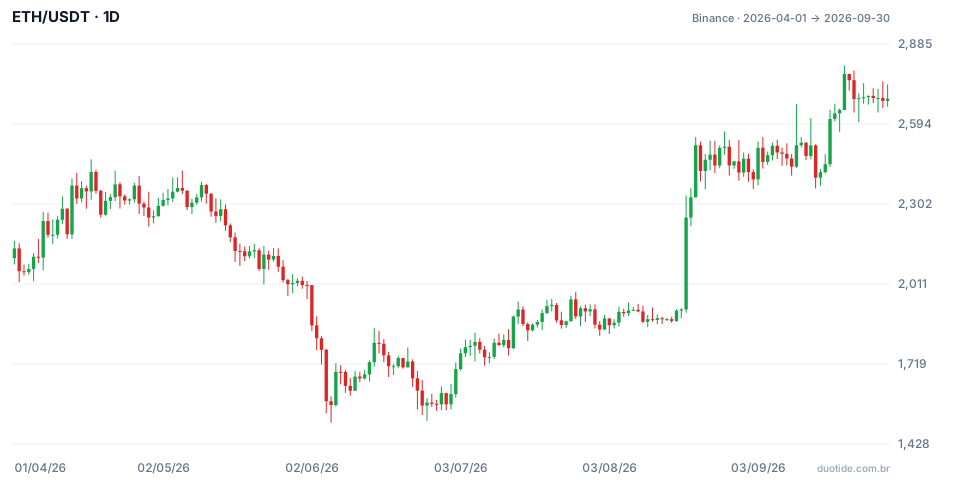
To move past the theoretical example, this guide uses a real crash: ether (ETH/USDT on Binance) closed on June 1, 2026 at $2,006.73 and touched $1,505.68 on June 6, a 25% drop in five days. Here's what would have happened to the same position under each model.
What isolated margin and cross margin are
Isolated margin
Each position gets a margin amount separate from the rest of the account. If the price moves against it and eats through that margin, the position gets liquidated and only that amount is lost. The rest of the balance isn't touched.
Cross margin
The entire available balance backs the open positions. A losing position can draw on money from the rest of the account to stay open, which avoids liquidations on short-lived swings, but exposes the entire balance to that trade's risk and creates a link between different positions.

How to calculate the liquidation price
On a long position, in simplified form (no fees and no maintenance margin):
- Liquidation price ≈ entry price × (1 − margin ÷ position value)
- With isolated margin, the margin is the amount you set aside for the position.
- With cross margin, the margin is the entire free balance of the account.
In practice, platforms require a maintenance margin and charge fees, which makes liquidation happen before the price calculated above. Treat the calculation as the best-case scenario, not a guarantee.
The calculation with ether
A $10,000 account. A $10,000 purchase of ETH at $2,006.73 (about 4.98 ETH), using $1,000 of margin, meaning 10x leverage on the margin set aside.
- Isolated margin of $1,000: 2,006.73 × (1 − 1,000 ÷ 10,000) = 2,006.73 × 0.90 = $1,806.06
- Cross margin with a $10,000 balance: 2,006.73 × (1 − 10,000 ÷ 10,000) = $0. With a balance equal to the position size, it would only get liquidated if ETH went to zero (before the maintenance margin).
- Cross margin with a $40,000 position (about 19.93 ETH): 2,006.73 × (1 − 10,000 ÷ 40,000) = 2,006.73 × 0.75 = $1,505.05
Real example: ether's drop in June 2026
Isolated margin: limited loss, but the position closes
On June 3, ETH fell to $1,769.62, below the $1,806.06 liquidation price. The isolated position would have closed with a loss of about $1,000, 10% of the account. The other $9,000 would have stayed untouched. The drop continued to $1,505.68 on June 6, but that no longer affected this account.
Cross margin with the same position size: it survives, with a bigger paper loss
With the entire balance backing the position, there would have been no liquidation. At the June 6 low, ETH was 24.97% below the entry (from $2,006.73 to $1,505.68), and the unrealized loss would have been $10,000 × 24.97% = $2,497, a quarter of the account, two and a half times the isolated margin loss. The first close back above the entry price only came on August 19, at $2,252.80, more than two and a half months later. Whoever held on recovered; whoever needed the money sooner, or got scared and closed at the low, locked in a much bigger loss.
Cross margin with too large a position: almost the whole account at risk
With $40,000 in ETH on the same $10,000 balance, the simplified liquidation price would be $1,505.05. The June 6 low was $1,505.68, just $0.63 above it. Since the maintenance margin and fees move liquidation up earlier, this account would have been liquidated, losing practically the entire balance. With cross margin, the risk isn't the margin you imagined setting aside, it's the position size relative to the account.
These three scenarios describe a drop that already happened and are meant to show the mechanics, not to predict ether's next move.

How to choose between cross and isolated margin
When isolated margin makes more sense
When you're testing a strategy, want the maximum loss on each trade set before entering, or have several positions open and don't want one to spill over into the others. For most beginners, it's the more predictable model.
When cross margin can make sense
For traders managing the risk of an entire portfolio, with positions that offset each other (one long and one short on correlated assets, for example), and who control the total size exposed relative to the balance. Even then, the stop still needs to be defined: cross margin delays liquidation, it doesn't limit the loss.
Multiple open positions
With cross margin, one heavily losing trade eats through margin that was backing the others, and one position getting worse can force the close of another one that, on its own, was fine. With isolated margin, each position has its own limit. Anyone using cross margin with multiple positions needs to add up the risk of all of them.
Limitations of the calculation
The formula above ignores the maintenance margin, funding fees, and the reference price each platform uses to liquidate, which can differ from the last traded price. In fast drops, the price can jump straight past the calculated level. Use the calculation to compare scenarios, and check the platform's own calculator before trading.
Common mistakes with cross and isolated margin
- Trading on cross margin thinking only the margin shown on the position is at risk.
- Increasing the position size on cross margin because liquidation looks far away.
- Using isolated margin with a margin so small that any normal swing liquidates the position.
- Calculating the liquidation price without accounting for maintenance margin and fees.
- Treating cross margin as a substitute for a stop.
- Leaving the margin mode on the platform's default without knowing which one is active.
Before trading with real leverage, redo these calculations on a demo account with the asset you follow: pick the position size, calculate the liquidation price under both models, and record what would have happened during the biggest recent drops. This log shows, with real numbers, how much of your account each choice puts at risk.
Practice before you risk. Open your Duotide account and test your ideas on the demo account with US$10,000 in virtual funds.
Create free accountUpdated:
Editorial character of the Duotide newsroom. Articles are written by the team with the help of artificial intelligence; prices and charts come from real market data. Writes about risk management, position sizing and the psychology behind traders' decisions.
Was this article helpful?
Be the first to rate it.
Comments
- No comments yet. Be the first to comment.
Ready to put it into practice?
Open your account and practice on the demo account with US$10,000 in virtual funds, without risking money.
- Secure platformProtected login and identity verification
- Multilingual supportHelp available every day
- Free demo accountUS$10,000 virtual to practice
Trading involves the risk of losing the capital invested.
