 Português pt
 Español es
 العربية ar
 বাংলা bn
 Deutsch de
 Filipino fil
 Français fr
 हिन्दी hi
 Bahasa Indonesia id
 Italiano it
 Русский ru
 Svenska sv
 ไทย th
 Türkçe tr
 Tiếng Việt vi
 简体中文 zh
Updated:
ETFs & indicesETFs for Beginners: What They Are and How to Trade Them
 Rafael AzevedoEditorial character · Markets Desk
Quick answer
An ETF is an exchange-traded fund that tracks an index and is bought and sold like a stock, with its own ticker. To trade it, you just need an account with exchange access, a balance, the ETF's ticker, and a buy order, preferably a limit order. It tracks the index up and down, minus costs.
For anyone who's never traded an ETF, the process is simpler than it looks: the share is bought and sold on the exchange, with a ticker, exactly like a stock. A few details, though, make the difference between a smooth first experience and one full of surprises, mainly the order type, the costs, and the taxes.
In this guide we explain how it works and use as an example the real daily quotes of BOVA11, an ETF that tracks the Ibovespa, and the index itself, from January to October 2026 (data from Yahoo Finance). BOVA11 appears here only to illustrate the mechanism, not as a recommendation.
What an ETF is
ETF stands for exchange traded fund. By buying a share, you buy a fraction of a portfolio that tracks an index. An Ibovespa ETF, for example, holds the index's stocks in the same proportion as the index. Instead of buying dozens of stocks, you buy one share and start tracking the performance of the whole basket, minus the fund's expense ratio.
The difference from a regular fund is the trading: the ETF's price changes throughout the session, and you enter and exit whenever you want, at the price of the moment, with no redemption waiting period.

How to buy and sell an ETF
- An account at an institution with exchange access: orders reach the market through it.
- Money in the account: the purchase is paid with the available balance.
- The ETF's ticker: in Brazil, ETFs have a ticker ending in 11, like BOVA11.
- Order type: a limit order sets the maximum price you'll accept to pay; a market order executes at the best price available at that moment.
- Quantity: the purchase amount is the share price × number of shares, plus costs.
To sell, the path is the same, in reverse. The money from the sale lands in the account after the exchange's settlement period.
Example with real quotes
On October 6, 2026, BOVA11's share closed at R$ 202.50. Buying 10 shares would cost 10 × 202.50 = R$ 2,025.00, plus trading costs. That same day the Ibovespa closed at 205,835 points. The share was worth about 0.984 times the index divided by a thousand, a ratio that changed little over the year, because the fund's portfolio tracks the index.
Real example: BOVA11 in 2026
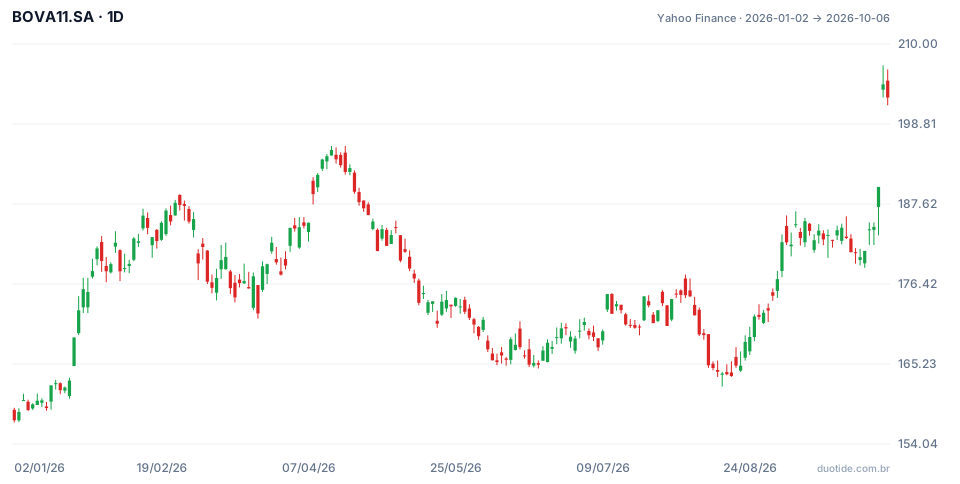
The chart shows BOVA11's share from January 2 to October 6, 2026. It rose 28.69%, from R$ 157.36 to R$ 202.50. The Ibovespa, over the same window, rose 28.21%, from 160,539 to 205,835 points. The small difference comes from the share price at each close, which can land a little above or below the portfolio's value.
Anyone who bought at April's peak
On April 14, the share closed at R$ 195.16. Ten shares would have cost R$ 1,951.60. On August 14, the close was R$ 163.90, and the same ten shares were worth R$ 1,639.00, a drop of 16.0%. An ETF diversifies across companies, but it doesn't protect against the whole market falling: if the index drops, the share drops with it.
Anyone who held through October
The recovery took the share to R$ 204.35 on October 5, the period's highest close, and to R$ 202.50 on October 6. The ten shares bought in April were worth R$ 2,025.00, 3.8% above the purchase price. Anyone who sold in August, out of fear, locked in the loss.
Liquidity
BOVA11 traded an average of 4.37 million shares a day over the period, about R$ 776 million. On ETFs with that volume, the gap between the buy and sell price tends to be small. On thinly traded ETFs, it can be much bigger, and that's where the limit order makes a difference.
How to use ETFs in practice
To invest for the long term
This is the most common use: buying shares periodically and holding, tracking the index. Here the expense ratio and the return difference against the index matter more.
To trade short term
Since the ETF trades like a stock, you can also trade short-term moves in the index. The risk rules are the same as any trade: a defined stop and a calculated position size.
Costs and taxes
There are trading costs from the institution and the exchange, plus the expense ratio, which is already deducted from the share's value. In Brazil, gains from selling stock ETFs pay 15% income tax on regular trades and 20% on day trades, and, unlike stocks, there's no exemption for sales up to R$ 20,000 a month. Check the current rules before trading.
Limitations
The ETF delivers the index's performance, up and down, minus costs. It doesn't pick the best companies or exit the market during a drop. The examples above describe what happened in 2026, not what will happen.
Common mistakes among those starting to trade ETFs
- Thinking diversification within the index eliminates the risk of a drop.
- Using a market order on a thinly traded ETF and paying a high price on entry.
- Forgetting that stock ETFs don't have the same tax exemption as stocks.
- Buying without knowing which index the fund tracks.
- Selling in the middle of a drop without having set an exit plan beforehand.
Before the first purchase, simulate it on a demo account: send a limit order, follow the share for a few weeks, and log how it behaved relative to the index. That way the first real trade won't have any new steps.
Practice before you risk. Open your Duotide account and test your ideas on the demo account with US$10,000 in virtual funds.
Create free accountUpdated:
Editorial character of the Duotide newsroom. Articles are written by the team with the help of artificial intelligence; prices and charts come from real market data. Follows the news that moves prices — rates, stock markets, companies and commodities — explained without jargon.
Was this article helpful?
Be the first to rate it.
Comments
- No comments yet. Be the first to comment.
Ready to put it into practice?
Open your account and practice on the demo account with US$10,000 in virtual funds, without risking money.
- Secure platformProtected login and identity verification
- Multilingual supportHelp available every day
- Free demo accountUS$10,000 virtual to practice
Trading involves the risk of losing the capital invested.
