

 Português pt
 Español es
 العربية ar
 বাংলা bn
 Deutsch de
 Filipino fil
 Français fr
 हिन्दी hi
 Bahasa Indonesia id
 Italiano it
 Русский ru
 Svenska sv
 ไทย th
 Türkçe tr
 Tiếng Việt vi
 简体中文 zh
Updated:
StrategiesHow the Market Behaves During the Holiday Season
 Naomi TanakaEditorial character · Analysis Desk
Quick answer
During the holiday season liquidity drops: during the 2025 holidays, the S&P 500's average volume was 35.6% lower than in the previous weeks. With fewer people trading, spreads can widen and moderate orders move the price more. The best adjustment is to reduce position sizes, check each exchange's calendar, and be wary of breakouts without volume.
Between Christmas and New Year, much of the financial market shifts into a different rhythm. Trading desks run with smaller teams, large institutions close positions earlier, and many individual traders take time off. The market stays open, but it runs with a fraction of its normal participation.
In this guide, instead of just speaking in theory, we measured what happened during the 2024 and 2025 holiday seasons using real daily S&P 500 and bitcoin quotes. The numbers show that the drop in volume is consistent, but price behavior changes from one year to the next.
Why liquidity drops during the holidays
Liquidity is how easily you can buy or sell an asset without moving the price much. At year-end, several factors combine to reduce it:
- Institutions close out their annual books and avoid opening new positions in the final weeks.
- Holidays shorten the weeks, and some exchanges run half sessions on Christmas Eve and New Year's Eve.
- Many individual traders cut back on activity, whether traveling or deciding not to trade during this period.

How to measure the drop in liquidity
A simple way is to compare the average volume traded during the holiday sessions with the previous weeks. We ran that math with the daily data:
- S&P 500, 2025 holidays (December 22, 2025 to January 2, 2026, 8 sessions): average volume of 3.37 billion shares per day, versus 5.24 billion between November 3 and December 19. A drop of 35.6%.
- S&P 500, 2024 holidays (December 23, 2024 to January 3, 2025): 3.16 billion per day, versus 4.37 billion over the previous seven weeks. A drop of 27.7%.
- Bitcoin, 2025 holidays (BTC/USDT on Binance, which trades every day): 11,690 BTC per day, versus 23,990 BTC before. A drop of 51.3%.
- Ibovespa, 2025 holidays: with the Brazilian exchange closed on December 24 and 31, there were only 6 sessions in the window, with average volume 27.2% lower than in the previous weeks.
- The emptiest session was Christmas Eve, which runs a half session in the US market: 1.80 billion shares on December 24, 2025 and 1.76 billion on December 24, 2024.
Real example: the S&P 500 during the 2025 and 2024 holidays
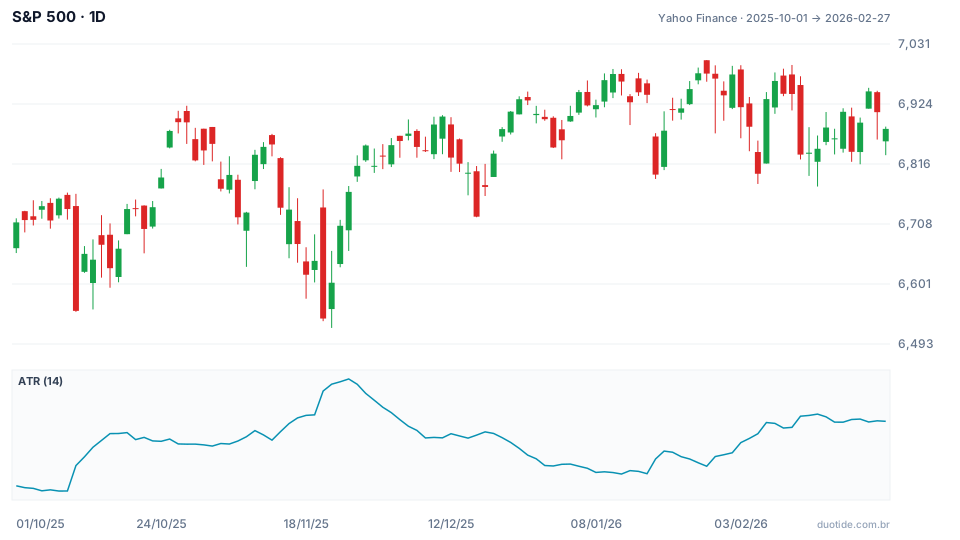
The chart shows the S&P 500 from October 2025 to February 2026, with the 14-day ATR in the bottom panel. The ATR measures the average daily price range in points. Two consecutive holiday seasons show that lower volume doesn't always mean the same thing:
2025 holidays: a quiet market
The average range of each session (high minus low, relative to the close) fell from 1.12% between November and mid-December to 0.55% during the holidays. The ATR, which had reached 99.65 points on November 25, 2025, dropped to 59.69 on December 31. The index closed December 22 at 6,878.49 points and January 2, 2026 at 6,858.47, almost in the same spot.
2024 holidays: a jittery market
A year earlier, volume also fell, but the average range rose: 1.15% per session during the holidays, versus 0.83% in the previous weeks. The index closed December 24, 2024 at 6,040.04 points and fell for five straight sessions, down to 5,868.55 on January 2, 2025, a decline of 2.8%. Lower volume, in this case, came with bigger moves.
What the two years teach
The drop in volume repeated in both years. The effect on price didn't: in one year the market stayed quiet, in the other it moved more than usual. That's why there's no fixed rule like the market stays calm during the holidays. These are past facts, and the next year-ends could differ from both.

How to trade during the holiday season
Reduce your position size
With fewer participants, a moderately sized order weighs more on the price and spreads tend to widen. Trading at half your usual size, or risking 0.5% of the account instead of 1%, reduces the damage from an unexpected move.
Check each exchange's calendar
Trading hours change from country to country. US exchanges close early on certain eves; the Brazilian exchange doesn't open on December 24 and 31. Knowing this avoids leaving a position open thinking you'll be able to exit the next day.
Be wary of breakouts
A break above resistance or below support on low volume has fewer people behind it. Before acting, wait for normal volume to return in the first or second week of January.
Use the period to review
For many traders, the best trade during the holidays is not to trade: review the year's journal, calculate the win rate and average result, and adjust the plan for the following year.
Adjust the stop to the current range
If you use the ATR to place your stop, remember it's an average of the last two or three weeks. In 2025, the S&P 500's ATR fell from 74.63 points on December 19 to 59.69 on December 31. A stop calculated with the holiday ATR ends up tighter and can get triggered easily once normal volume returns in January, or if the market gets jittery during the holidays themselves, as in 2024. One way around this is to use the highest ATR from recent weeks, not the day's own reading.
Limitations
Two holiday seasons are a small sample. Unexpected news can happen on any date, and with a thin market the reaction to it can be bigger. Markets that trade every day, like cryptocurrencies, also lose volume, but they never close.
Common mistakes when trading during the holidays
- Keeping your usual position size while the market has no liquidity.
- Treating a move on a thin day as if it were a new trend.
- Forgetting holidays and half sessions and getting stuck in a position.
- Leaving old orders forgotten on the platform while traveling.
- Assuming the market always stays quiet during the holidays: in 2024 it didn't.
To practice without risking money, use a demo account during the next holiday season: compare each session's volume and range with November's and log what happens with your trades. That log will tell you, with your own data, whether it's worth trading during this period.
Practice before you risk. Open your Duotide account and test your ideas on the demo account with US$10,000 in virtual funds.
Create free accountUpdated:
Editorial character of the Duotide newsroom. Articles are written by the team with the help of artificial intelligence; prices and charts come from real market data. Explains charts, indicators and trading strategies: how they work, where they fail and how to test them first.
Was this article helpful?
Be the first to rate it.
Comments
- No comments yet. Be the first to comment.
Ready to put it into practice?
Open your account and practice on the demo account with US$10,000 in virtual funds, without risking money.
- Secure platformProtected login and identity verification
- Multilingual supportHelp available every day
- Free demo accountUS$10,000 virtual to practice
Trading involves the risk of losing the capital invested.
