

 Português pt
 Español es
 العربية ar
 বাংলা bn
 Deutsch de
 Filipino fil
 Français fr
 हिन्दी hi
 Bahasa Indonesia id
 Italiano it
 Русский ru
 Svenska sv
 ไทย th
 Türkçe tr
 Tiếng Việt vi
 简体中文 zh
Updated:
Risk managementWhat Is Leverage in Trading and How It Works
 Camila NascimentoEditorial character · Risk & Behavior Desk

Quick answer
Leverage is using a small margin as collateral to control a larger position: at 1:30, every $1 of margin moves $30. Gains and losses are calculated on the whole position, so a 1% move on a position 11 times the size of the account costs 11% of the account. Real risk is measured by position size and stop distance, not by margin.
Leverage is one of the most powerful tools in trading and one of the most misunderstood. It lets you open a position larger than the money you deposited, using part of that money as collateral. The result, however, is calculated on the whole position, not on the collateral.
To move past the generic example, we used EUR/USD's real daily quotes (Yahoo Finance data) between April and October 2026 and the ATR, an indicator that measures how much the pair typically moves per day. With these numbers you can see the real size of the risk at each leverage level.
What Leverage Is
A leverage of 1:30 means that, for every $1 of margin, you control $30 in position. Margin is the collateral held in reserve while the trade is open. Leverage doesn't change your exposure to the market: it only changes how much money needs to sit idle to open the position.
Margin and Margin Calls
If the price moves against you and the loss gets close to the money available in the account, the platform may ask for an additional deposit (the margin call) or close the position automatically. In a sharp move, that closure can happen well before the stop you had in mind would have been hit.

How to Calculate the Risk of a Leveraged Position
Three calculations solve almost everything:
- Position value = quantity × price.
- Required margin = position value ÷ leverage.
- Risk in dollars = distance to the stop × quantity. Margin doesn't enter into this calculation.
Example With Real EUR/USD Data
On 10/07/2026 EUR/USD closed at 1.12535 and the 14-day ATR stood at 0.00654, or about 65 pips of typical daily movement. Imagine a $1,000 account and one mini lot (10,000 euros), where each pip is worth $1:
- Position value: 10,000 × 1.12535 = $11,253.50, more than 11 times the account's size.
- Margin at 1:30 leverage: 11,253.50 ÷ 30 = $375.12.
- A typical day (65.4 pips): $65.40, or 6.5% of the account, on a single ordinary day.
Now the same account with 1:100 leverage and three mini lots. The margin drops to $337.61, and it looks like there's money to spare, but the position is worth $33,760.50 and a typical day already costs $196.20, nearly 20% of the account. Low margin hides the risk; position size is what actually matters.
Real Example: What EUR/USD Did in 2026
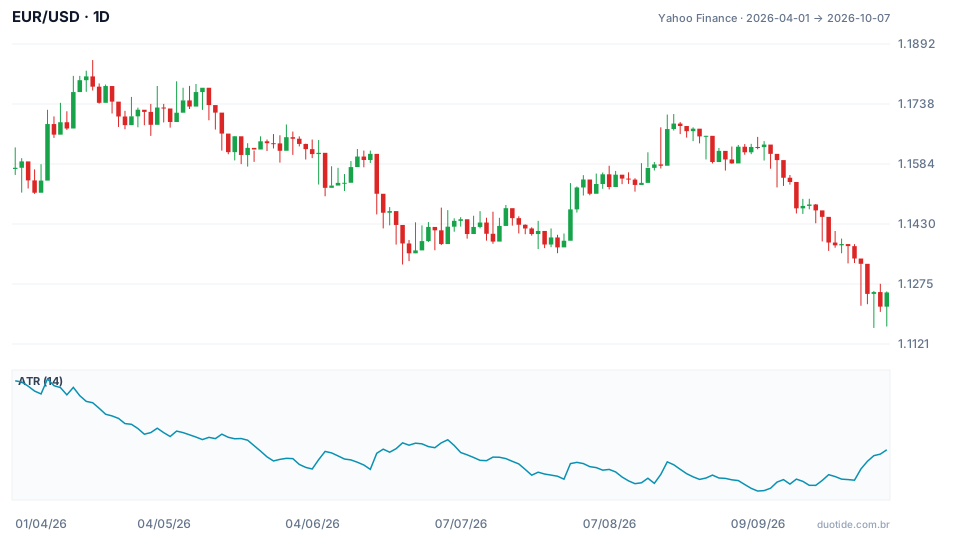
The chart shows the EUR/USD price and, below it, the 14-day ATR. Three situations show why leverage needs to be calculated for the worst-case scenario, not the average day:
April 8: the Most Volatile Day
The pair went from 1.15412 on 04/07 to 1.16866 on 04/08, a 1.26% gain in a single day, the window's biggest. The ATR hit the period's peak, 0.00965 (about 97 pips). With three mini lots, that single day would have meant about $436 in result, up or down, on a $1,000 account.
June 18: the Biggest Daily Drop
From the 06/17 close (1.16100) to the 06/18 close (1.15073), the pair fell 0.88%, or 102.7 pips. With one mini lot, a $102.70 loss; with three, $308.10, nearly a third of the account in a single day.
April to October: the Cumulative Decline
From the 04/16 close (1.18092) to the 10/06 close (1.12171), EUR/USD fell 5.01%, or 592 pips. That sounds small in percentage terms. For anyone long with one mini lot, that's a $592 loss, 59% of the account. With three mini lots, the loss would top $1,700, and the account would have been wiped out by a margin call long before that.

How to Use Leverage With Control
Start With Risk, Not With Leverage
Set how much you're willing to lose per trade, say 1% of the account ($10), and where the stop goes. If the stop sits at 1.5 ATR, about 98 pips with the 10/07 ATR, the right size is about $0.10 per pip, meaning one micro lot (1,000 euros). The risk comes out to $9.81, and the effective leverage to just over 1 times.
Look at Effective Leverage
Divide the position value by the account balance. One mini lot in a $1,000 account gives an effective leverage of about 11 times, regardless of whether the platform offers 1:30 or 1:500. This is the number that tells you how much each 1% move costs: 11% of the account.
Adjust to the Asset
More volatile assets call for smaller positions. That's why leverage limits are usually lower for cryptocurrencies and stocks than for major currency pairs, which move proportionally less per day.
Limitations
The ATR measures past average movement; it doesn't warn of an unusual day. Weekend or news-driven gaps can jump right over a stop. And the numbers above come from a specific pair over a specific period.
Common Mistakes When Using Leverage
- Calculating risk based on the deposited margin, not on the position's total value.
- Using all the available leverage just because it's there.
- Sizing the position by the average day and forgetting the days with 1% moves or more.
- Trading without a stop and counting on the margin call as protection.
- Applying the same position size to assets with very different volatilities.
- Forgetting that the examples above describe what happened, not what will happen.
To practice without risking money, open a demo account, note the asset's ATR before each trade, and calculate position size from the risk you're willing to accept. Also log the effective leverage of each trade: after a few weeks, it becomes clear how much of the result came from the analysis and how much came from the size.
Practice before you risk. Open your Duotide account and test your ideas on the demo account with US$10,000 in virtual funds.
Create free accountUpdated:
Editorial character of the Duotide newsroom. Articles are written by the team with the help of artificial intelligence; prices and charts come from real market data. Writes about risk management, position sizing and the psychology behind traders' decisions.
Was this article helpful?
Be the first to rate it.
Comments
- No comments yet. Be the first to comment.
Ready to put it into practice?
Open your account and practice on the demo account with US$10,000 in virtual funds, without risking money.
- Secure platformProtected login and identity verification
- Multilingual supportHelp available every day
- Free demo accountUS$10,000 virtual to practice
Trading involves the risk of losing the capital invested.
